

Support CleanTechnica’s work through a Substack subscription or on Stripe.
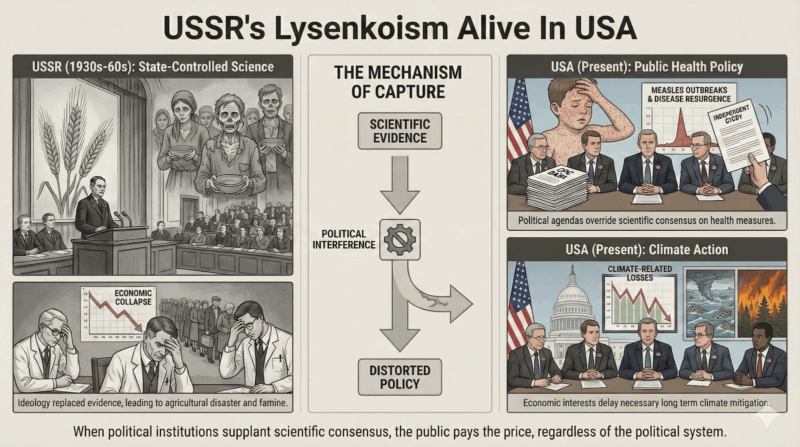
On December 30, a little noticed federal vaccine advisory meeting took place in the United States. It was scheduled between Christmas and New Year’s, broken into four brief sessions for a specific reason, and focused on procedural matters within a committee most Americans have never heard of. There was no dramatic announcement and no sweeping policy change. Yet the structure, timing, and institutional role of that meeting matter far more than its immediate outcomes. It is a small but telling example of how the United States is beginning to reorganize the relationship between science and power in ways that echo one of the most damaging episodes in modern scientific history. It is slow institutional reconfiguration that makes evidence optional that is likely to have significant impacts on Americans’ health, and won’t stay within its borders.
Lysenkoism was the body of ideas and practices promoted by Soviet agronomist Trofim Lysenko, who claimed that plants could be permanently improved through environmental conditioning rather than genetic inheritance. He rejected Mendelian genetics and natural selection, arguing that traits acquired during a plant’s lifetime could be passed to future generations. Lysenko promoted techniques such as vernalization, dense planting, and the belief that plants of the same species would cooperate rather than compete, claims that appealed to ideological views of malleability and collectivism. These theories lacked experimental support but were presented as practical and revolutionary. Once adopted by the Soviet state, Lysenko’s ideas became official doctrine, and alternative explanations were dismissed as harmful or reactionary. This transformed agricultural science into a tool of political narrative rather than empirical testing, with far reaching consequences for Soviet farming and biology.
Lysenkoism in the Soviet Union is often misunderstood as a story of ignorance or isolation. In reality, it occurred in a country with trained scientists, access to international journals, and awareness of global scientific progress. Genetics continued to advance rapidly in the United States, Britain, and Western Europe during the same period. Soviet leaders and scientists knew this. The defining feature of Lysenkoism was not lack of information but the decision to reject external scientific consensus within domestic institutions. Lysenko’s theories were elevated not because they worked, but because they aligned with political narratives about malleability and control. Advisory bodies, academies, and education systems were reshaped so that evidence no longer constrained authority. Once that happened, falsifiability disappeared. Errors could not be admitted because disagreement itself became disloyalty.
The human cost of Lysenkoism was catastrophic during the Soviet famines of the 1930s and again after World War II, when agricultural failure intersected with state policy to produce mass hunger and deaths numbering in the tens of millions. Lysenko’s rejection of genetics led to widespread adoption of ineffective practices such as vernalization, and the dismissal of soil science and crop breeding methods that could have improved resilience. These ideas were enforced across collective farms despite mounting evidence of failure. Crop losses were explained as sabotage or improper execution rather than flawed theory, preventing correction. While famine had multiple causes including forced collectivization, grain requisitioning, and state repression, Lysenkoism played a direct role by stripping Soviet agriculture of the tools needed to respond. Millions died not because food science was unknown globally, but because domestic institutions refused to accept or apply it. The tragedy illustrates how separating authority from evidence turns environmental stress into catastrophe.
The long term impacts of Lysenkoism did not end with the fall of Trofim Lysenko or even with the death of Stalin. By the time Soviet genetics was formally rehabilitated in the 1960s, the USSR had lost decades of accumulated knowledge, international standing, and institutional capability in biology, agriculture, and medicine. Entire generations of scientists had been diverted, silenced, or driven out, leaving gaps that could not be rapidly closed. This damage carried forward into late Soviet and post Soviet Russia, where weak biotechnology sectors, underperforming agricultural productivity, and limited biomedical innovation persisted well into the 1990s and beyond. While other countries built global industries around genetics, molecular biology, and pharmaceuticals, the Soviet Union and later Russia became technology importers rather than leaders. The cost was not only scientific. It showed up as lost export industries, reduced food security resilience, weaker public health capacity, and diminished soft power in global science. Lysenkoism imposed a long shadow, demonstrating that when a state breaks the link between evidence and authority, the economic and technological consequences can last for generations.
I have traced clear echoes of past political interference in the sciences that extend beyond isolated incidents and point to a deeper structural risk. In May 2025 I observed how the Trump administration’s decision to bar international students from Harvard echoes a historic Soviet error, when the USSR curtailed educational exchange with China out of ideological fear, inadvertently weakening its own innovation ecosystem while accelerating China’s rise in technologies that now underpin the 21st century’s strategic industries. At the time I noted that Soviet leaders viewed foreign students as ideological threats rather than collaborators, and that their rigid isolation helped freeze Soviet science even as global knowledge advanced around it. In a similar spirit, policies that restrict academic exchange or treat foreign talent as hostile disrupt the flow of ideas that fuels scientific progress and economic competitiveness. I have also written about how moves to sideline climate scientists, reshape federal research institutions, and dismiss career experts resembles the chaos of China’s Cultural Revolution, when political loyalty replaced expertise and research programs ground to a halt. These historical parallels reinforce the central warning of this article: when domestic institutions begin to subordinate evidence and open inquiry to political dictates, the long-term damage to a nation’s scientific capacity and economic prospects can mirror some of the most self-inflicted declines of the last century.
The first and most immediate symptom of Lysenkoism was institutional capture and the collapse of falsifiability. Soviet scientific bodies were reorganized so that loyalty, not experimental validation, determined authority. Genetics was declared incorrect by decree, and alternative explanations were excluded from official consideration. The result was a system in which outcomes no longer tested ideas. Failure was explained away rather than investigated. Over time, this destroyed the ability of the system to learn.
In the United States over the past year, a comparable mechanism has emerged in both vaccination and climate science through control of advisory institutions. In vaccination, the December 30 meeting of the Advisory Commission on Childhood Vaccines matters because this body feeds directly into the Vaccine Injury Compensation Program and reports to the Secretary of Health and Human Services. In 2025, the commission’s membership and meeting cadence, required under law to occur four times a year, changed while long scheduled sessions were postponed without clear explanation. This occurred alongside the removal and replacement of members on the Advisory Committee on Immunization Practices earlier in the year. Those committees do not set law, but they define what evidence is treated as legitimate. When their composition or scope shifts, conclusions are pre filtered before debate begins. Effectively, all four annual meetings took place on December 30th, when most external members were on vacation.
The Advisory Committee on Immunization Practices sits at the center of the US vaccination system in ways that are easy to underestimate. Its recommendations determine which vaccines are included in the national schedule, which in turn governs insurance coverage, federal purchasing, liability protection, and eligibility for the Vaccine Injury Compensation Program. Over the past year, changes to ACIP membership, scope, and process have signaled a willingness to reopen settled questions and to blur the line between scientific assessment and political preference. If ACIP recommendations become unstable or are perceived as disconnected from evidence, the consequences cascade. Manufacturers rely on predictable schedules and liability protections when deciding whether to invest in vaccine production. If confidence erodes, fewer vaccines are developed and supply becomes fragile. At the same time, expanded or ambiguous injury definitions could overwhelm the compensation program’s trust fund, which currently holds only a few billion dollars and is financed by a $0.75 excise tax per dose. A surge in claims could exhaust the fund and force Congress to intervene under crisis conditions. The harm to Americans would not be abstract. It would appear as reduced vaccine availability, higher prices, slower responses to emerging diseases, and increased exposure to preventable outbreaks, all driven by institutional instability rather than scientific necessity. A very likely outcome is the refusal of pharmaceutical firms to serve the US market due to high liability costs. No firms providing vaccines, no vaccination. No vaccination, massive public health problems.
This isn’t abstract for me. I helped build one of the world’s most sophisticated public health, vaccination, communicable disease and outbreak management systems in the world in the late 2000s in the aftermath of SARS. Canada funded it to attempt to reduce the impacts in the next significant outbreak, and the system was used during COVID-19. I worked closely with epidemiologists, public health nurses and other public health professionals on and off for years, with my last role with the global technology firm being lead healthcare architect for Canada. I have a strong understanding of the harm that the current administration, driven by Secretary of Health and Human Services Robert F. Kennedy Jr.’s conspiracy ideation addled zeal, is doing to American public health. And as a Canadian, I know how trivially that harm will cross the border, both in terms of the outbreaks that will inevitably ensue, and in terms of the disinformation that will spread, mostly but not solely on the populist right.
And, of course, US Lysenkoism isn’t isolated to vaccines, but includes the field where I spend most of my time and effort these days, climate change solutions, another major public health concern.
In climate science, a parallel process has unfolded through the weakening of the Environmental Protection Agency’s advisory boards and the effective sidelining of the social cost of carbon framework. Over the past year, federal agencies were directed to stop using established climate damage metrics in regulatory analysis, even though those metrics remain standard across OECD countries and international institutions. The science behind climate risk did not change. What changed was whether it was allowed to constrain federal decision making. In both vaccination and climate, evidence still exists externally. Domestically, it increasingly does not bind.
The second symptom of Lysenkoism was the redefinition of categories to force desired outcomes. Lysenko did not simply argue that Mendelian genetics was wrong. He redefined heredity itself so that observed failures could be interpreted as successes. If crops failed, the explanation was not incorrect theory but improper implementation or sabotage. By shifting definitions, reality was made to appear compliant.
In the United States this year, similar definitional maneuvers have appeared in vaccination policy. Autism causation claims were litigated and rejected years ago through the Omnibus Autism Proceedings. No new credible evidence has emerged since. Again, this is an area I once had significant depth in, and read many of the core studies personally. Yet recent federal discussions have focused on redefining neurological injury categories and expanding interpretations of encephalopathy within compensation frameworks. This does not require declaring that vaccines cause autism. It only requires adjusting definitions so that causality is implied procedurally. Once those definitions enter official records, they acquire legitimacy regardless of scientific merit. The compensation system, once carefully bounded to ensure the massive benefit of vaccination would be protected, instead will likely be inundated with spurious claims, amplified by a Secretary of Health who is convinced against all global evidence that vaccines cause autism, and who repeats anti-vaccination conspiracy theories regularly.
Climate policy has followed the same pattern through definitional narrowing of what counts as harm. Over the past year, federal agencies were directed to stop using the Social Cost of Carbon in regulatory analysis, removing a metric that incorporates long term damages from sea level rise, heat related mortality, crop losses, and infrastructure degradation. In parallel, the Environmental Protection Agency moved to revisit and potentially rescind the 2009 endangerment finding, which legally recognizes greenhouse gases as a threat to public health and welfare. Neither action disputes the underlying physics or observational data. Satellite records, tide gauge measurements, and attribution studies on extreme heat remain intact. Instead, those impacts are excluded from decision frameworks by definition. When future damages are ruled irrelevant on paper, projects that increase climate risk appear acceptable by construction. This mirrors Lysenkoism’s core tactic. The world is not denied. It is re labeled until it stops constraining decisions.
The third symptom of Lysenkoism was the flight of scientists and the hollowing out of expertise. Soviet geneticists were dismissed, reassigned, silenced, or left the country. Entire research programs collapsed. Young scientists learned to avoid the field altogether. This was not only repression. It was a massive misallocation of human capital. Once expertise drains away, it cannot be quickly rebuilt.
Over the past year in the United States, similar dynamics have appeared without overt coercion. In public health, several senior CDC and advisory committee experts resigned or declined reappointment following politicized disputes over vaccine guidance. Career staff reported restrictions on public communication and increased political review of scientific outputs. Early career researchers have taken note. Fields that become politically unstable become professionally risky.
In climate science, NOAA and EPA have faced budgetary uncertainty, leadership turnover, and program disruption. Long term climate monitoring depends on continuity. When that continuity is threatened, scientists move elsewhere. Anticipatory obedience does the work without any formal purge.
The fourth symptom of Lysenkoism was that policy became uncorrectable. Because error could not be acknowledged, feedback loops broke. Crop failures were blamed on enemies or weather. Correction only came after catastrophe. By then, the institutional damage was severe.
In the United States today, both vaccination and climate policy show early signs of the same risk. In vaccination, declining childhood immunization rates have already led to measles outbreaks in multiple states over the past year. Rather than treating this as evidence of communication failure, federal rhetoric has increasingly framed the issue around parental choice and mistrust without addressing the underlying misinformation dynamics. In climate policy, escalating disaster costs are treated as isolated events rather than signals of systemic risk that demand recalibration of planning assumptions. When institutions cannot say they were wrong, they lose the ability to learn.
A long term consequence of Lysenkoism was the loss of future economic value propositions. The Soviet Union did not only suffer poor harvests. It forfeited leadership in genetics, biotechnology, and downstream industries that later became central to global economies. There was no Soviet equivalent of the biotech revolutions that followed in the West. The opportunity cost lasted decades.
In vaccination science, the United States now risks a comparable erosion. The Vaccine Injury Compensation Program was created in the 1980s precisely to stabilize vaccine supply and encourage innovation by limiting liability. Over the past year, renewed signals questioning vaccine causality and compensation scope have introduced uncertainty into that system. Manufacturers respond to uncertainty by reducing investment. The damage would not show up as immediate shortages. It would appear years later as slower development of next generation vaccines and weaker pandemic readiness. It would appear years later as foreign pharmaceutical firms reaping the profits of developing next generation drugs and vaccines used globally.
Climate science presents an even larger economic parallel. In 2025, the United States stepped back and attacked international shipping decarbonization efforts at the International Maritime Organization while other countries continued building low carbon maritime technology supply chains. Domestically, climate risk metrics were stripped from infrastructure planning even as climate related disasters imposed tens of billions of dollars in annual losses. The result is not ideological satisfaction. It is forfeited leadership in clean energy systems, grid modernization, and adaptation technologies that other countries are already exporting.
The United States still has, for now, advantages that the Soviet Union lacked. Independent courts, state level policy autonomy, universities, a market economy, private companies, and international scientific institutions continue to operate. But many of these things are under daily attack, including the rule of contractual law that underpins markets and private firms.
In this period of noisy distractions, quiet signals matter for the long term of science and health in the USA. Advisory committee restructuring. Definitional changes. Removal of measurement tools. Low visibility procedural shifts. Language changes in official documents. These are the opening moves. Lysenkoism did not begin with famine. It began with committees, definitions, and meetings that looked routine at the time.
The United States is unlikely to see the famines of the Soviet Union’s worst excesses. But more Americans will sicken and die, and be more impacted by extreme weather events and die, than under administrations aligned with empirical reality. By leveraging reactions to the fringe excesses of social justice advocates which harmed no one, they are creating policies which harm everyone, and not just Americans.
Sign up for CleanTechnica’s Weekly Substack for Zach and Scott’s in-depth analyses and high level summaries, sign up for our daily newsletter, and follow us on Google News!
Have a tip for CleanTechnica? Want to advertise? Want to suggest a guest for our CleanTech Talk podcast? Contact us here.
Sign up for our daily newsletter for 15 new cleantech stories a day. Or sign up for our weekly one on top stories of the week if daily is too frequent.
CleanTechnica uses affiliate links. See our policy here.
CleanTechnica’s Comment Policy