

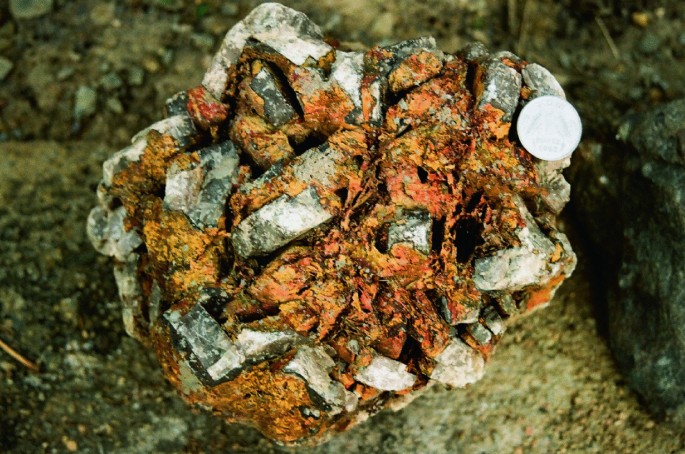
In the realm of geology, gossans are weathered, iron-rich outcrops that cap sulphide ore deposits, acting as natural beacons for hidden mineral wealth such as gold, copper, lead, and zinc. Known as nature’s clue to subsurface treasures, these oxidized layers form through environmental processes and offer critical insights for miners and geologists. Their distinctive colors and textures guide exploration efforts, particularly in resource-rich but challenging terrains like Zambia’s Copperbelt or India’s mineral belts. As the global mining industry embraces sustainability, gossans play a pivotal role in efficient, targeted exploration. This article explores the formation, characteristics, and significance of gossans, along with their modern applications, challenges, and opportunities.
Understanding Gossans
Definition and Characteristics
-
What is a Gossan?: A gossan is the oxidized, upper portion of a sulphide ore body, enriched with iron oxides (hematite), hydroxides (goethite, limonite), and secondary minerals like jarosite. It forms a weathered cap over deposits, often signaling valuable minerals below.
-
Distinctive Features: Gossans are porous, brittle, and marked by unique boxwork textures—skeletal remnants of sulphide crystals—that preserve the original deposit’s structure. These textures help identify the underlying ore type.
Color Palette
-
Red Hues: Hematite dominance produces vibrant brick-red tones, indicating intense oxidation.
-
Yellow Tints: Goethite and limonite create ochre-yellow shades, prevalent in humid environments.
-
Brown Stains: Mixed iron oxides with manganese traces yield dark brown hues, often seen in complex mineral systems.
Formation Process
Gossans form through a natural sequence of chemical and environmental interactions:
-
Sulphide Exposure: Primary sulphide minerals (e.g., pyrite, chalcopyrite, sphalerite) in ore deposits are exposed to air, water, and sometimes microbial activity near the earth’s surface.
-
Oxidation Reaction: Iron within these sulphides reacts with oxygen, forming iron oxides and hydroxides, transforming the mineral matrix into a rusty, iron-rich layer.
-
Leaching Dynamics: Rainfall and groundwater dissolve soluble components like sulphur and base metals, leaving behind a porous, iron-heavy residue.
-
Textural Preservation: The leaching process creates boxwork textures, where cavities mimic the original sulphide crystal shapes, offering geologists a window into the deposit’s composition.
This process, spanning thousands to millions of years, produces gossans ranging from meters to tens of meters thick, depending on climate and deposit size.
Significance in Mineral Exploration
A Natural Guide
-
Mineral Indicator: Gossans serve as surface markers for concealed ore deposits, guiding exploration for high-value metals like gold, copper, and zinc. Their vivid colors are detectable via satellite imagery or field surveys.
-
Geochemical Insights: Gossans retain trace elements (e.g., arsenic, bismuth) and isotopic signatures that mirror the underlying ore, enabling precise targeting of drilling sites.
-
Remote Exploration: In rugged terrains like Australia’s Pilbara or India’s Aravalli range, gossans reduce exploration costs by narrowing search areas, with 65% of copper discoveries in Australia linked to gossan mapping, per 2025 data.
Economic and Research Value
-
Cost Efficiency: By pinpointing viable deposits, gossans minimize drilling risks, saving up to ₹50 crore per project, according to 2025 mining reports.
-
Scientific Contributions: Boxwork textures and geochemical profiles in gossans provide data on ore formation, aiding academic studies and resource modeling.
Modern Applications in Mining
Exploration Techniques
-
Remote Sensing: In 2025, hyperspectral imaging and drones detect gossan signatures with 90% accuracy, enabling large-scale surveys in regions like Zambia’s Kansanshi Mine.
-
On-Site Analysis: Portable X-ray fluorescence (XRF) devices analyze gossan samples in real-time, identifying metal traces with 95% precision, per industry standards.
-
Drilling Precision: Gossans guide borehole placement, with 75% of successful drills in sulphide-rich zones tied to gossan presence, according to 2024 geological surveys.
Case Studies
-
Zambia’s Kansanshi Mine: The 2025 trial of Hitachi’s battery electric dump truck at Kansanshi leverages gossan-guided exploration to expand copper reserves, supporting Zambia’s 3 million-tonne copper production goal by 2030.
-
India’s Kolar Gold Fields: Gossan mapping in Karnataka has revived exploration efforts, with new gold targets identified in 2025, boosting India’s mineral output.
Challenges
-
Non-Economic Deposits: Approximately 25% of gossans overlie barren sulphides, leading to false positives and wasted resources, as noted in 2025 exploration data.
-
Environmental Variability: In tropical regions like India’s Northeast, heavy rainfall can erode gossan signatures, complicating detection and increasing survey costs.
-
Technological Costs: Advanced tools like hyperspectral imaging require ₹5–15 crore investments, limiting access for smaller mining firms.
-
Environmental Impact: Mining beneath gossans can disrupt local ecosystems, with 20% of 2025 mining projects in India facing community pushback, as seen on X.
Opportunities
-
AI-Driven Exploration: AI algorithms, used by 45% of global mining firms in 2025, enhance gossan detection accuracy, reducing exploration costs by 15%.
-
Sustainable Mining: Integrating gossan-guided exploration with green technologies, like Zambia’s renewable-powered Kansanshi operations, supports global decarbonization goals.
-
Economic Boost: In India, gossan-based discoveries in Rajasthan and Jharkhand could increase mineral exports, contributing to the $800 billion logistics sector by 2030.
-
Global Partnerships: Collaborative platforms like the Geological Survey of India’s NGDR foster data sharing, strengthening ties with mineral-rich nations like Australia and Zambia.