

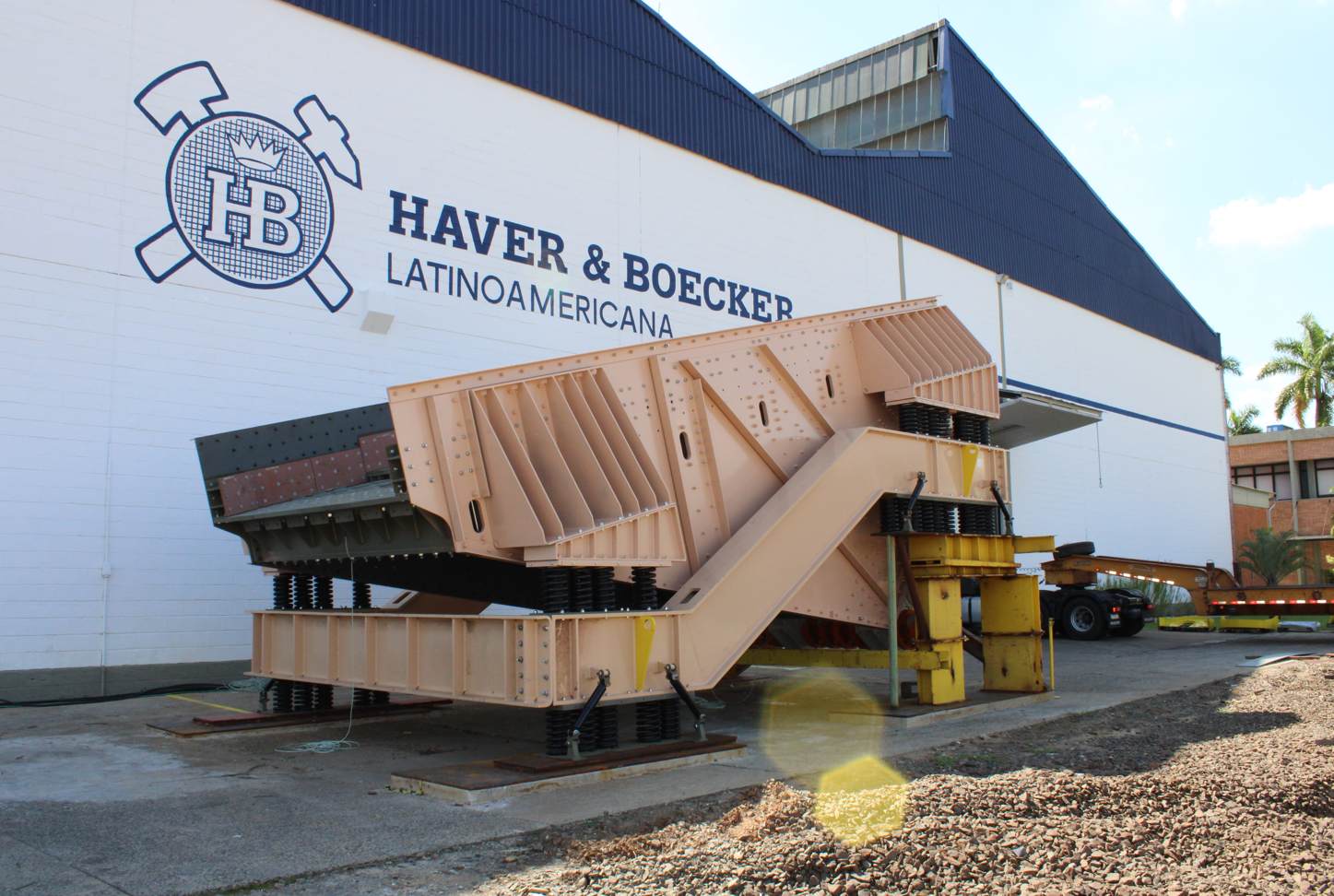
In 2024, Haver & Boecker completed 50 years in Brazil – at the Exposibram 2025 event in Salvador recently, IM Editorial Director Paul Moore sat down with Denilson Moreno, Sales Manager for Mineral Processing Equipment at Haver & Boecker Latinoamericana, to talk about its position in the country, innovations and market strengths.
First off, the main players. Leading the iron ore producers, Vale remains the major force in Brazil’s iron ore industry – it produced 327 Mt in 2024 from a country total of 410-440 Mt depending on which source you use. It is the largest single customer for most suppliers of mining services and equipment, followed by Anglo American. On the supplier side, iron ore is Haver’s number one market in Brazil. After iron ore, copper is next in the region in terms of importance for the company.
Denilson Moreno, Sales Manager for Mineral Processing Equipment at Haver & Boecker Latinoamericana and IM Editorial Director Paul Moore
Haver’s success is underpinned of course by its network – Haver has its main vibrating screen manufacturing plant in Monte Mor, near Sao Paulo which is also the home of the engineering and R&D teams. In Minas Gerais state in Pedro Leopoldo city, which is close to Belo Horizonte airport, is the factory for screening media – polyurethane, steel and rubber as well as combinations. Being in the main southern mining region, it is a major service centre location for vibrating screens. Finally, in Parauapebas in Para state is another large service centre for the northern mines – both the northern and southern service centres are carrying out overhauls and refurbishments of customer screens which is a very fast growing market. Beyond these are its various teams of screen engineers that visit customers on a regular basis.
Overhauls and refurbs of large screens is a major part of Haver’s business in Brazil – both for its own machines and those of competitors

So what are the distinctive aspects of the market in Brazil for screens and screening versus other mining markets? Moreno: “I would say it is similar to Australia in that it is very strong in a few commodities – first and foremost iron ore but also copper, bauxite and gold. Plus the principal mines are very large with high plant throughputs. In screening that is reflected in the fact that is by far the largest market for our biggest and highest production screens – the XL-Class, which can process up to 15,000 t/h. This screen was developed in Brazil for the iron ore market, though it has also found applications elsewhere such as in Canada’s oil sands. It remains unique in the market and combines advanced exciter drive technology with a wide body to achieve very high capacity production. Each machine is custom-designed to its specific application using Finite Element Analysis to predict the high-stress areas and natural frequencies of the vibrating screen.”
He adds: “What I would say makes the XL-Class and all Haver different from other options is that it was and is engineered for this market – others see customer requirements and only offer a more off the shelf option from their existing range. For every project, Haver receives the plant layout and limitations along with all the material characteristics, and we build up a customised solution for that client and that application. Each one is tailor-made.”
He also points out that Haver does not just sell screening machines – the solution includes Ty-Deck PU, Ty-Dura, Ty-Wire and Ty-Max screening media plus side-tensioned deck set-ups incorporating the Ty-Rail quick-tensioning system, which cuts screen change-out times in half. It also offers Niagara exciters up to the 45.894 kgmm-150.459 kgmm HB150 – the largest in the world; and the Pulse Condition Monitoring (Pulse CM) offering for preventative maintenance – using data and AI to assist with maintenance and production planning, helping to prevent unwanted downtime or even catastrophic failures. This 24/7 monitoring is being used more and more both on Haver and on competitor screens.
The XL-Class remains the largest and most powerful mining screen in the world and is widely used in the Brazilian iron ore sector

The nature of the screening plants varies – there are plants with five or six very large XL-Class screens running, but others with much larger numbers of smaller screens – one site has 66 screens operating at one location. Haver also has the scale and capabilities to offer complete processing plant solutions, leading with the screens but partnering with other suppliers to offer the other elements as well.
Aside from the XL-Class, also very strong in Brazil is the N-Class – in 2009 a big mining company in Brazil contracted Haver to test a screening solution that made it possible to achieve high throughput and performance but without using water. Today, Haver has sold over 100 N-Class screens in Brazil for this dry processing market. The key aspect is that the N-Class takes advantage of natural moisture in the ROM ore – this so called natural moisture screening has key upsides including elimination of water in the process route and consequently downstream tailings dams. It also means lower investment in CAPEX and OPEX.
The N-Class is an eccentric inclined screen built with an advanced four-bearing design that minimises structural vibration and maintains constant g-force, despite fluctuating material feed rates. Before this development, screening plants involved washing the ore with water to remove fines.
Driving this is the fact that the process has changed so that sinter plants are using higher grade Direct Shipping Ore haematite material even up to 65-67% Fe – and this meant a classification change as well as the sinter feed is no longer -6.3 mm, it is more like -16 mm and the fines go for sintering along with the main feed.
To deliver an N-Class solution for this natural moisture screening required an increase in the screen acceleration ie the rate of change of velocity from 4G up to 5.5G. It was also necessary to develop a new polyurethane screen media that fitted well with the application to be able to handle the higher contained moisture and avoid pegging. The result was Ty-Deck Ultra – which features H-shaped openings made up of individual strips of polyurethane. Each opening is separated by two independent extensions parallel to each other. The strips vibrate independently to increase material acceleration, improving material separation and cleanliness. It is effectively self-cleaning.
The only limitation with N-Class is that the design does not allow for a screen more than 2.4 m in width and 3,000 t/h. For much higher throughputs, however, it means larger screen widths so it is necessary to move up to the linear motion XL-Class. So it is a trade off, which also depends on the nature of the ore and the size of the operation. The XL-Class can measure up to 4.3 m in width and over 7 m in length, even up to 8.5 m; by far the largest available from any OEM.
Another recent development from Haver is the development of polyurethane media with two colours – dual-coloured – to show operators visually when the wear is at a critical level. An additional innovation widely used in Brazil is the fast change out mechanism for Ty-Deck which uses pins.
Last but not least, is the aftermarket and aftersales part of the screening business in Brazil, which is the largest in revenue terms. This includes a very significant spare parts business for Haver machines but also a thriving refurbishment and rebuild offering – in iron ore, every two years on average, Haver receives back the screen for a refurb – this has become an industry standard approach today in Brazil and is also being used more and more in Chile and Peru. Plus today, Haver is carrying out these rebuilds on a lot of competitor screens as well with its own components and exciters. Because of this, Haver in Brazil is investing in expanding its rebuilding capacity as well as enlarging its team looking after Pulse CM.
The rebuilt machines can offer two years of additional life, with one year included under warranty, so it also represents a major investment upside for the client as well versus the alternative which would have been looking at a new screen. And it has a sustainability benefit by reducing the amount of steel going to scrap – as not all of this is recycled.
And it is not all about screening. For iron ore, Haver pelletising technology is also important – today the installed base is the older design GR disc but there is increasing interest in its state-of-the-art Scarabaeus pelletising disc as well. More than 30 Haver large pelletising discs are running in Brazil including the largest in the country. Trials with Brazilian iron ore samples have been carried out on the Scarabaeus disc at Haver’s Freiburg, Germany site with good results, and the technology is part of ongoing planning for several new projects. The advantage of Scarabaeus is that the inclination, speed, and side wall height can be adjusted to for optimal operation, increasing the productivity and profitability of the entire system. It is also possible to improve the particle size distribution of the pellets.
The post Haver’s half century of success in Brazil appeared first on International Mining.