

During the recent Exposibram 2025 event in Salvador, Brazil, IM Editorial Director Paul Moore took the opportunity to meet with Rodrigo Couto – Latin America Regional Vice-President at Hexagon – for a wide ranging discussion on its presence in Brazil, the potential for further growth there with its technologies plus Hexagon’s wider technology roadmap and strategy for mining
Q Hexagon’s presence and growth in Brazil started with the acqusition of Devex – can you talk about the background to that and what it brought in terms of solutions and focus?
Yes, our journey in Brazil in mining began in 2013 when Hexagon agreed to acquire Devex, which was a Brazilian company with leading mine-management software solutions for open-pit and underground mines. They were primarily known for their SmartMine and Extreme solutions; plus they also distributed the SAFEMine collision avoidance system in Brazil which Hexagon also went on to acquire in 2014. The way they approached the market was with a high degree of customisation for mining customers – they started with Vale and three sites with their FMS, and by the time Hexagon acquired them they had 23 sites. Many of these were small to mid-sized mines so it was also a great complementary solution to Leica Jigsaw, which was our FMS offering; it was a higher cost but more comprehensive solution so it was mainly being used at the very large mining sites. Ultimately the best of both systems have ended up being used in our current FMS platform, OP Pro, and a lot of what made SmartMine attractive we have also replicated in our new lighter version of OP Pro, which is in the final stages of development before commercialisation and is designed for smaller mines along with ancillary fleets and contractor operations. Plus we think that underground mining FMS is missing a lot of task management capability so that is an area we are focused on as well, which will be a differentiator for us.
Rodrigo Couto – Latin America Regional Vice-President at Hexagon with IM Editorial Director Paul Moore
Q What about IDS GeoRadar – one of the leading global slope stability radar providers in mining – were they already active in Brazil when you acquired them in 2016?
They were there but not yet across the market. When Hexagon bought Devex it began to implement all the processes and protocols in terms of maintenance and productive support, so when Hexagon also acquired IDS GeoRadar it was able achieve huge increases in that business in Brazil as well in mining. IDS GeoRadar alone saw a 900% revenue increase in only a matter of years. And we increased our level of all-site support – focusing on specific areas of concern in customer pits and tailing dam walls; and monitoring them for small movements both through the customer being trained to do this in their own control rooms but also through our specially trained geomonitoring staff in our monitoring centres – the main one in Brazil being in Belo Horizonte. From that location we monitor 24/7 more than 100 pit walls and tailings dams with a total staff across all shifts of 75.
Q How did Hexagon’s business take off as a result of the Devex buy and what other areas have grown apart from FMS?
Believe it or not in the first five years since acquiring Devex, Hexagon’s business in Brazil grew by 257% in revenue terms. This was primarily because Devex had a great customer base – to which we were also able to bring other Hexagon solutions and innovations – including high-precision GPS/GNSS technologies, SAFEMine and fatigue management, which we developed following the acquisition of Guardvant in 2018 – today our fatigue system is known as Hexagon Operator Alertness System (OAS). Now, not just in Brazil but most major mining markets, we are the market leader in both CAS and fatigue management. Our CAS is installed on more than 65,000 machines and has built up more than 1.9 billion operational hours. And in Brazil it is installed on thousands of machines with many important clients. In many mines today, as soon as you pass the entry gate, all vehicles from large mining trucks to pick ups, are equipped with Hexagon CAS. Not only that but we have gone a step further – again not just in Brazil but globally – with Hexagon OAS 7.5, which integrates operator alertness monitoring with Hexagon CAS 10, delivering unparalleled insights into vehicle interactions and operator behaviour.
Hexagon’s CAS and OAS are widely used at many of the largest mines in South America

Q What upside is there from integrating the two solutions?
I would say first and foremost you can define much better the false positives, which to some extent have been a weakness in both CAS and fatigue management systems when used in isolation. For example if an operator was watching another vehicle in close proximity, and the head movement triggered the fatigue system, the CAS would indicate that the nearby vehicle was the reason. Its also about taking clutter out of the cab – too many separate systems in the past has meant too many hardware boxes and too many screens. Our market strategy has been to bring these technologies and others together in what we call a single core – with one onboard computer and a single in-cab screen. It integrates OP Pro, (our FMS) and OAS.
Q Is this single core system being used at any minesites yet? What about the lighter version of OP Pro? What is the demand level like for the unified approach?
Single core has completed initial internal testing, and we are now preparing for our first commercial deployments in 2026. The lighter version of OP Pro will be available to our first customers in the second half of 2026. The demand for the single core concept is huge – and it is not only about consolidation of screens. We estimate that combining the two main systems (OAS and OP Pro) can eliminate 27 points of potential failures when it comes to maintenance – including things like cabling and antennas. Even better, we also reduce the cost of acquisition for the systems, because they have a single piece of hardware to which they can keep adding the latest software. Plus for mining companies it is an area where they can agnostic to the major truck OEMs. And its not just about the three systems themselves – its about the data they generate and how we can use tools like AI to interpret it – already we can see a massive reduction in false positive alarms as well as improvements in operator behaviours.
Q Can you give any specific examples of how it can lead to operator behaviour improvements?
At one mine we were able to reduce stop-sign infractions by 70%. This was a real eye opener for mine management, which had expected compliance to be high. We then talked to the drivers about it, and made adjustments in some stop signs, and subsequently the compliance figure increased significantly.
Q Do you also monitor CAS and OAS in Brazil from your own locations?
Yes, we have four locations monitoring fatigue data for our customers specifically in Latin America. Right now we are also creating Smart Centres – these will interpret the FMS/CAS/OAS data that is coming out of the mine and use AI to identify trends or issues so we can work more preventatively. This includes in relation to haul road quality causing any problems as our systems can also capture vibration levels – improving those haul road areas also means the speed of the trucks can increase on those sections with a corresponding increase in mine productivity.
Q Are there are also customer staff in customer remote operations centres monitoring data from your suite of solutions today? In the future as these systems become more embedded can you see a point where you might have a Hexagon person permanently located in a customer IROC?
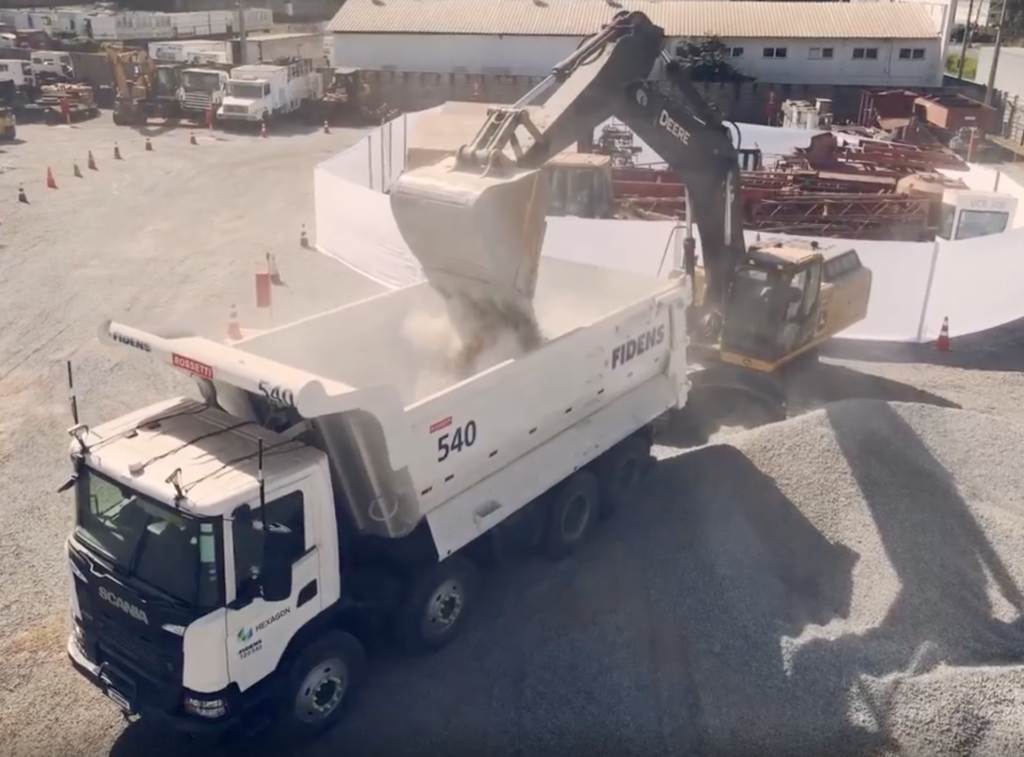
These systems are actually becoming quite strategic for the mining environment – all these digital technologies are helping mining companies attract new and younger people to the industry. And I haven’t mentioned teleoperation – which is becoming an important market for us, for example in relation to dozers, excavators and trucks working in more risky tailings dam areas. In Brazil alone we have seen 65% growth in our teleremote business in just one year. For the trucks, we have a partnership with Scania where we have Scania trucks teleoperated in these tailings areas. And we have two partner contractor companies we work closely with who are operating the teleremote equipment – Construtora Barbosa Mello and Fidens. We announced in 2024 for example that we had partnered with Fidens to debut Brazil’s first ever remotely operated 8×4 mining truck. This combines Hexagon’s sophisticated HARD-LINE TeleOp remote operation technology with Scania’s robust G 500 8×4 XT model mining truck and Fidens’ expertise in mining operations. The tailings areas where these trucks are operating are deemed high risk under Brazilian law, so human operators are not permitted. The systems can operate up to 200 km from the mine, plus the systems themselves are very inclusive – by that I mean older people, people with disabilities, pregnant women– all of these can now become equipment operators. And in fact some of the control centres have been set up in local communities themselves.
Q Moving on to full autonomy and trucks – Hexagon has publicly stated it is working on a full stack OEM agnostic autonomous haulage solution – plus in Brazil you have also worked closely with contract mining leader U&M on helping them advance their system. What is the latest on this?
Our intention is to be able to offer the market an autonomous kit that can be used equally to retrofit existing trucks or even on new trucks. The most significant steps we have taken in our journey with our autonomy kit are the purchase of two companies – HARD-LINE in Canada, bringing their automation and teleoperation technology and expertise; and indurad in Germany – including from the autonomous haulage side of things, xtonomy, which has already automated ADT fleets using its primarily radar-based system, which unlike camera-based and LiDAR systems is immune to challenging climatic conditions as well as dust and dirt on the sensors. HARD-LINE also brings the vehicle integration capability, allowing us much more flexibility when retrofitting – either for AHS or for CAS. Another great upside is that our system will not have the network bandwidth requirements of existing OEM-owned AHS systems. And with HARD-LINE’s capabilities we will be able to work with more or less any truck – even older models. On that note, we continue our cooperation with U&M – Brazil’s largest mining contractor. They are developing their own AHS to offer as part of an autonomy as a service solution – but we are able to bring them the benefits of our sensors, CAS and positioning tech for example. Already there are five Cat 777 trucks running autonomously using the U&M system at a major gold mine in Brazil. Just a final note on CAS – we believe that autonomy should allow for fully mixed autonomous and non-autonomous machines without having to use limited access autonomous zones. And CAS plays a huge role in making that a reality. The future of mine haulage I truly believe is multi fleet and multi brand; with a mix of staffed and autonomous machines.
Q Finally, does Hexagon Drill Assist also have a lot of potential in the Brazilian market?
Drill Assist has huge potential in Brazil – it has almost all the benefits of full autonomous drilling without the same level of investment plus you are leveraging the existing OEM technology. Automation removes the need for operator input, guaranteeing performance, regardless of drill operator experience. And AI algorithms monitor all input signals and determine the best parameters for a given ground type to avoid hole failure. When you think about it 90% of the drilling process concerns the machine drilling holes so once you automate that, fully automating the tramming part from hole to hole – the other 10% – is only bringing marginal added productivity benefits but a lot of extra cost – we can already use teleoperation for this, and of course can automate the tramming as well, it just isn’t our current focus – the other 90% is. Customers in Brazil have said to me – what about the fully autonomous drills we already have? Actually these are a great market for Drill Assist as well – because they generally use a set point and fixed parameters for the autonomous drilling itself. Our AI can and does change these in real time to respond to changes in hardness for example. So I am not exaggerating by saying that Drill Assist actually improves the performance of drills that are already autonomous. We have shown that – in one case we improved the penetration rate by 35% on a drill using an OEM autonomy system.
The post Hexagon and Brazil’s mining technology boom appeared first on International Mining.