
India’s Evolving Approach to Foreign Trade: Balancing Services, Manufacturing, and Strategic Diplomacy

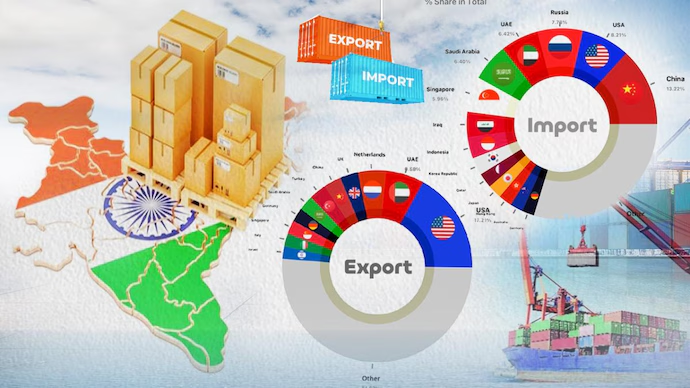
As global trade undergoes a period of transformation, India is reconfiguring its foreign trade strategy to align with shifting international dynamics. The rise of protectionist policies in several parts of the world, alongside a trend toward regionalization in the Asia-Pacific, is prompting India to pursue a more pragmatic and strategically integrated trade policy.
The Current Economic Backdrop
India’s economic structure significantly shapes its trade priorities. As of fiscal year 2024–25, services account for more than 50% of India’s GDP, while manufacturing contributes less than 20%. This economic composition provides both opportunities and challenges:
-
Services: India has long been a global leader in IT, business process outsourcing, and digital solutions. The next step is to expand integration of Indian services into global value chains, leveraging digital transformation and knowledge-based industries.
-
Manufacturing: Recognizing the limitations of its current manufacturing base, India is pushing policies to attract investment, upgrade technology, and promote domestic production. Initiatives such as Make in India, Production-Linked Incentive (PLI) schemes, and infrastructure expansion are central to this strategy.
This dual emphasis—strengthening services exports while boosting manufacturing capacity—forms the backbone of India’s evolving foreign trade approach.
Diplomacy Meets Trade
India’s trade negotiations are increasingly embedded within its larger strategic and diplomatic engagements. A case in point is the India–UK Free Trade Agreement (FTA) signed in July 2025. While the agreement covers conventional trade issues such as tariff rationalization and export promotion, it also incorporates defense cooperation frameworks and regional security alignment.
This demonstrates India’s recognition that trade is no longer an isolated economic activity; it is a multi-ministerial and multi-dimensional agenda that integrates national security, technological collaboration, and geopolitical positioning.
Preference for Bilateralism Over Multilateralism
One of the enduring features of India’s trade strategy is its preference for bilateral agreements over large multilateral pacts. This approach became especially visible in 2019, when India exited the Regional Comprehensive Economic Partnership (RCEP) over concerns of excessive import dependence and insufficient benefits for services exports.
Bilateral agreements provide India with:
-
Greater flexibility in negotiating tariffs and duty structures.
-
Opportunities to secure immigration pathways for Indian professionals.
-
Leverage to set terms on labor, environmental, and compliance standards more aligned with domestic interests.
For India, bilateral trade deals are not only about goods and services but also about building political trust and strategic partnerships.
Key Elements of India’s Emerging Trade Strategy
-
Maximizing Services Integration: Expanding India’s digital economy footprint, exporting IT-enabled solutions, fintech, education, and healthcare services.
-
Manufacturing Push: Using foreign trade agreements to attract investment in advanced manufacturing sectors such as semiconductors, electric vehicles, and renewable energy technologies.
-
Strategic Linkages: Embedding trade talks within defense, technology, and geopolitical cooperation frameworks.
-
Selective Engagement: Prioritizing bilateral agreements with countries where India sees scope for deeper services integration and trust-based partnerships.
-
Political-Economic Synergy: Ensuring that trade outcomes reinforce India’s diplomatic positioning as a reliable, independent, and emerging global power.
Looking Ahead
India’s foreign trade strategy is undergoing a structural shift—from a passive participant in multilateral trade platforms to an active architect of bilateral and strategic trade partnerships. The focus on services integration, coupled with a push for manufacturing-led growth, reflects India’s ambition to balance global competitiveness with domestic priorities.
At the same time, India’s insistence on linking trade with political trust highlights a uniquely Indian model—one where trade is not simply about commerce but also about building long-term, reliable, and strategic partnerships in an uncertain global landscape.
In the years ahead, this calibrated approach is likely to position India as not only a growing trade power but also a shaper of the global trade architecture in the Asia-Pacific and beyond.