
India’s Minerals and Metals Sector at an Inflection Point: Growth, Green Transition and Strategic Security

Post-Event Report | Published by Metals and Minerals Publication of India (MMPI), Media Partner
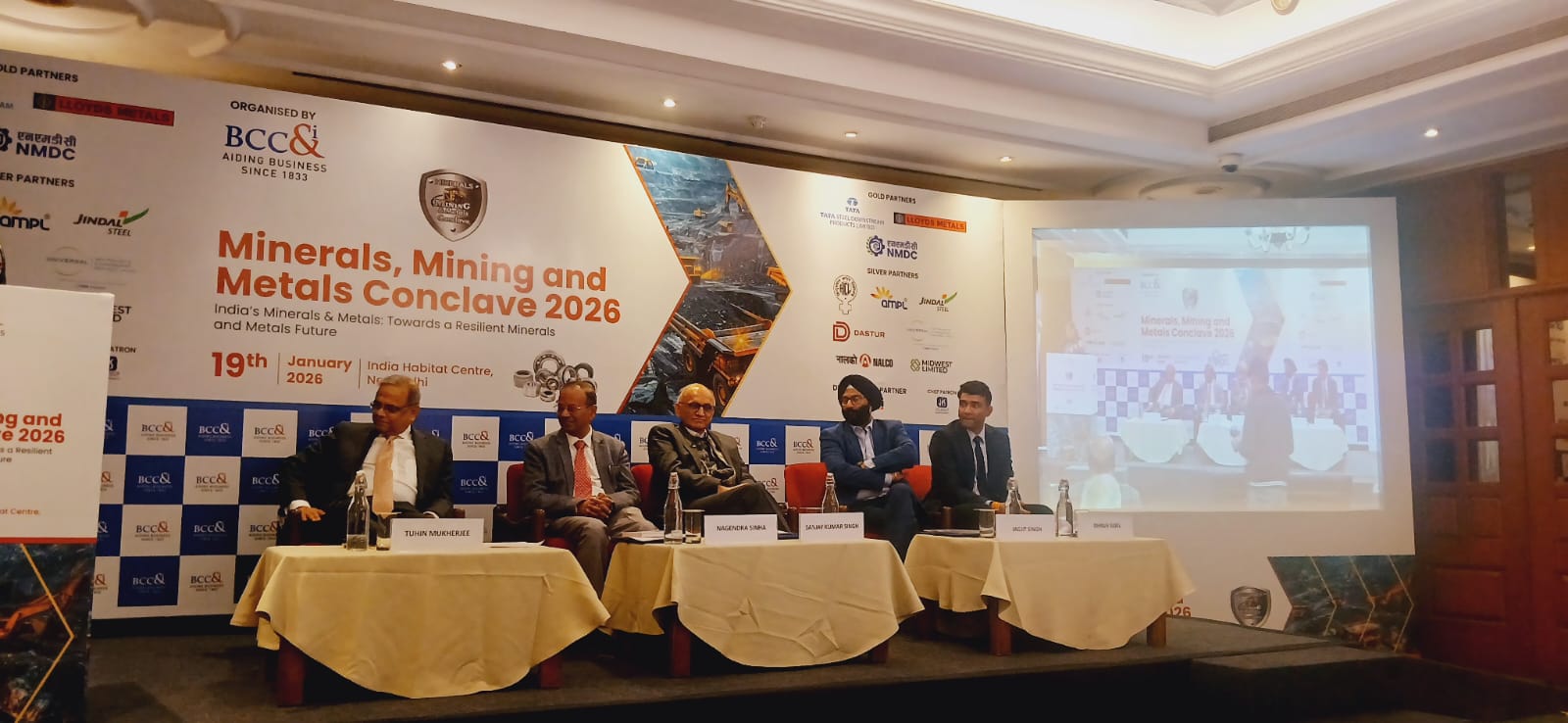
The Minerals, Mining and Metals Conclave, organised by The Bengal Chamber of Commerce and Industry (BCC&I), concluded with a strong consensus that India’s minerals and metals sector is entering a historic phase of expansion. However, the sustainability, technology adoption, and strategic resilience of this growth will determine its long-term success.
As the Media Partner, Metals & Minerals Publication of India (MMPI) presents a comprehensive post-event account capturing key deliberations and insights shared by policymakers, industry leaders, and technology experts.
India as the Global Growth Engine for Metals
Setting the tone for the conclave, Nagendra Sinha, Mentor, Metals National Committee, BCC&I and former Secretary, Ministry of Steel, highlighted India’s emergence as the world’s leading growth engine, comparable to China’s role 15–20 years ago.
He noted that India’s economy continues to grow despite geopolitical uncertainty, driving sustained demand for metals. Steel demand grew by 9–10 percent, while aluminium and copper recorded nearly 8 percent growth. These trends, he said, are expected to continue. He referred to the government’s long-term vision of achieving 500 million tonnes of steel capacity by 2047, along with ambitious expansion plans for aluminium and copper supported by recycling and secondary refining.
He also emphasised the strategic importance of the National Critical Minerals Mission in strengthening India’s economic security and clean energy transition.
Consumption-Led Growth and the Steel Imperative
Expanding on the macroeconomic perspective, Sanjay Kumar Singh, Executive Director – Strategy and External Relations, Jindal Steel, highlighted that India’s 8.2 percent quarterly GDP growth is rooted in its consumption-driven economy, strengthened by the Make in India initiative.
Steel, he noted, remains the backbone of India’s industrial growth. With production at around 160 million tonnes and consumption growing at nearly 10 percent annually, demand is largely driven by infrastructure spending. The planned increase in infrastructure investment from 3.1 percent of GDP to nearly 6 percent under National Infrastructure Pipeline 2.0 will further accelerate steel demand, supporting targets of 300 million tonnes by 2030 and 500 million tonnes by 2047.
He cautioned that decarbonisation remains the sector’s biggest challenge, with steel accounting for nearly 12 percent of industrial carbon emissions, and highlighted policy tools such as the Carbon Credit Trading System as critical enablers of transition.
Data-Driven Outlook on Demand, Capacity and Iron Ore
Providing a quantitative perspective, Dhruv Goel, CEO of BigMint, presented a detailed outlook on steel supply-demand dynamics up to 2030.
He projected steel demand to rise from around 150 million tonnes currently to over 204–205 million tonnes by 2030, driven primarily by construction and infrastructure, which account for 60–65 percent of total demand. Installed capacity, currently at around 215 million tonnes, is expected to expand to nearly 280 million tonnes by 2030.
He also highlighted a gradual shift in steelmaking routes and its implications for raw materials. Iron ore demand is projected to rise sharply from 256 million tonnes in FY25 to nearly 375 million tonnes by FY30, underscoring the importance of long-term resource planning.
Growth with Responsibility: Sustainability and Social Licence
Summing up the broader industry sentiment, Jagjit Singh, Managing Director, TSDPL and Chairman, Metals National Committee, BCC&I, stressed that scaling up today is not merely about adding volumes, but about scaling responsibly.
He emphasised the need to move from linear to circular value chains, improve raw material efficiency, adopt digital technologies, and earn a social licence to operate. Drawing from global examples, he highlighted the shift from blast furnace-based steelmaking to electric arc furnaces, noting that similar transitions will become inevitable in India despite high capital requirements.
Green Mining in Action: India’s First Fully Green Mine
One of the most compelling case studies came from R R Satapathy, who detailed how Lloyds Metals and Energy Limited is on the verge of declaring India’s first fully green mine in Maharashtra.
He outlined large-scale electrification of mining equipment, regenerative braking in dumpers, battery-operated loaders, green logistics using LNG and battery swapping, slurry pipelines for ore transport, and sourcing 100 percent renewable power. The initiative demonstrated how mining operations can align productivity with decarbonisation.
Technology Localisation and Underground Mining
Addressing the technology dimension, Ranjit Ravindran, Head – Mining Business, Universal MEP Projects & Engineering Services, highlighted the importance of technology localisation.
He noted that true technology adoption goes beyond importing equipment and lies in building skills, maintenance capabilities, and local ecosystems. This approach will be critical as India scales up underground mining and expands exploration of metals and critical minerals.
Critical Minerals and Magnet Security
A strategic wake-up call came from K Raghav Reddy, Chairman of Midwest Energy Ltd, who highlighted India’s vulnerability in permanent magnets, a critical component for electrification.
He pointed out that 93 percent of electric motors rely on permanent magnets and that supply disruptions could cripple global industries. With China tightening export controls, he outlined Midwest Energy’s efforts to build domestic magnet manufacturing capacity and bridge the interim supply gap until India fully utilises its vast monazite reserves.
Policy Support and Trade Protection
From a policy standpoint, Ashwini Kumar, Economic Advisor, Ministry of Steel, highlighted India’s position as the brightest spot in global steel trade, even as other countries reduce production.
He explained the rationale behind safeguard duties introduced earlier this year and finalised for a three-year period, aimed at protecting domestic producers, stabilising margins, and encouraging fresh investments. While India has strong iron ore reserves, he cautioned against dependence on imported coking coal and exposure to global price volatility.
Conclusion: A Defining Decade Ahead
The conclave underscored that India’s minerals and metals sector stands at a defining crossroads. With strong domestic demand, policy backing, and ambitious capacity targets, growth opportunities are unprecedented. At the same time, sustainability, decarbonisation, technology localisation, and critical mineral security will determine how resilient and globally competitive this growth will be.
As Media Partner, MMPI notes that the deliberations reflected not just optimism, but a clear recognition of the responsibilities that accompany scale. The coming decade will test the sector’s ability to grow not just faster, but smarter and greener.