
Iran Conflict Set to Hit Petrol Drivers 5 Times Harder than EV Drivers — Analysis


Support CleanTechnica’s work through a Substack subscription or on Stripe.
As EU Environment Ministers meet to discuss electric vehicle targets, new research shows EVs are the best way to protect drivers from oil shocks.
- The EU spent €67 bn on oil imports for cars last year
- Accelerating the roll-out of EVs would cut oil imports by €45bn over the next decade
Petrol car drivers can expect to be hit far harder by price rises related to the Iran conflict than electric vehicle drivers, new analysis finds. With oil prices surpassing $100 a barrel, the additional cost of fueling a petrol car is expected to be five times the extra cost of charging an electric car, according to T&E. Electric vehicles will be top of the agenda for EU Environment Ministers meeting in Brussels today when they will discuss a proposal to weaken climate targets for carmakers in the EU Automotive Package.
T&E analysed the likely impact on petrol prices and found that fuelling the average petrol car would cost €14.20 per 100km, a rise of €3.80 due to the conflict. The average cost of charging an EV would be €6.50 per 100km — an increase of €0.70 because of higher electricity prices due to more expensive gas.¹ For company cars, which drive high mileage, the impact will be even greater: an extra €89 per month for every petrol car in a company’s fleet. EV company cars would cost just €16 extra per month to charge.
Lucien Mathieu, cars director at T&E, said: “Petrol drivers get hammered at the pump every time we face an oil shock. Electric cars are the best bet to ensure this never happens again. But Chancellor Merz and Prime Minister Meloni want to slow down the transition to EVs, which will only prolong our dependence on oil. A Trump or an Ayatollah can control the oil taps, but they can’t control the wind and the sun.”
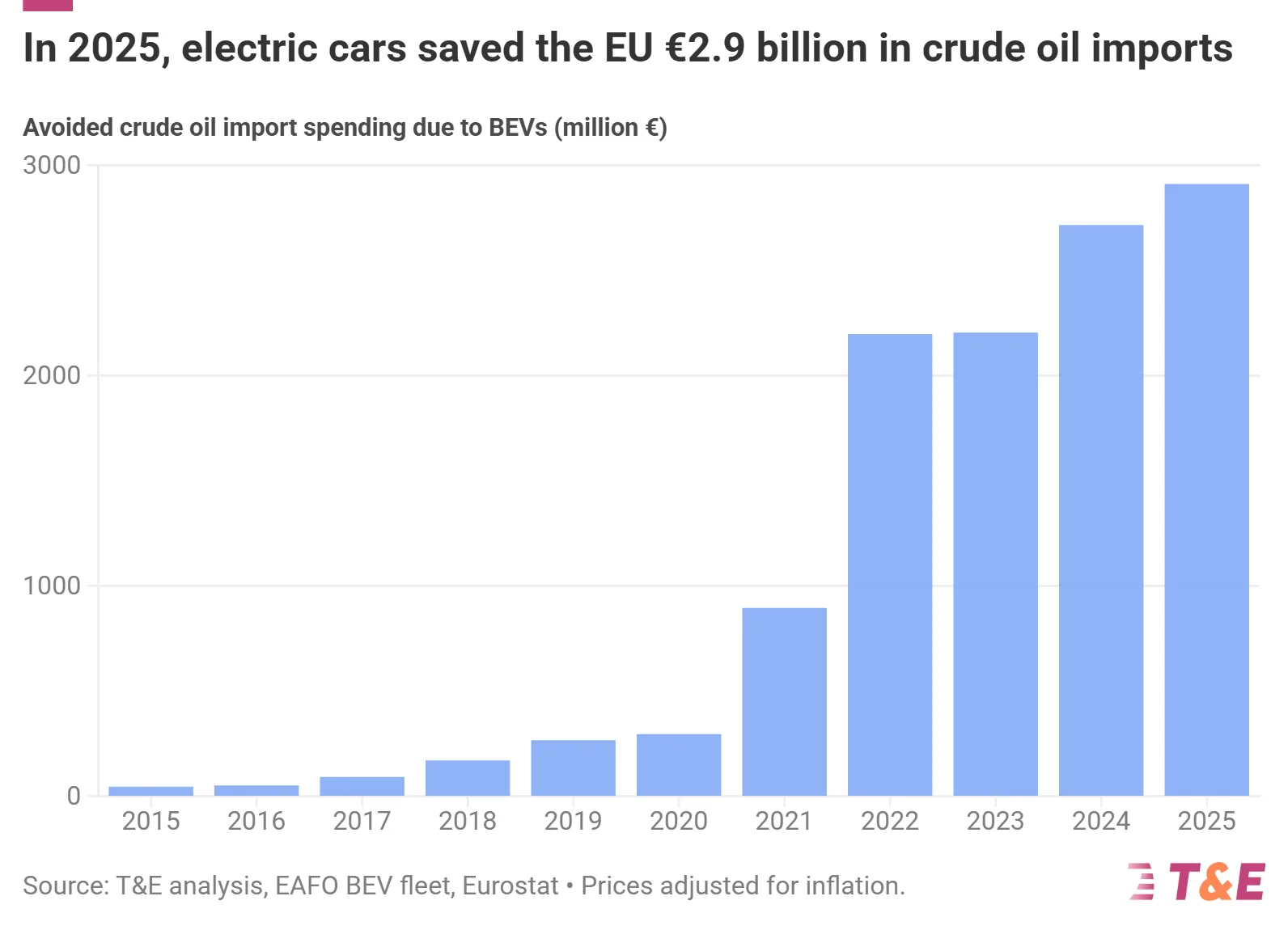
The EU imported 1 billion barrels of oil for cars in 2025, costing €67 billion, the analysis also finds. But the 8 million EVs already on Europe’s roads saved the bloc a further 46 million barrels of oil imports last year, worth €2.9 billion.
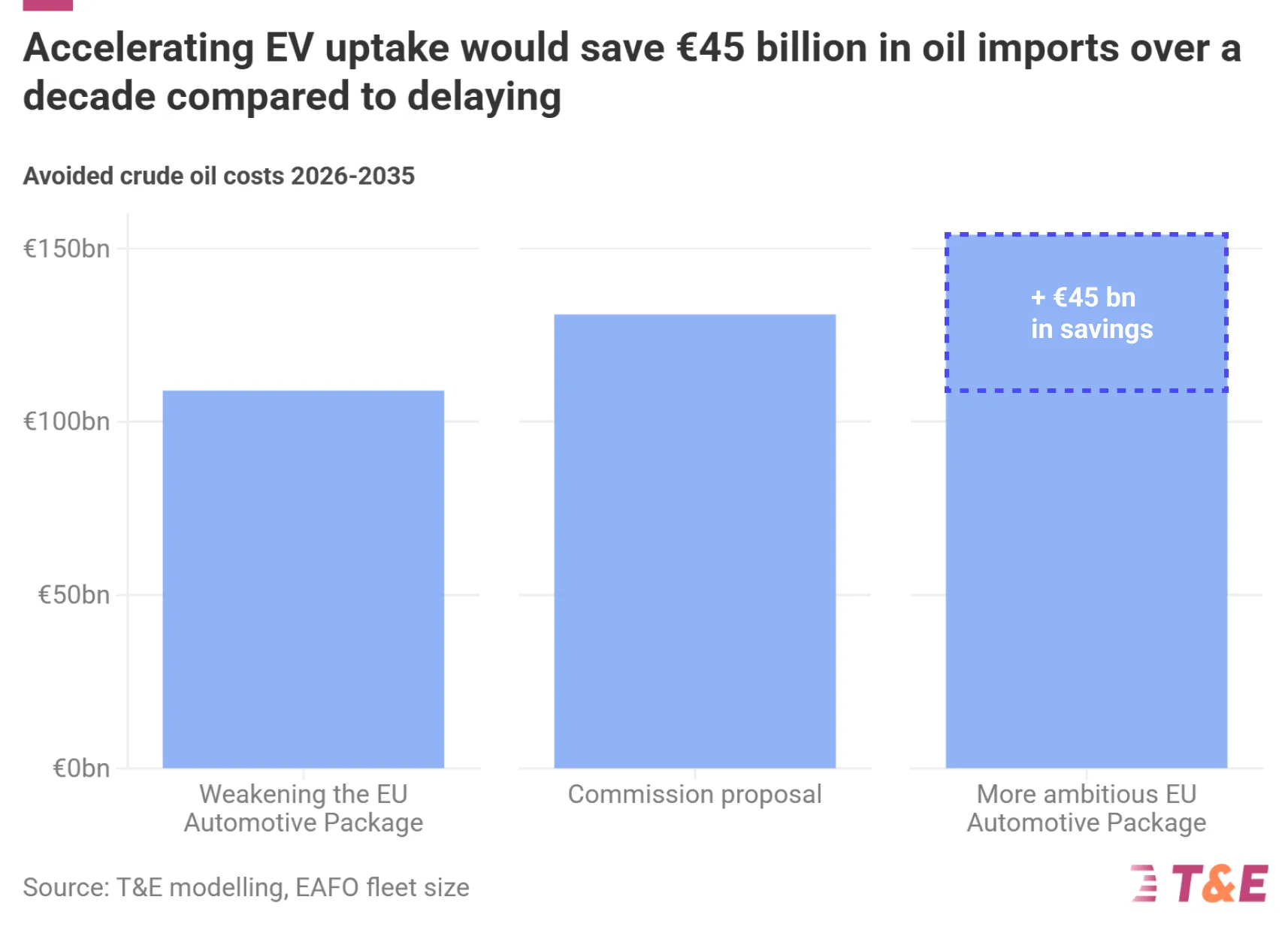
In its Automotive Package last December, the EU Commission proposed to weaken the CO2 targets for cars and to set electrification targets for large company car fleets. The car industry and some EU leaders, including Germany’s Friedrich Merz and Italy’s Giorgia Meloni, want the CO2 standards to be weakened even further and oppose the fleets targets. This weakening would delay the switch to EVs in Europe, prolonging its dependency on oil. But increasing the ambition of the Automotive Package² would boost EV uptake and reduce oil imports by €45 billion between 2026-2035 compared to weakening it, the analysis finds.
Today Environment Ministers will discuss the EU Commission’s proposal to weaken the 2030 and 2035 CO2 targets for carmakers. T&E called on ministers to stand up for citizens facing rising fuel costs by keeping the pressure on car manufacturers to provide more EVs. A recent T&E report found the average price of an electric car in the EU has fallen for the first time since 2020, driven by the release of more affordable models to comply with the bloc’s car CO2 targets.
T&E also said lawmakers must increase the ambition of a Commission proposal to electrify the vehicle fleets of large companies. The current draft targets are only in line with market trends and would not result in companies electrifying their fleets faster. Corporate fleets are the primary source of vehicles for the second-hand market. By strengthening the proposed fleets targets, 3.6 million additional used EVs could be provided to the used cars market in 2035, bringing energy savings to second-hand car buyers.
Lucien Mathieu said: “Lawmakers have it in their power to speed up the roll-out of EVs and protect more of their citizens from oil shocks. Car CO2 standards require manufacturers to provide increasing amounts of affordable electric cars for the mass-market. An ambitious EV fleets law will accelerate electrification and guarantee the supply of cheap EVs for used-car buyers.”
Notes to editors:
¹ T&E analysis assumes that average petrol prices at the pump remain high at levels around €2 per litre, as last seen in the 2022 energy crisis when oil prices stayed around $100/barrel. On average, this means a 24% increase for petrol prices compared to the 2025 average.
The analysis assumes that the average EU consumer electricity price would increase in the mid-term by 12% compared to H1 2025. This is based on what was seen in the 2022 crisis, when wholesale electricity prices jumped but the end consumer prices progressively increased over a longer period (2-3 years).
² In modelling a more ambitious Automotive Package being implemented, T&E assumed the current 2030 and 2035 car CO2 targets would remain unchanged. It also assumed the Commission’s proposed company car electrification targets would enter into force, but that — unlike in the Commission proposal — plug-in hybrids would not count towards any portion of the target.
Article from T&E.
Sign up for CleanTechnica’s Weekly Substack for Zach and Scott’s in-depth analyses and high level summaries, sign up for our daily newsletter, and follow us on Google News!
Have a tip for CleanTechnica? Want to advertise? Want to suggest a guest for our CleanTech Talk podcast? Contact us here.
Sign up for our daily newsletter for 15 new cleantech stories a day. Or sign up for our weekly one on top stories of the week if daily is too frequent.
CleanTechnica uses affiliate links. See our policy here.
CleanTechnica’s Comment Policy