

In the dynamic world of drilling operations, early kick detection stands as one of the most vital defenses against well control incidents. A “kick” — the unintended entry of formation fluids into the wellbore — can escalate rapidly into a blowout if not detected and managed promptly. The following case study from an actual reaming operation offers valuable insight into how surface parameters, when interpreted correctly, can prevent a potentially catastrophic situation.
The Scenario: A Routine Reaming Operation Turns Critical
During a reaming operation — specifically while reaming down the last stand — the drilling crew encountered a situation that tested their vigilance and understanding of well behavior. The operation appeared normal at first glance; however, subtle but consistent anomalies began to emerge across multiple surface indicators.
Each signal, viewed in isolation, might not have seemed alarming. But when examined collectively, they told a clear story — a kick was developing in the well.
Step-by-Step Breakdown of the Indicators
1. Standpipe Pressure – The First Subtle Shift
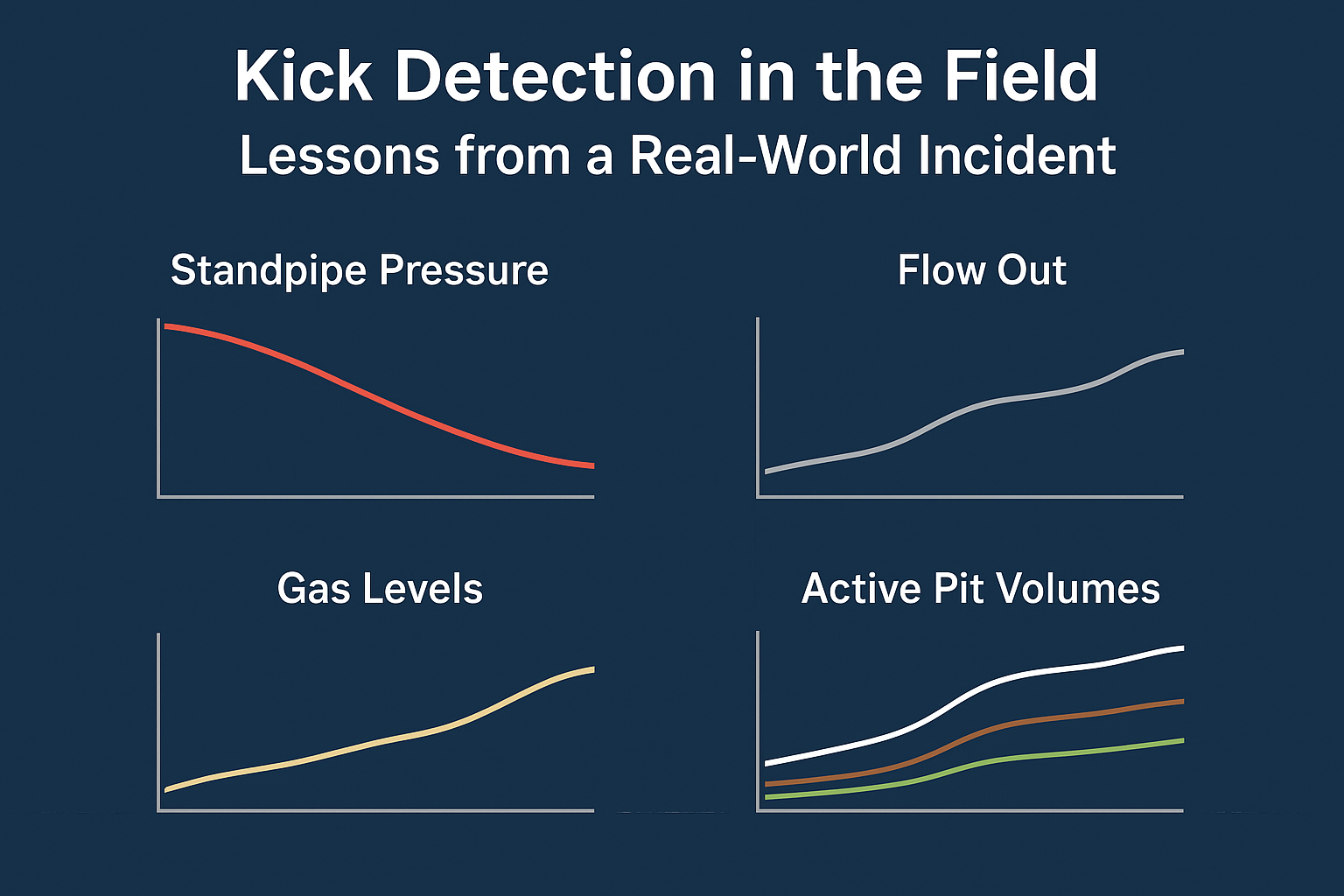
The standpipe pressure (displayed as a red curve on the surface data) began to show a gradual decrease, even though the pump speed and flow rate remained constant.
This phenomenon occurs because an influx of formation fluids — usually less dense than the drilling mud — enters the wellbore, effectively reducing the overall hydrostatic pressure at the bit. The lighter mixture in turn lowers the circulating pressure, resulting in a noticeable pressure drop at surface level.
2. Flow Out – The Silent Alarm
Simultaneously, the flow out (represented by the light grey curve) showed a slight but consistent increase. Since no operational parameter had changed and the pumps were running at a steady rate, the only logical explanation was an external source of fluid entering the system — in this case, formation fluids moving upward into the wellbore.
This increase in flow out is one of the most reliable early indicators of a kick, as it suggests that the well is no longer balanced.
3. Gas Levels – The Invisible Intruder Revealed
Shortly after the pressure and flow anomalies, the gas readings (light yellow curve) began to rise. This indicated that gas from the formation was migrating into the drilling mud.
Even before the kick fully manifested in surface pits, these rising gas levels served as an early warning — a critical cue that subsurface fluids had begun to intrude into the wellbore environment.
4. Pit Volume – The Confirmation Signal
Finally, the active pit volumes (white, brown, and green curves) showed a measurable gain. When an influx enters the well, it physically displaces drilling mud from the borehole, causing an increase in the surface pit volume.
This pit gain, when correlated with the earlier pressure, flow, and gas anomalies, confirmed the situation beyond doubt: the well had taken a kick.
Immediate Response: Containing the Kick
Upon recognizing the alignment of all indicators, the drilling team treated the event as a confirmed kick. Immediate actions were initiated:
-
Well Shut-In: The well was promptly shut in to prevent further influx.
-
Pressure Control: The choke manifold was engaged to safely circulate the influx out of the wellbore.
-
Mud-Gas Separator Activation: The separator was used to handle gas-laden drilling mud and prevent contamination of surface systems.
-
Monitoring: Continuous monitoring of casing and drill pipe pressures ensured that the well was being brought back under control in a stable and safe manner.
Thanks to prompt action and a disciplined adherence to well control protocols, the situation was contained without any damage to equipment, personnel, or the environment.
Key Takeaways from the Incident
-
No Single Parameter Tells the Whole Story:
A decrease in standpipe pressure alone may not raise alarm. However, when combined with rising flow out, increasing gas levels, and pit gains, the pattern becomes unmistakable. -
Early Detection Saves Time — and Lives:
Every second matters once a kick begins. The quicker it’s detected, the smaller the influx and the safer the operation. -
Human Vigilance Is Irreplaceable:
Even with automated systems and advanced sensors, it was the crew’s situational awareness and experience that led to the early recognition of the event. -
Teamwork and Communication Are Critical:
Effective coordination between the driller, mud logger, and well control personnel ensured swift and decisive action. -
Continuous Monitoring Is the Key to Prevention:
Consistent attention to multiple real-time parameters is essential for early kick detection — complacency can turn a minor influx into a full-blown blowout.
Conclusion: The Power of Awareness and Team Discipline
This real-world kick detection event underscores the vital importance of interpreting surface data holistically and maintaining constant vigilance during all drilling operations. The combination of sharp observation, prompt decision-making, and disciplined adherence to well control procedures prevented what could have been a serious incident.
In the end, this case reaffirms a timeless truth in drilling: technology assists, but human awareness saves wells.
Every anomaly tells a story — the key is learning to listen before it’s too late.