
MINERAL POWER PLAY: US & AUSTRALIA FORGE $8.5BN ALLIANCE TO BREAK CHINA’S RARE‑EARTH STRANGLEHOLD

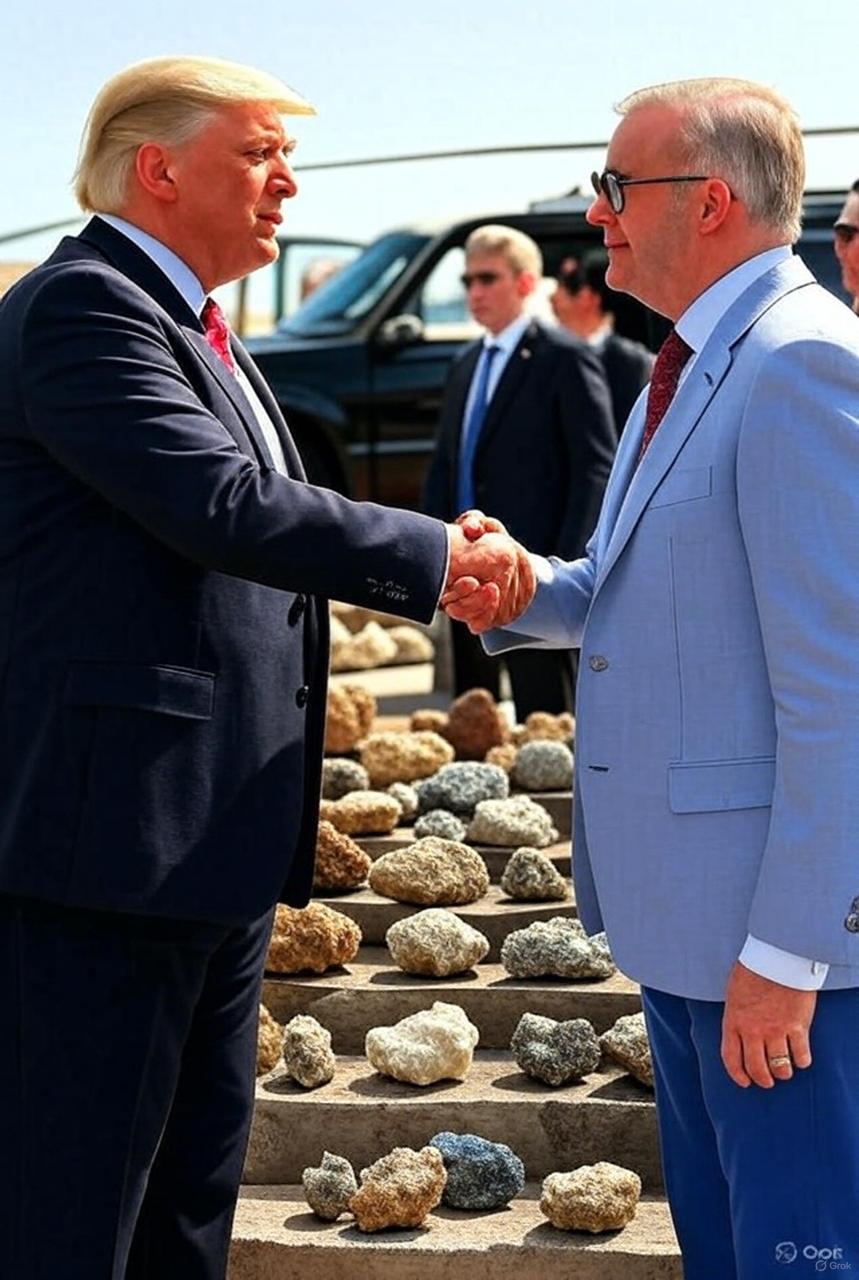
In a move that signals a seismic shift in global supply‑chains and geopolitics, the United States and Australia have inked a landmark agreement to jointly secure and process critical minerals and rare earths. The pact — valued at roughly US $8.5 billion — was signed on October 20 2025 by Donald Trump and Anthony Albanese at the White House, underscoring the strategic importance of minerals like gallium, lithium, and heavy rare earths.
WHY IT MATTERS TO BOTH COUNTRIES
For both the United States and Australia, this agreement is not just economic — it’s strategic.
– **For the United States:** The deal strengthens its ambition to reduce dependency on China for critical minerals used in semiconductors, defence systems, and clean‑energy technologies. It also supports Washington’s vision of rebuilding domestic supply chains and reshoring key industries.
– **For Australia:** It solidifies its position as a global hub for mining and refining, enabling local industries to move up the value chain from raw extraction to advanced processing. Australia will also attract significant foreign investment and technology transfers under this agreement.
Both nations benefit from the establishment of a transparent pricing mechanism, shared infrastructure development, and a framework for sustainable extraction aligned with ESG standards. This collaboration also strengthens defence alliances under the Indo‑Pacific economic framework.
STRATEGIC & ECONOMIC IMPLICATIONS
– **Challenging China’s dominance:** The deal directly counters China’s control over rare‑earth supply and processing. It diversifies the global critical mineral ecosystem, making Western economies more resilient.
– **Technology and defence integration:** Critical minerals are central to advanced defence systems, EV batteries, and renewable energy grids. By combining U.S. technology and Australia’s rich mineral resources, the pact fuses industrial strategy with national security.
– **Global ripple effect:** Other mineral‑rich nations are expected to follow suit, forging similar strategic alliances to protect supply‑chain sovereignty.
– **Market reactions:** Mining and processing stocks in Australia surged following the announcement, reflecting investor confidence in long‑term mineral security.
KEY FEATURES OF THE AGREEMENT
– A joint framework titled “United States‑Australia Framework for Securing Supply in the Mining and Processing of Critical Minerals and Rare Earths.”
– Within six months, both countries will invest at least US $1 billion each in project financing for mining and processing.
– Permitting and regulatory reforms to accelerate the approval of new projects.
– Price‑floor and trade protection mechanisms to shield supply chains from market distortions.
RISKS & CHALLENGES
– **Execution complexity:** Building new mining and processing infrastructure will take time and may face environmental and logistical challenges.
– **Geopolitical reaction:** China may retaliate with export restrictions or trade barriers, potentially increasing global price volatility.
– **Supply‑chain volatility:** Early optimism could give way to bottlenecks in technology transfer, project financing, or ESG compliance.
WHAT THE WORLD ECONOMIES SHOULD MONITOR
– **Shift in global trade flows:** As the U.S. and Australia expand cooperation, other nations such as Canada, India, and African mineral hubs may reposition themselves within this emerging ecosystem.
– **Pricing trends:** Watch for new benchmarks in rare‑earth and lithium pricing as Western alliances attempt to create transparent market structures.
– **Investment patterns:** Expect increased venture capital flow into battery metals, refining technologies, and sustainable extraction models.
– **Environmental governance:** Whether this alliance upholds higher ESG standards will shape its global legitimacy and influence.
– **Technological dependencies:** The partnership could drive innovation in recycling and substitution of rare minerals — key areas for long‑term stability.
CONCLUSION
This U.S.–Australia critical minerals pact marks a watershed moment in the evolution of global mineral policy — a pivot from extraction dependency to integrated, sovereign supply‑chain design. It signifies a future where energy transition, defence readiness, and economic resilience are intertwined.
As the race for rare‑earth sovereignty accelerates, the world watches closely. The outcome of this alliance will determine not only who controls mineral wealth but who shapes the technological and geopolitical balance of the next industrial era.