

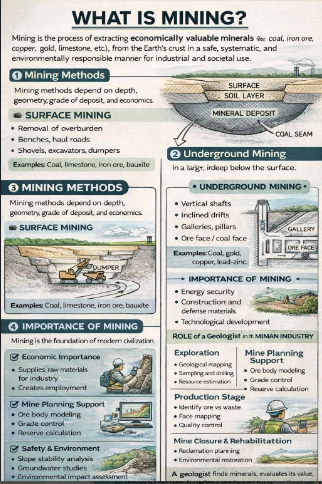
Mining is the process of extracting economically valuable minerals such as coal, iron ore, copper, gold, and limestone from the Earth’s crust. It is carried out in a planned, safe, and environmentally responsible way to meet industrial needs and support daily life. From electricity generation to construction and technology, mining forms the backbone of modern civilization.
Mining Methods
Mining methods are selected based on the depth, shape, quality of the mineral deposit, and economic viability.
Surface Mining (Opencast / Open-pit)
Surface mining is used when mineral deposits are located close to the Earth’s surface. It involves the removal of overburden to access the mineral.
Common forms include opencast or open-pit mining, strip mining, and quarrying. These operations use benches, haul roads, and heavy machinery such as excavators, shovels, and dumpers. Surface mining is widely used for coal, limestone, iron ore, and bauxite.
Underground Mining
When mineral deposits are deep below the surface, underground mining methods are adopted. Techniques such as room and pillar, longwall mining, cut and fill, and shrinkage stoping are used to safely extract minerals.
Underground mines consist of vertical shafts, inclined drifts, galleries, pillars, and working faces. This method is commonly applied to coal, gold, copper, and lead-zinc deposits.
Importance of Mining
Mining is essential for economic growth and industrial development. It supplies raw materials for key industries, creates large-scale employment, generates government revenue, and supports infrastructure growth.
Industrially, mining fuels power generation through coal, enables steel production using iron ore, supports cement manufacturing with limestone, and drives the electrical industry with copper.
Strategically, mining strengthens energy security, provides materials for construction and defense, and supports technological advancement.
Role of a Geologist in Mining
Geologists play a vital role throughout the life cycle of a mine. Their work begins with exploration through geological mapping, sampling, drilling, and resource estimation. During mine planning, geologists assist with ore body modeling, grade control, and reserve calculations.
In the production stage, they help distinguish ore from waste, conduct face mapping, and ensure quality control. Geologists also contribute to safety and environmental management by assessing slope stability, studying groundwater behavior, and supporting environmental impact assessments.
At the end of mining operations, geologists are involved in mine closure and rehabilitation, focusing on land reclamation and environmental restoration.
In simple terms, a geologist discovers mineral resources, evaluates their value, supports safe extraction, and helps ensure that mining is sustainable and environmentally responsible.