


Support CleanTechnica’s work through a Substack subscription or on Stripe.
For a market that is still largely fossil fuel engine-dominated, the ability to compare multiple electrified platforms in one venue matters.
The United Asia Automotive Group Inc. (UAAGI) ability to bring champion brands BAIC, Chery, Foton, Jetour, Lynk & Co, and Radar under its wing reflects how quickly Chinese and China-linked brands are expanding the range of electrified options available to Filipino consumers, from family SUVs to commercial vans and lifestyle pickups.
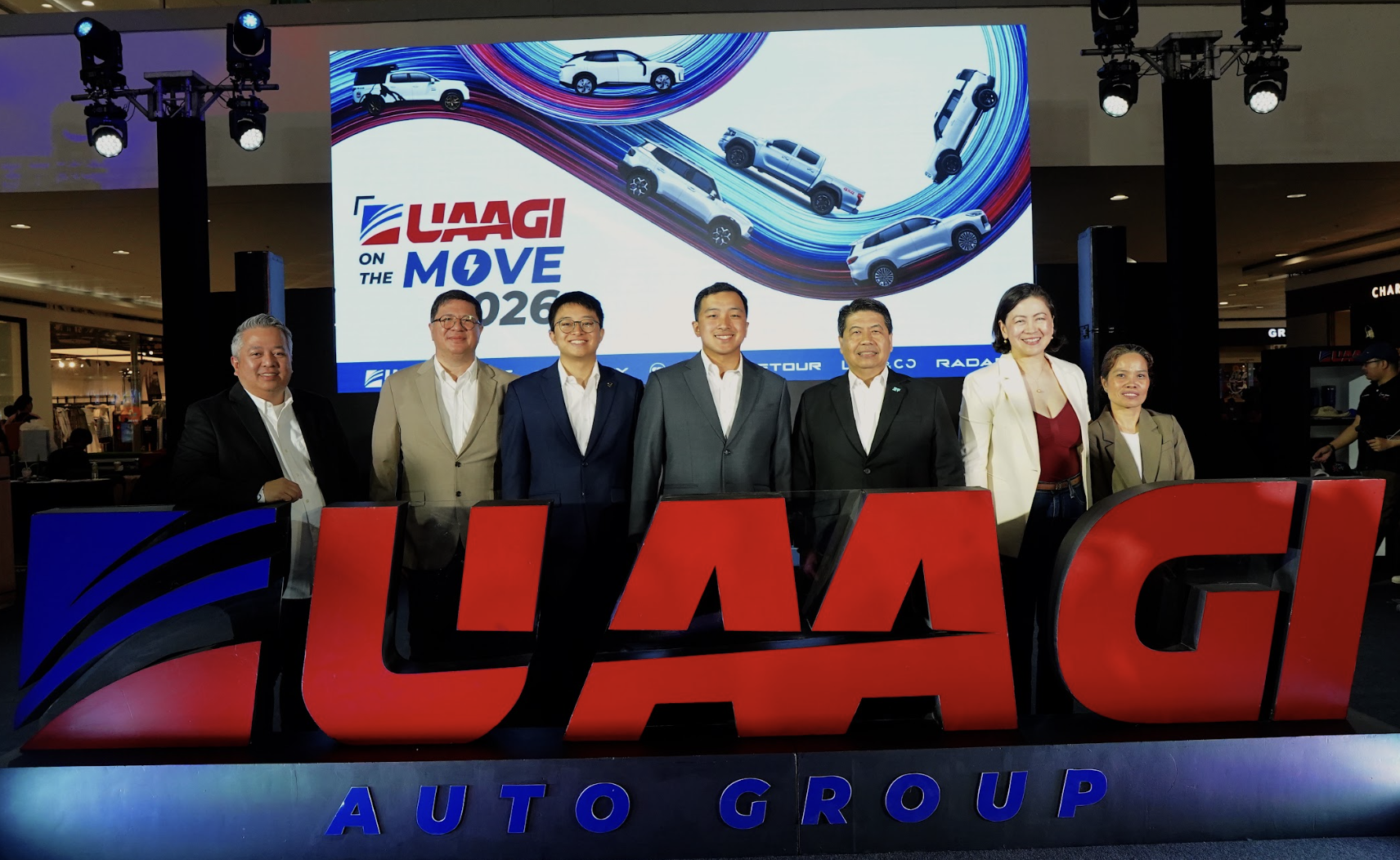
UAAGI is leaning into that shift with the first leg of its 2026 “On the Move” roadshow at SM Mall of Asia, a four-day event that places hybrids, plug-in hybrids, range-extended EVs, and battery-electric vehicles side by side with their internal-combustion counterparts — and, more importantly, puts them on a test-drive route.
More than 20 vehicles are available for test drives, and the mix shows how the industry is approaching electrification in the Philippines: not through a single technology, but through a spectrum. There are conventional hybrids aimed at fuel savings, plug-in hybrids designed to extend electric-only daily driving, range-extended electric vehicles that address charging anxiety, and full battery-electric platforms for fleet and shuttle applications.
“By locating these strong brands together in one we provide the power of choice,” Rommel Sytin, CEO of UAAGI, told CleanTechnica. He said that in the choice of brand partners, technology diversity is not accidental. Charging infrastructure in the Philippines is growing but remains uneven, and many buyers are still making their first move away from pure combustion. Electrified vehicles that can operate without daily reliance on public charging — particularly PHEVs and REEVs — are emerging as a transitional solution.
“We believe we are contributing largely to the quick adoption of EVs and helping build the ecosystem for it,” Sytin said.
The BAIC B60e Beaumont rEV is a full-size, 7-seat, range-extended electric vehicle (REEV) priced at approximately P3,498,000 ($62,098) in the Philippines. Unlike traditional hybrids, it uses a 1.5-liter turbocharged gasoline engine primarily as a generator to charge a 40.3 kWh lithium-ion battery, which in turn powers a dual-motor all-wheel-drive system. This configuration produces a combined output of 540 hp and 655 Nm of torque, enabling a manufacturer-claimed comprehensive driving range of 1,200 km and a pure electric range of approximately 152 km.
Designed with off-road utility in mind, the B60e features a body-on-frame chassis, nine selectable drive modes, and a 800 mm wading depth with a dedicated water level indicator. The interior is characterized by a “six-screen” layout, including twin 12.8-inch panels for the driver and front passenger, a head-up display, and a digital rear-view mirror. Standard equipment includes a 12+1 Infinity speaker system with active noise cancellation, ventilated and massaging seats, and the “Big Assist+” ADAS suite, which provides Level 2 automation features like lane centering and autonomous emergency braking.
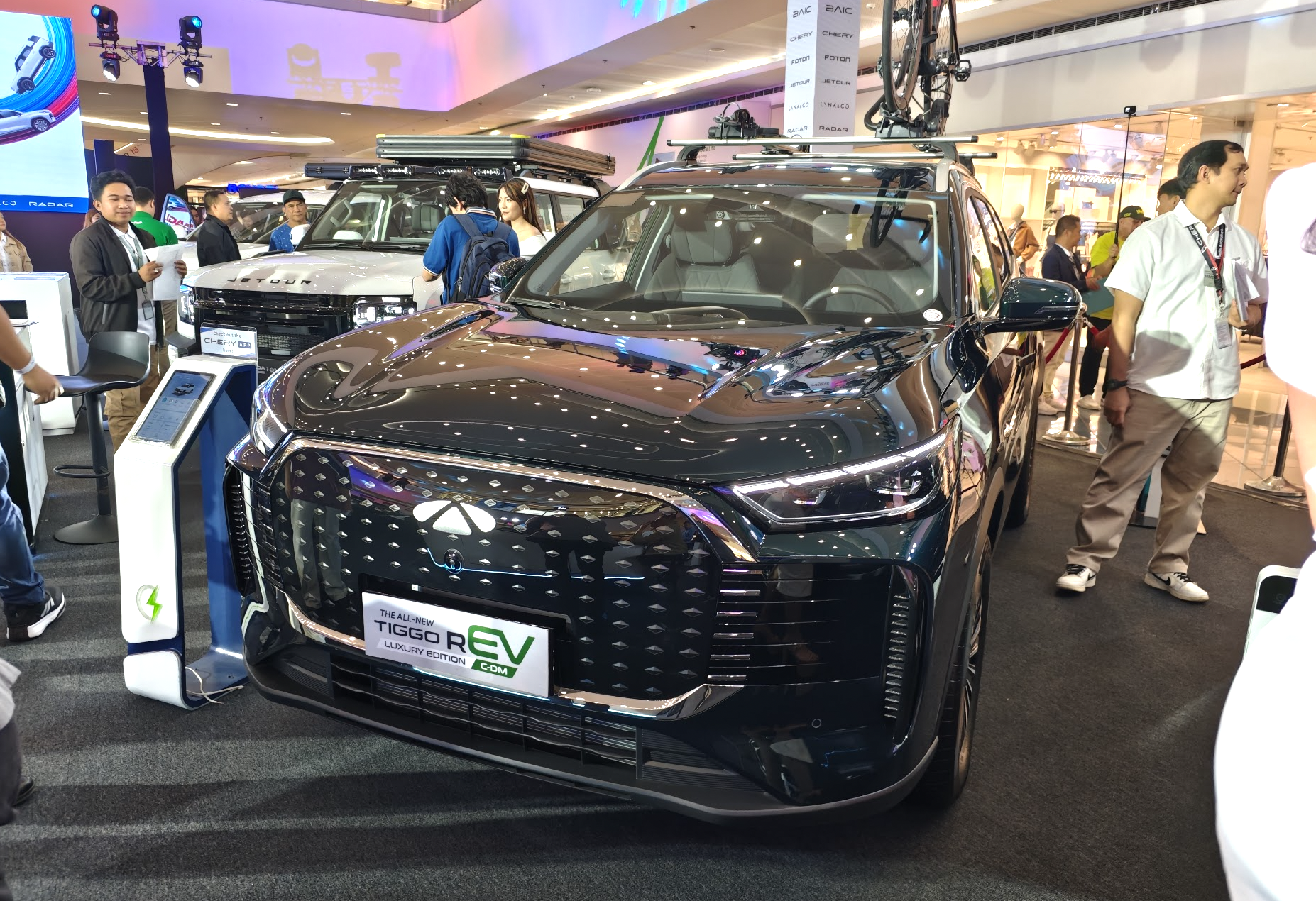
Chery is showcasing the Tiggo rEV Luxury Edition, a 7-seat plug-in hybrid SUV priced starting at P1,528,000 ($26,463) and reaching P1,598,000 ($27,676) for the high-trim variant. It utilizes a 1.5-liter turbocharged engine combined with a Dedicated Hybrid Transmission (DHT) and an 18.66 kWh lithium-ion battery. The system produces a combined output of 204 hp and 310 Nm of torque, supporting a manufacturer-rated combined driving range of up to 1,400 km. It is compatible with both Type 2 (AC) and CCS2 (DC) charging standards, which is a distinguishing feature in its price segment, where many competitors only offer AC charging. The vehicle posted a fuel economy figure of 84.28 km/Lge (liters gas equivalent) in the Department of Energy (DoE) fuel-economy run in 2025.
The vehicle is equipped with a 15.6-inch infotainment touchscreen, a 10.25-inch digital instrument cluster, and a 12-speaker Sony audio system. Standard safety features include a 540-degree camera system and an Advanced Driver Assistance System (ADAS) suite featuring adaptive cruise control, autonomous emergency braking, and lane departure warning.
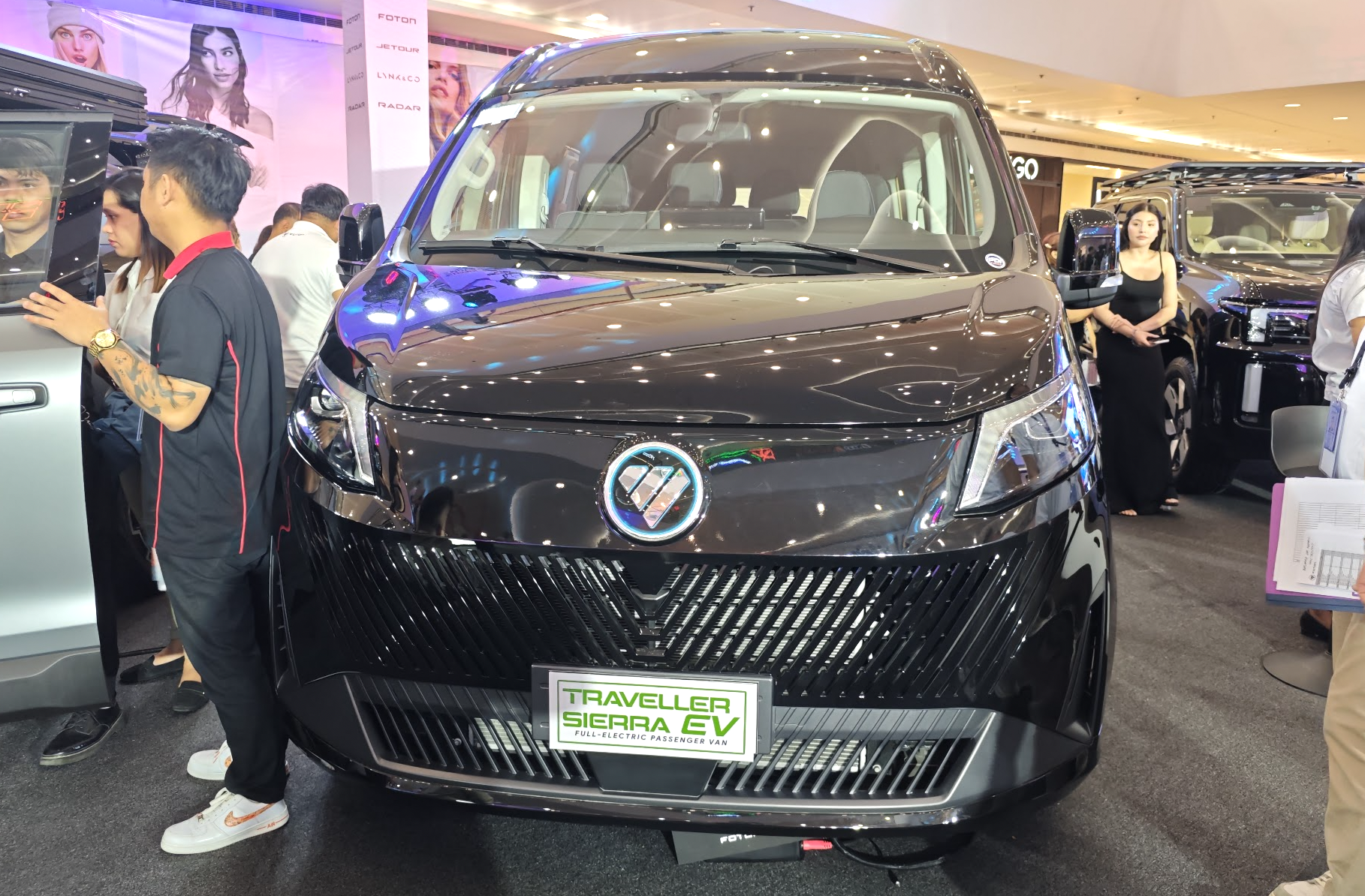
For the commercial sector — a crucial piece of the local transport ecosystem — Foton’s Traveller Sierra EV points to where electrification could scale faster. The 12-seat battery-electric van, with a 77.28 kWh lithium-iron-phosphate battery and a rated range of over 300 kilometers (WLTP), fits the duty cycle of shuttle services, hotels, and corporate fleets, where vehicles return to a depot and can charge overnight. Fleet adoption has long been viewed as a practical entry point for EVs in the country because utilization rates are high and operating costs are easier to quantify.
“Our commercial vehicle offerings are far advanced than any other brand in the market,” Sytin stressed.
Then there is the Radar RD6 EM-P electrified pickup — a segment that has traditionally been among the hardest to decarbonize in Southeast Asia. Pickup trucks are central to both private use and small-business logistics in the Philippines. Introducing electrified options in this category signals that the transition is moving beyond city cars and crossovers into work vehicles and lifestyle platforms.
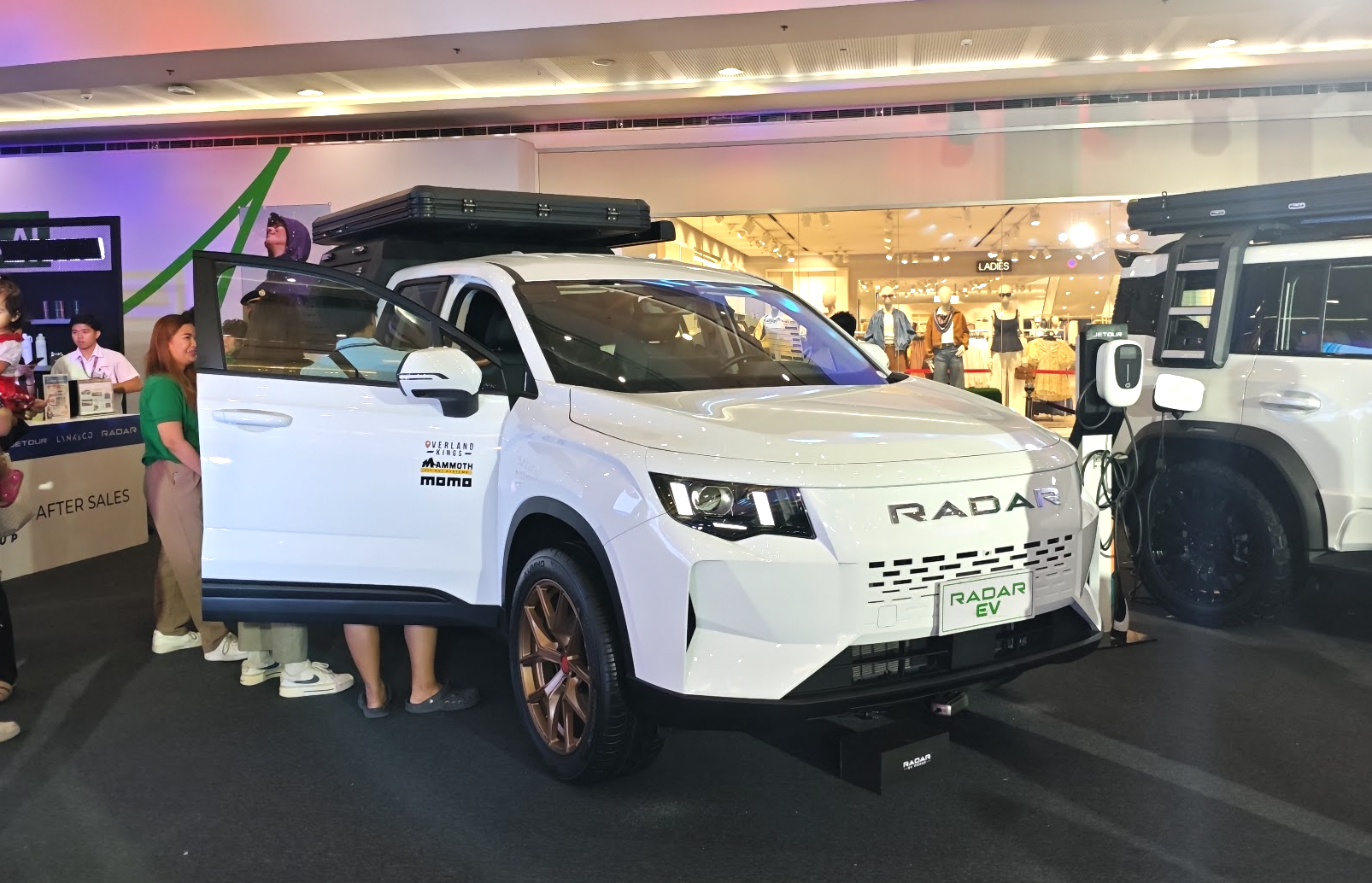
Jetour and Lynk & Co are both emphasizing long-range plug-in hybrid systems that can function as daily EVs for short urban trips while retaining the ability to travel intercity without charging stops. Lynk & Co’s 08 EM-P, in particular, has already demonstrated what that architecture can do in controlled conditions, setting distance records for both hybrid and pure-electric operation.
On-site financing approvals, insurance packages, and trade-in appraisals reduce the friction that often slows adoption. For many buyers, the barrier is no longer awareness but the complexity of the purchase process and the upfront cost. Packaging everything into one location shortens the decision cycle — something that has proven effective in other emerging EV markets.
Equally important are the test drives. Primarily a sales tool, they are also educational. Experiencing instant torque, quiet operation, regenerative braking, and one-pedal driving are difficult to communicate through specifications alone. Putting first-time drivers behind the wheel remains one of the most effective ways to shift perception.
UAAGI says additional legs of the roadshow will be announced later in the year. If the format travels beyond Metro Manila, it could help address one of the persistent gaps in the Philippine EV transition: most exposure to electrified vehicles is still concentrated in major urban centers.
The broader significance of events like this is that they move the conversation from future plans to present-day choices. Electrification in the Philippines is no longer limited to early adopters and pilot programs. It is showing up in mainstream retail spaces, in family SUVs, in people movers, and in pickup trucks.
And when buyers can test drive all of those in a single afternoon, the transition stops being abstract.
Sign up for CleanTechnica’s Weekly Substack for Zach and Scott’s in-depth analyses and high level summaries, sign up for our daily newsletter, and follow us on Google News!
Have a tip for CleanTechnica? Want to advertise? Want to suggest a guest for our CleanTech Talk podcast? Contact us here.
Sign up for our daily newsletter for 15 new cleantech stories a day. Or sign up for our weekly one on top stories of the week if daily is too frequent.
CleanTechnica uses affiliate links. See our policy here.
CleanTechnica’s Comment Policy