

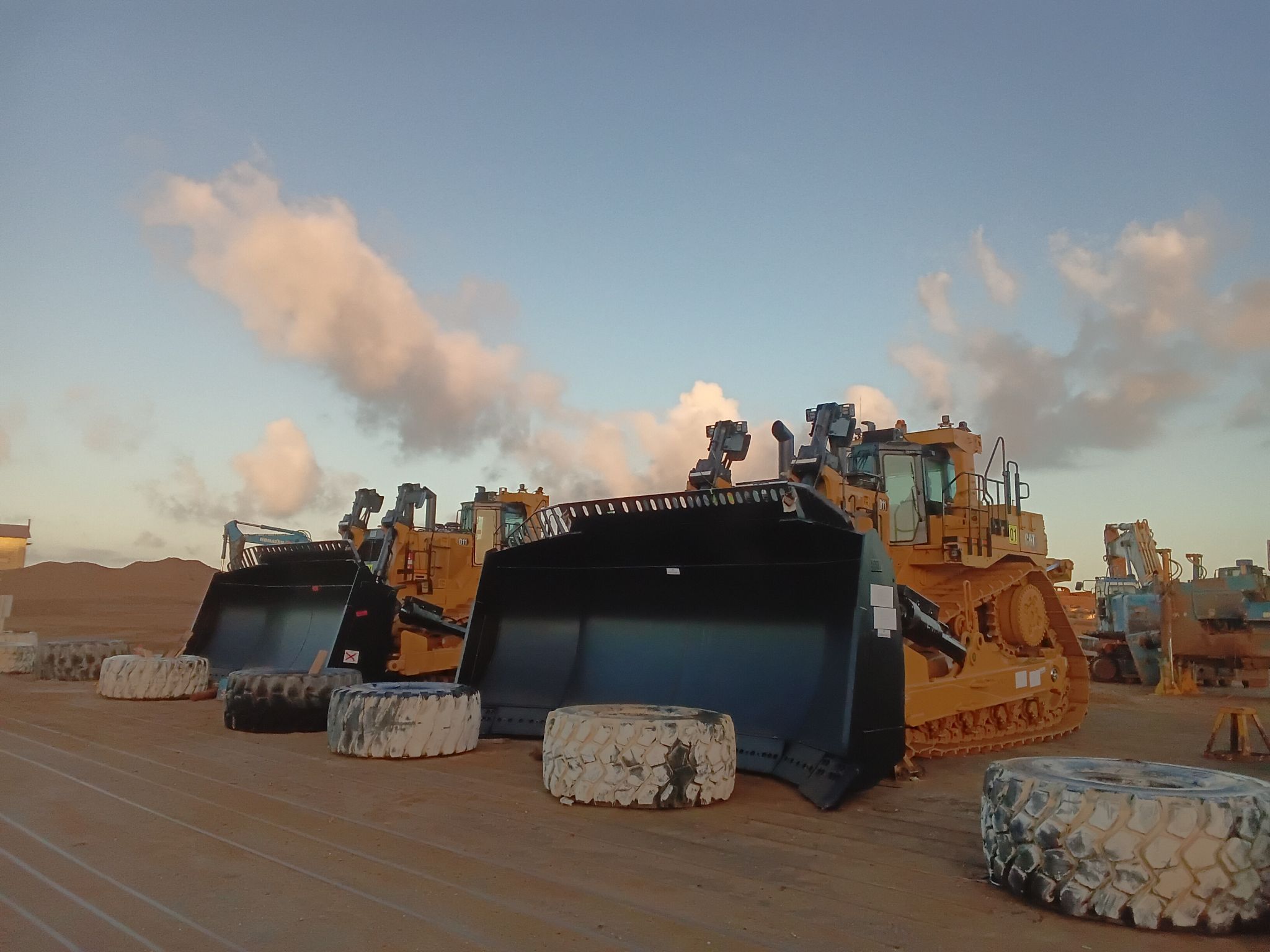
The future of mining at Namdeb took another important step forward recently as the company procured four Caterpillar D11 dozers from Barloworld Namibia on a rent to buy agreement. The machines will assist with operation of Dry Mining Unit (DMU) plants, by feeding them with sand using power dozer pushing. The DMU is a key innovation aimed at transforming the way Namdeb carries out overburden sand mining.
The D11s are Caterpillar’s largest and most powerful dozers and are classified as ultraclass mining dozers, fitted with semi-universal blades and can move up to ~27.2 cubic metres of material in a single push. Speaking during the handover of the machines, held on 17 June 2026, Barloworld Country Manager, Nick Kyriacos, expressed his pride in delivering the machines to Namdeb. “From Caterpillar and Barloworld’s perspective, being able to deliver four D11s to an operation like Namdeb and have them all in production is very exciting for all of us. We are proud to support Namdeb with equipment that will contribute to a more efficient and cost-effective way of mining and help drive the business forward.”
Namdeb Chief Operating Officer, Jurgen Jacob, commended the Barloworld and local Caterpillar team for their continued support and service excellence. “These D11 Caterpillar machines are a massive step forward for our operation, and we are very pleased with both the performance and quality of service provided by the Barloworld team in general. We are looking forward to making good use of these machines,” he noted.
The machines will play a critical role in improving efficiency and productivity, helping to unlock the next phase of Namdeb’s mining future. Namdeb extended its appreciation to Barloworld and the Caterpillar team for their partnership and continued support as they work together to build a more efficient and sustainable future for mining. Through the procurement of these dozers, Namdeb added that it is reaffirming its commitment to Mining for Good.
Namdeb recently announced that it had started commissioning of its first DMU on April 1, 2026. It stated: “The Dry Mining Unit (DMU) represents one of Namdeb’s most exciting steps toward transforming the way we mine, safely, efficiently, and sustainably. As part of our ongoing journey to innovate and remain globally competitive, the DMU introduces a smarter and more cost-effective way of moving vast volumes of sand.” The first tonnes of sand were fed into the DMU on 20 April with each unit then processing 800-900 t/h but with the intention to ramp up to 2,000 t/h.
DMU technology was developed for mineral sands mining both by Australian company Piacentini & Son with fabrication in Bunbury, WA and by South African company ADP Group with fabrication in Cape Town, with supply to their respective regional markets. ADP was acquired by Australian engineering company Lycopodium and ultimately rebranded as Lycopodium Africa. In the Namibian market the two companies are now collaborating through 50:50 JV Lycopodium Piacentini Namibia (LPN) to deliver DMU projects in the country.
The DMU technology is described as the marriage of underwater track crawler technology with high-capacity skid-mounted materials handling and sand pumping systems, into a single remotely controlled mobile sand processing machine. The remotely operated tracked unit receives ROM material in excess of 1,500 t/h into a ROM bin. This material is drawn out via a feeder at a controlled tonnage, discharged via a pulping chute, fluidised and screened into a wet bin. Thereafter it is drawn out and pumped up to two kilometres by a centrifugal pump and booster stations. The DMU is mobile and relocated every seven days to follow the mining face.
The efficiency compared to conventional tramming is substantial, with the machine relocated regularly to keep tramming distance to a minimum, thereby lowering diesel fuel consumption and carbon emissions. It is estimated that the power saving will be significant compared to the conventional load and haul method.
The post Namdeb’s Dry Mining Unit boosted by arrival of Cat D11 dozers appeared first on International Mining.