

Support CleanTechnica’s work through a Substack subscription or on Stripe.
Or support our Kickstarter campaign!
The greedy, grasping, living cartoon of a Scrooge who currently occupies the White House is leveraging coal power to support his plans for killing as many Americans as possible. Hopefully he will leave office again — peacefully, this time — before doing much further damage. In the meantime, energy storage innovators are already laying the groundwork for a fresh burst of wind and solar activity in the coming years, pushing coal out of the power generation picture once and for all.
Canada Has Your Compressed Air Energy Storage Solution
The low cost of wind and solar power supports high-volume, non-battery energy storage solutions that would be impractical or uneconomical under a fossil fuel scenario, and compressed air storage is a good example.
The devil is in the details, but the basic idea is simple enough. Use excess renewable energy to compress air in a storage facility, and release it to a generating station when the grid needs more electricity.
As for why not just use the familiar lithium-ion solution, that’s a good question. Li-ion battery arrays will occupy a solid position in the energy storage field for a long time to come, but they only last for a few hours and their dependence on critical minerals calls for new solutions that introduce a wider range of supply chain options, preferably with a domestic focus.
The Canadian startup Hydrostor is among those promoting compressed air as a long duration energy storage solution that can support the addition of more wind and solar resources on the grid. The company claims that it can deliver electricity for 8 hours or more from a 500-megawatt utility-scale storage facility.
Compressed Air Storage Meets Community Choice Aggregation
Despite the advantage of longer duration, compressed air systems have had a tough time making their case against Li-ion batteries. However, back in 2024, BloombergNEF compared 8-hour compressed air storage systems against 4-hour Li-ion arrays on a capex (capital expenditure) basis and reached a favorable conclusion. According to their calculations, compressed air came in at $293 per kilowatt-hour compared to $304 for Li-ion arrays.
That doesn’t necessarily mean compressed air is out of the woods. In the same analysis, BNEF placed thermal energy storage in the lead at $232/kWh. Still, the overall picture is one of building more resiliency, security, and diversity into a supply chain that supports the nation’s energy storage assets.
Hydrostor is about to put that to the test. On February 12, the company announced that it has just signed a 50-megawatt offtake agreement with California Community Power. The agreement marks a significant milestone towards the construction of Hydrostor’s first 500-megawatt A-CAES (advanced compressed air energy storage) facility, the Willow Rock Energy Storage Center in Kern County, California.
The CC Power connection adds another layer of significance to the Willow Rock facility. CC Power is part of the emerging community choice aggregation movement, which enables local energy providers to leverage the combined buying power of ratepayers to negotiate for more affordable electricity rates. In today’s market, that mean solar, solar, and more solar, with wind also playing a role.
Community choice aggregation systems require enabling legislation on a state-by-state basis, so it’s no surprise to see the movement gathering steam in deep blue California along with other blue and purple states. As of last August, the US Environmental Protection Agency (such as it is now) also listed Illinois, Maryland, Massachusetts, New Hampshire, New Jersey, New York, Ohio, Rhode Island, and Virginia in the small but growing number of states permitting community choice systems.
CC Power is a partnership between nine community choice aggregators covering almost 2.7 million ratepayers among 112 municipalities scattered from Humboldt County to Santa Barbara County. Six of those nine aggregators are participating in the Willow Rock offtake agreement.
How Does It Work?
The “A” in Hydrostor’s A-CAES energy storage system refers to a sophisticated system that combines water-assisted compression with heat recovery.
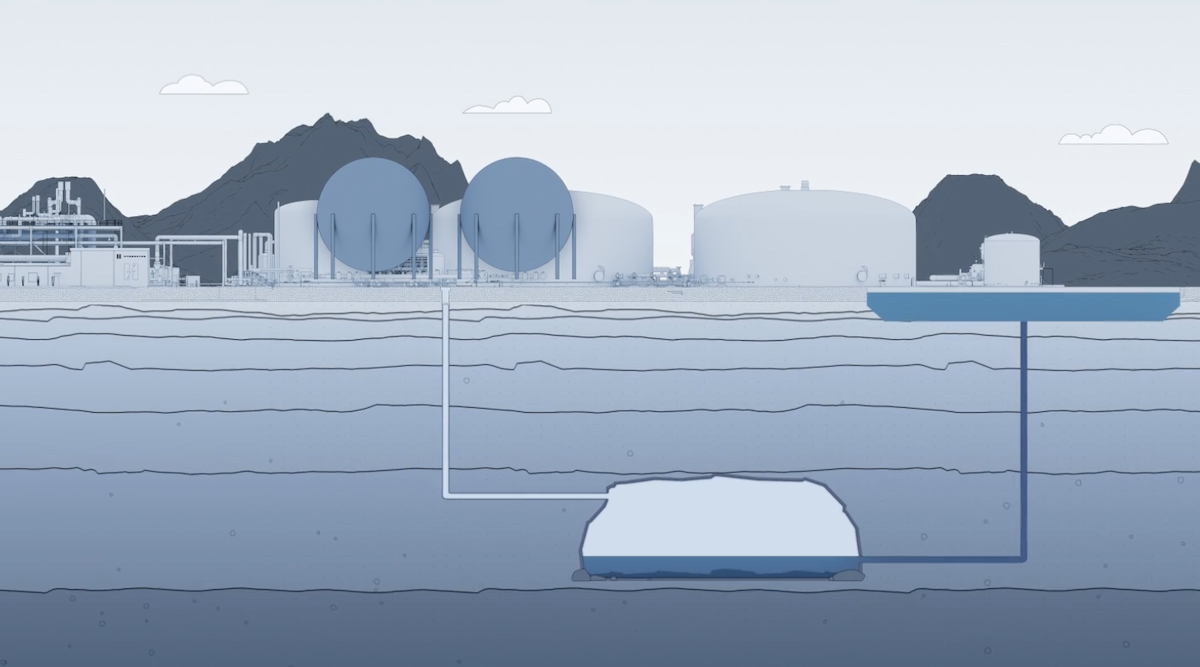
“The WRESC operates by running excess power from the grid through turbines and then compressing air, which is then pumped into a large, water-filled cavern 2,000 feet underground,” Hydrostor explains, with WRESC short for the Willow Rock facility.
“The heat removed from the air in the compression process is stored for later, and the cavern below-ground fills with compressed air while a surface reservoir holds the water above,” they elaborate.
When the “air battery” is in discharge mode, the process is reversed. “While it might sound like science-fiction, A-CAES simply utilizes long-established principles of thermodynamics, along with components and know-how from the oil & gas and mining industries, and readily available rock, water, and air to store and deliver energy at-scale and on-demand,” Hydrostor notes.
“Willow Rock can store, move, and deploy excess energy between the grid, shafts, cavern, surface reservoir, and thermal storage tanks through a transformative flow of air, heat, and water. The end result is energy storage composed of synergistic parts functioning like an integrated organ system,” the company elaborates.
Next Steps For Compressed Air Energy Storage
Hydrostar also notes that the longest project phase of the Willow Rock facility involves subsurface construction, including excavating the shafts for the underground cavern and building the 600 acre-foot above-ground reservoir.
As for where all that water will come from, that’s a good question. By way of comparison, a 600 acre-foot reservoir holds about the equivalent of water entering the wastewater treatment plants of a major city every day. Hydrostor cites San Diego as an example.
That’s a lot of water on a daily basis, but the Willow Rock facility only requires one fill-up to get started. According to Hydrostor, no additional fillings are needed. Condensation will also produce more water within the system (see lots more construction and operation details here).
The model seems to be catching attention. Hydrostor started off with a 2-megawatt, commercially contracted A-CAES project in Canada, and now it has two triple-digit projects in the works, with the 200-megawatt Silver City Energy Storage Centre in Australia joining the roster along with Willow Rock.
Other projects at various points in the pipeline total 7 gigawatts and growing. Hydrostor cites Arizona, New York, and Nevada in addition to California, with utilities in the Southeast and Northwest also under discussion along with additional projects in Canada and Australia.
Meanwhile, it’s a day late and a dollar short for the 77 million eligible US voters to suddenly wake up and realize they made a horrible mistake when they shoveled US President Donald Trump into the White House for the second time on Election Day 2024, with clean air just one among a long list of foundational public rights now at risk. The same goes for the millions of eligible voters who didn’t bother to vote, or threw away their vote on a third-party spoiler because the Democratic candidate, Kamala Harris, didn’t meet their purity standards.
Purity, schmurity. Oh well, better late than never….
Image: Long duration, compressed air energy storage meets the community choice aggregation movement at Hydrostor’s forthcoming A-CAES facility in California (screenshot courtesy of Hydrostor).
Support CleanTechnica via Kickstarter

Sign up for CleanTechnica’s Weekly Substack for Zach and Scott’s in-depth analyses and high level summaries, sign up for our daily newsletter, and follow us on Google News!
Have a tip for CleanTechnica? Want to advertise? Want to suggest a guest for our CleanTech Talk podcast? Contact us here.
Sign up for our daily newsletter for 15 new cleantech stories a day. Or sign up for our weekly one on top stories of the week if daily is too frequent.
CleanTechnica uses affiliate links. See our policy here.
CleanTechnica’s Comment Policy