
OPINION: A Month After e-Trike Ban In Manila: Has It Made Manila’s Streets Safer?

Support CleanTechnica’s work through a Substack subscription or on Stripe.
Or support our Kickstarter campaign!
One month after the Philippines’ Land Transportation Office (LTO) began strict enforcement of its ban on light electric vehicles along major Metro Manila roads, officials have been quick to frame the policy as a win for traffic order. Fewer apprehensions are being reported. Selected corridors appear to be moving faster. From the standpoint of traditional traffic management, the logic seems simple: remove slower vehicles from fast roads and congestion improves.
Yet beneath that narrative lies a more complicated reality. The ban has surfaced long-standing tensions in Philippine transport policy, particularly the tendency to regulate new forms of clean mobility using frameworks designed almost exclusively for private cars, often without collecting the data needed to evaluate real-world outcomes.
What is unfolding on Manila’s roads is less a question of discipline than of whether speed is being mistaken for safety, and enforcement for evidence.
Speed has been treated as safety, without proof
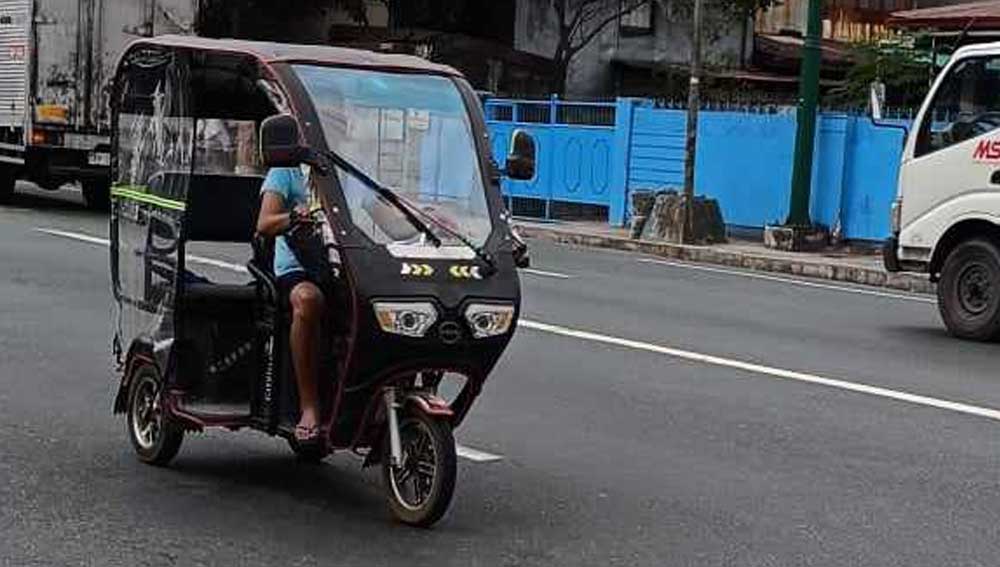
The LTO’s justification rests on the idea of speed mismatch. Officials argue that e-bikes and e-trikes, typically operating at 25 to 40 kilometers per hour, create rear-end collision risks when mixed with faster-moving vehicles on the main roads in the city, such as on EDSA, C-5, and Roxas Boulevard.
By this reasoning, removing slower vehicles restores predictability and reduces accidents. Early enforcement figures have been presented to support this claim.
Apprehensions reportedly dropped from more than a hundred on the first day of implementation to fewer than fifty by the end of the first week. For the agency, the decline signals improved compliance and discipline.
Transport research, however, suggests that the relationship between speed and safety is far more complex.
International studies consistently show that crash severity is influenced less by speed variance than by vehicle mass, road geometry, and the presence or absence of physical separation. When lighter vehicles are removed from a roadway, average speeds often increase. While this may reduce minor conflicts, it can also raise the likelihood of severe or fatal outcomes when collisions occur.
So far, the LTO has not released comparative crash data to show whether accidents have declined since the ban took effect. There are no publicly available figures comparing January 2026 with the same period in 2025, no breakdown of injuries involving light electric vehicles prior to enforcement, and no analysis of whether travel-time improvements extend beyond private motorists. In the absence of such data, enforcement statistics have effectively become a stand-in for safety outcomes.
Displacement, not reduction
What can be inferred from conditions on the ground suggests that the ban has not reduced the demand for mobility. Instead, it has redirected it.
The Philippines is estimated to have more than 1.5 million e-trikes and e-bikes nationwide, many of them locally assembled and used daily for commuting, informal transport, and livelihood activities. In Metro Manila, these vehicles often function as first- and last-mile links in areas poorly served by jeepneys or buses. When barred from major arteries without alternative routes or lanes, riders do not disappear. They move elsewhere.
Reports from barangay traffic offices and commuter feedback indicate increased congestion on secondary and inner roads, particularly during peak hours. These streets are often narrower, less regulated, and more dangerous, especially for pedestrians. From a systems perspective, this raises a critical question. If risk is merely being shifted from highways to residential streets, can the policy credibly be described as improving safety?
Riders and operators describe regulation without transition
In the absence of official studies, much of the clearest insight into the ban’s impact has come from the people most affected by it. Social media posts from established e-trike and e-bike groups have filled the information gap left by the lack of government data.
In one widely shared Facebook post from a national e-trike operator group, a member wrote that authorities kept saying the ban was about safety, but never explained where displaced riders were expected to go. “We’re not racing cars,” the post read. “We’re trying to get to work without paying fares that change every week.”
On X, a Manila-based e-bike delivery cooperative described the policy as exclusion rather than regulation. The group noted that banning light electric vehicles from highways without building lanes or posting clear signage amounted to removal, not management. Another post from a metro-wide e-trike rider network focused on enforcement economics, pointing out that a single apprehension could wipe out a week’s income for a driver already operating on thin margins.
These accounts reflect a broader sentiment that enforcement arrived without transition. Clear technical standards, dedicated space, and public information campaigns were largely absent when the ban took effect.
Advocates and industry point to different failures
Transport advocacy groups and industry stakeholders agree that the current approach is flawed, though they differ on why. AltMobility PH has criticized the policy as emblematic of car-centric thinking, arguing that it prioritizes the convenience of a minority of motorists at the expense of the majority who rely on public or informal transport. In their view, equating emptier highways with safer streets ignores how most Filipinos actually move through the city.
The Electric Vehicles Association of the Philippines (Electric Vehicles Association of the Philippines) has focused instead on regulatory clarity. EVAP has repeatedly pointed out that the LTO has yet to clearly define categories distinguishing pedal-assist bicycles, low-speed scooters, and heavier passenger e-trikes. Without such definitions, enforcement becomes inconsistent, leaving even compliant riders vulnerable to apprehension.
Both perspectives converge on a central issue. Regulation without clear standards and infrastructure undermines both safety and public trust.
When clean mobility is a matter of survival
The human consequences of the ban were brought into sharp relief by the viral apprehension of an 88-year-old e-trike driver on Roxas Boulevard. The incident resonated widely not because it was exceptional, but because it captured a familiar reality. For many Filipinos, light electric vehicles are not experimental technology or lifestyle choices. They are tools for survival.
In transport-poor areas, e-trikes often provide the only affordable link to hospitals, markets, and schools. Passengers affected by the ban have reported longer walks, higher costs, and fewer options. These burdens are not reflected in traffic flow statistics, yet they shape everyday life in ways that enforcement tallies cannot capture.
As one commenter wrote beneath a widely shared video, cars might lose a few minutes when traffic slows, but e-trike users lose their only ride.
Sequencing, not shortcuts
Cities that have successfully integrated light electric vehicles tend to follow a consistent pattern. They define vehicle classes, redesign streets to accommodate mixed speeds, manage vehicle velocity rather than access alone, and enforce rules only after alternatives exist. The Philippine experience has largely reversed this sequence.
From a clean transport perspective, the problem is not electrification, but governance. Light electric vehicles reduce emissions, noise, and operating costs, while expanding access for populations underserved by conventional transit. Treating them primarily as obstacles to car flow risks undermining those benefits.
Until comprehensive crash data, travel-time studies across all modes, and displacement analyses are made public, the e-bike ban will remain difficult to justify as a safety measure. For now, it appears less like a carefully planned transition and more like a familiar response: applying twentieth-century traffic logic to twenty-first-century mobility tools.
Support CleanTechnica via Kickstarter

Sign up for CleanTechnica’s Weekly Substack for Zach and Scott’s in-depth analyses and high level summaries, sign up for our daily newsletter, and follow us on Google News!
Have a tip for CleanTechnica? Want to advertise? Want to suggest a guest for our CleanTech Talk podcast? Contact us here.
Sign up for our daily newsletter for 15 new cleantech stories a day. Or sign up for our weekly one on top stories of the week if daily is too frequent.
CleanTechnica uses affiliate links. See our policy here.
CleanTechnica’s Comment Policy