
Photovoltaic Windows Have Been Heating Water in a Bucharest Apartment for Two Years


Support CleanTechnica’s work through a Substack subscription, on Patreon, or on Stripe. Help us produce all of the high-quality, original content we publish week after week despite the challenges of content-scraping AI, antisocial media, inflation, and other hurdles.
A two-year apartment pilot in Bucharest uses semi-transparent photovoltaic windows to heat domestic water directly in DC, turning an ordinary water tank into thermal storage without a solar inverter or battery.
By Adrian Băisan, PhotoVoltaic Windows SRL
For people living in apartment buildings, using solar energy is not as straightforward as it is for homeowners who have access to their own roofs.
Millions of apartment residents have no usable roof area of their own. In many cases, the only surfaces directly available to them are balconies, balustrades and windows.
Plug-in balcony photovoltaic systems have become an important response to this problem. But they also raise another question: what happens to the solar electricity when it is produced at a time when the apartment does not need it?
For more than two years, we have been testing a different approach in a real apartment in Bucharest, Romania.
Instead of feeding photovoltaic electricity into the apartment electrical installation, semi-transparent photovoltaic windows supply an ordinary electric water heater directly in DC.
The idea is simple: use the water heater itself as energy storage.
Solar electricity produced over several hours during the day is converted directly into heat and stored as hot water for use later.
There is no photovoltaic battery and no solar inverter between the photovoltaic glazing and the heating element. The PV side operates off-grid and does not inject electricity into the public grid.
When solar energy is insufficient, the controller switches the same water heater to the normal AC grid after sunset so that it can reach the thermostat setpoint.
Two years of real household operation
The system is installed on a south-facing glazed balcony in Bucharest.
The photovoltaic glazing has a nominal installed capacity of approximately 845 Wp and supplies domestic hot water for a household of four people, with hot water used every day, including one shower per person per day.
Earlier project documentation used a nominal capacity of 683 Wp, based on the 2021 manufacturer data sheet available when the glazing was ordered in 2022. The manufacturer has since confirmed that the delivered glazing corresponds to newer, higher-power models. Recalculating the same 11-window configuration with the current data sheet gives approximately 845 Wp. This correction changes the nominal STC rating, but it does not change the measured energy delivered to the water heater or the measured hot-water coverage reported below.
We monitored the system over two consecutive October-to-September periods.
During 2023–2024, the photovoltaic windows supplied 446 kWh to the water heater and covered 46.7% of the household’s domestic hot water energy demand.
During 2024–2025, they supplied 462 kWh and covered 43.7% of the domestic hot water energy demand.
In both periods, the family was away for approximately one month, meaning that each October-to-September measurement period effectively represents about 11 months of actual household use.
These results are important because the objective of the system is not maximum instantaneous photovoltaic output. The objective is to use as much of the available solar energy as possible inside the apartment.
The corrected PV nameplate rating also does not affect the separate water-saving and cooling analyses later in this article: the water calculation is based on measured flow and waiting time, while the cooling model is based on glazing area and solar-heat-gain characteristics rather than PV electrical nameplate power.
The balcony solar self-consumption problem
Germany’s Umweltbundesamt, or UBA — the German Environment Agency, Germany’s federal environmental authority — provides an interesting reference point.
For a south-facing, vertically mounted 800 W plug-in balcony photovoltaic system, UBA estimates annual production of approximately 532 kWh. It also estimates that, without a battery, around 240 kWh per year — approximately 45% — may be consumed directly in the apartment.
The reason is easy to understand.
A conventional plug-in photovoltaic system supplies whatever electrical loads happen to be operating at the same moment the sun is producing electricity.
If the photovoltaic system is producing 500 W while the apartment is using only 150 W, the household cannot simultaneously consume all 500 W unless another load starts, energy is stored, or the surplus is exported.
Our approach changes this relationship.
Instead of trying to make solar generation follow the apartment’s instantaneous electrical demand, we connect it to a load that can absorb energy over time.
A water heater is effectively a thermal battery.
It can receive 100 W, 300 W or 500 W over several hours, accumulate that energy as heat, and provide the stored hot water later in the day.
This allows solar production and actual use to occur at different times without an electrochemical battery.
Why photovoltaic windows are electrically different from two conventional balcony panels
There is another important part of the concept that is easy to overlook.
The system works particularly well not simply because photovoltaics are connected to a water heater, but because photovoltaic glazing can be a much better electrical match for direct-DC water heating than a typical one- or two-panel balcony PV system.
An electric water heater has a fixed resistive heating element.
Take, as an example, a standard 3 kW, 230 V water heater. The same electrical principle applies to water heaters with other rated powers; the 3 kW value is used here only as a clear comparison example.
If photovoltaic modules are connected directly to that heating resistance, without an inverter or active DC/DC MPPT converter, the operating point depends on the relationship between the PV array voltage and the resistance of the heating element.
This means that the wattage written on the photovoltaic module is not automatically the wattage that reaches the heater.
Consider two conventional modern PV modules with a combined nominal capacity of approximately 800 Wp.
For the module characteristics used in our comparison, connecting those two modules directly to the heating element of a 3 kW, 230 V water heater results in a maximum transferred power of only around 300 W, despite the approximately 800 Wp nominal rating of the pair.
The exact figure depends on the current-voltage characteristics of the modules, but the underlying problem remains the same: two conventional modules operate at a DC voltage that is relatively low compared with the voltage required for a good match with the resistance of a conventional 230 V water heater.
Their nominal 800 W rating therefore cannot be used efficiently by simply connecting them directly to the heating element.
Our photovoltaic-window installation behaves differently.
Although the corrected nominal installed capacity is approximately 845 Wp, we have measured a peak of 499 W delivered directly to the water heater.
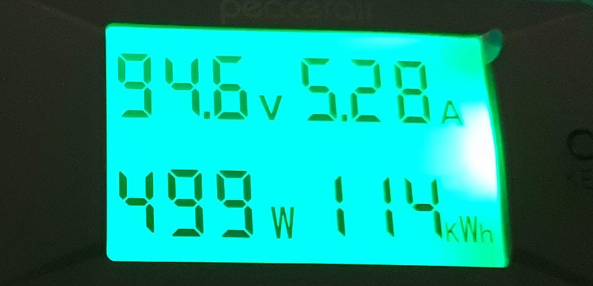
This does not mean photovoltaic glass is inherently more efficient than conventional crystalline-silicon modules. It means the electrical configuration is better suited to the load.
Instead of one or two relatively high-power modules operating at low voltage and high current, photovoltaic glazing provides a larger number of lower-power generating elements.
These can be connected electrically so that the array reaches a much more useful DC voltage while total installed power remains moderate.
Moderate power + suitable DC voltage + resistive heating + thermal storage.
That combination fits a resistive water-heating element particularly well.
Why an active MPPT is not essential here
An active MPPT converter could increase the instantaneous power transferred to the heater under some irradiance conditions by keeping the photovoltaic array closer to its exact maximum-power point.
However, the gain in instantaneous power would not translate one-for-one into additional useful annual energy. The water tank has finite thermal capacity, and once the thermostat setpoint is reached the heater stops accepting energy. Extra midday power can therefore make the tank reach its cut-off temperature earlier rather than increase annual self-consumption proportionally.
In our configuration, the photovoltaic array and the heating resistance are already sufficiently well matched that an active MPPT stage is not essential to achieve the design objective. Any additional useful gain also has to be weighed against the converter’s own consumption, conversion losses, added cost and added complexity.
The measured 499 W peak from an approximately 845 Wp photovoltaic-window system shows that useful power can already be transferred directly to the heater with a very simple architecture.
This is different from the two-conventional-panel example. With two conventional modules totaling around 800 Wp, the poorer voltage match with a 3 kW/230 V heating element makes active power conversion much more important if the objective is to extract something close to the modules’ available photovoltaic power.
Alternatively, several conventional modules can be connected in series to raise the array voltage.
But once several conventional high-power PV modules are installed, total available power becomes much larger. At that point, using an inverter and supplying multiple household electrical loads generally makes more sense than dedicating the whole array to one water heater.
That is why we see photovoltaic glazing and direct-DC water heating as a particularly natural combination.
Photovoltaic windows → direct DC → heating element → stored hot water.
This is not an argument against conventional balcony PV
Conventional balcony PV is an excellent solution and has helped make solar generation accessible to people who do not own a roof.
Nor are we saying that conventional modules cannot be used for direct-DC water heating. They can.
With enough modules in series, an appropriately selected heating resistance, or active DC/DC power electronics, conventional modules can also heat water efficiently.
The difference is that a typical balcony system consisting of one or two conventional high-power modules is not naturally matched to a standard 230 V water-heater element.
Photovoltaic glazing occupies a different electrical niche.
A façade or balcony can contain several photovoltaic glazing elements, providing the voltage needed for direct heating without simultaneously creating a multi-kilowatt PV array.
This makes the concept especially interesting for apartments.
Storing energy in water instead of a battery
The water tank also changes the way we should think about photovoltaic system sizing.
With a conventional electrical system, users often focus on reaching the highest possible instantaneous power.
For direct solar water heating, that is not necessarily desirable.
If a large PV array heats the tank completely by midday, additional production later in the day can no longer be used by that dedicated load.
A more moderate photovoltaic system can instead supply energy for many hours. The heater slowly accumulates that energy.
The important quantity is therefore not only peak watts, but useful kilowatt-hours stored during the day.
The Bucharest results illustrate this. The approximately 845 Wp photovoltaic-window system, with a measured peak of 499 W at the heater, supplied 446 kWh in the first monitored period and 462 kWh in the second.
That was enough to cover 46.7% and 43.7%, respectively, of the domestic hot water energy requirement of a four-person household.
There is also a water-saving benefit
The experiment also revealed another benefit that has little to do with photovoltaic efficiency.
Before using the local water heater, the apartment relied on centrally supplied domestic hot water.
As happens in many apartment buildings, residents had to let water run while waiting for sufficiently hot water to arrive at the shower.
In our Bucharest case study, a measurement showed a shower flow rate of 6.7 liters per minute and approximately five minutes to reach about 43°C in late September.
Based on this measurement and seasonally extrapolated waiting periods of approximately five to eight minutes, the case-study model estimated approximately 62.1 cubic meters of water per year flowing during the waiting periods for a household of four people taking one shower per person per day.
This is not a universal figure. Waiting times vary substantially depending on the building, pipe length, circulation system and operating conditions.
But the mechanism is universal.
If hot water is produced locally and stored only a short distance from the shower, the waiting time can become practically negligible.
In our case, the local 80-liter water heater therefore provides a benefit beyond solar energy: it substantially reduces water wasted while waiting for centralized hot water to arrive.
Photovoltaic glazing also acts as solar protection
Photovoltaic windows have another characteristic that conventional opaque PV modules do not have when they are simply attached to a balcony.
They become part of the building envelope.
The same glazing that generates electricity also reduces solar radiation entering the apartment.
We separately modeled this effect for the Bucharest apartment.
The south-facing glazed façade has approximately 12.9 m² of glazing, including 7.92 m² of semi-transparent photovoltaic glass.
Under the assumptions used in the study, replacing conventional clear glazing with the photovoltaic glazing reduces the solar heat gain through the overall glazed façade by approximately 40%.
For the particular apartment and air-conditioning operating assumptions used in the model, this corresponds to an estimated reduction in cooling electricity consumption of approximately 433–481 kWh per summer, with a central value of about 457 kWh.
These figures are calculated estimates, not measured air-conditioning savings. The distinction is important.
Nevertheless, the calculation illustrates a major characteristic of building-integrated photovoltaics.
The glazing can produce electricity and reduce the cooling load at the same time.
For apartments with large south-, east- or west-facing glazed areas and significant summer overheating, this secondary benefit may be particularly relevant.
Windows and balustrades are surfaces apartment residents can actually use
The roof is not the only place where a building receives solar radiation. Apartment façades receive it too.
Photovoltaic glazing can be integrated into fixed window sections, balcony enclosures or glazed balustrades.

It therefore makes use of surfaces that already have an architectural function.
This does not mean photovoltaic glazing is suitable for every façade. Orientation, shading, transparency, architectural appearance and economics all have to be considered.
But for apartments with significant sun-exposed glazing, the façade can become an energy-producing surface without requiring access to the roof.
And when that electricity is used locally for domestic hot water, the system does not need to depend on simultaneous household electricity consumption.
Keeping the architecture simple
One of the objectives of our pilot was to avoid unnecessary components.
On the photovoltaic side there is no battery and no solar inverter. The photovoltaic electricity is used in DC directly by a resistive heating element.
When solar energy is insufficient, the controller automatically switches the heater to the AC grid after sunset so that it can reach the temperature set by the boiler thermostat.
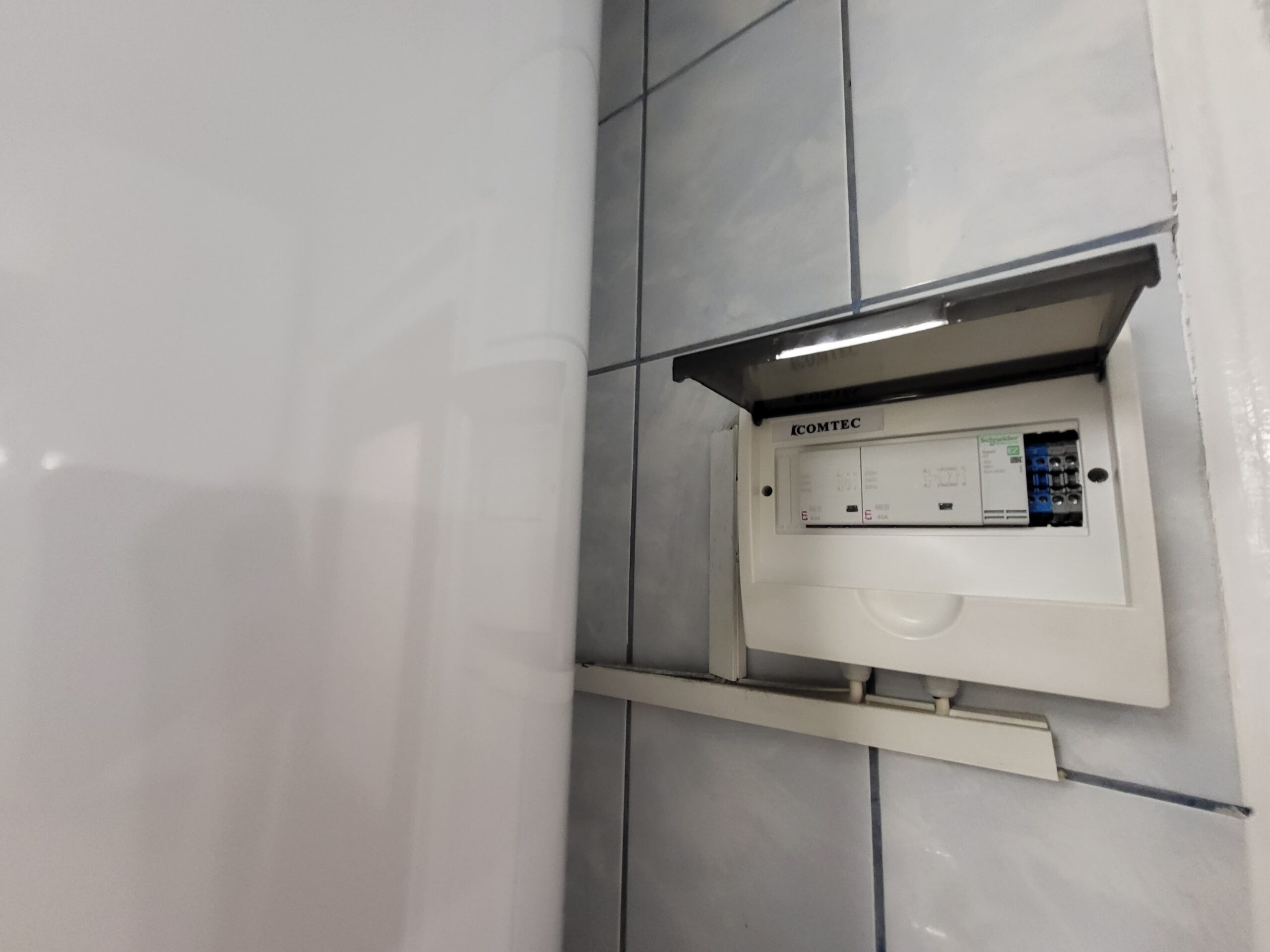
The automatic switching concept between photovoltaic DC and AC grid supply has also been included in a Romanian patent application published by the Romanian State Office for Inventions and Trademarks.
But the most important part of the concept is simpler than the switching system itself.
It is the combination of a façade-integrated photovoltaic generator with suitable DC electrical characteristics, a simple resistive load, and inexpensive thermal storage that the household already needs every day.
Apartments should be part of the solar transition
Most discussions about residential photovoltaics still begin with the roof.
That works well for detached homes. For millions of people living in apartment buildings, it does not solve the problem.
Balcony solar has already shown that apartment residents want access to their own renewable generation.
The next question is how the limited solar surface available to them can be used most effectively.
Our Bucharest pilot suggests one possible approach.
Over two consecutive measurement periods, photovoltaic windows supplied 446 kWh and 462 kWh directly to domestic hot water, covering 46.7% and 43.7% of the household’s hot water energy demand.
The household consists of four people using hot water daily.
The same installation also provides solar shading, while local hot-water production can reduce water losses associated with waiting for centralized hot water.
Most importantly, the system demonstrates that photovoltaic electricity does not always have to be converted into AC, stored in a battery or exported to the grid before becoming useful.
Sometimes the most effective storage system is already inside the apartment.
It is a tank of water.
And for photovoltaic glazing, the combination of higher useful DC voltage, moderate power and thermal storage may make direct DC one of the most natural ways to use the electricity it generates.
The most valuable solar kilowatt-hour may not be the one produced by the largest system. It may be the one generated on the balcony, stored as hot water and used by the same family a few hours later.
Monthly measurements and detailed supporting calculations are available from the author on request.
Sign up for CleanTechnica’s Weekly Substack for Zach and Scott’s in-depth analyses and high level summaries, sign up for our daily newsletter, and follow us on Google News!
Have a tip for CleanTechnica? Want to advertise? Want to suggest a guest for our CleanTech Talk podcast? Contact us here.
Sign up for our daily newsletter for 15 new cleantech stories a day. Or sign up for our weekly one on top stories of the week if daily is too frequent.


CleanTechnica uses affiliate links. See our policy here.
CleanTechnica’s Comment Policy