

Support CleanTechnica’s work through a Substack subscription or on Stripe.
Recycling. We should all do it whenever possible, but in reality, it is often cheaper to mine new materials than it is to recapture and reuse the ones we already have. One of the reasons we have single-use plastic bottles is because soft drink companies and dairies found it was far cheaper to buy billions of plastic containers than it was to collect, clean, and reuse glass bottles.
Opponents of electric cars and renewable energy work themselves into a lather over the young children in the Democratic Republic of Congo who are being poisoned while working in cobalt mines. People get all worked up about how in the future there will be millions of tons of solar panels clogging up landfills and leaching harmful chemicals into the soil. And don’t get them started on the stacks of broken wind turbine blades piling up around the world!
Fortunately, recycling lithium-ion batteries is now an established solution, so the claim by some that EV owners simply push their vehicles into the nearest lake when the batteries die is now demonstrably false. Also, recycling wind turbine blades is becoming a viable business as well.
Truthfully, there are reasons to be concerned about those issues. But the thing that rankles me is how those pious defenders of the environment are so willfully ignorant of the harm done by virtually every form of commercial endeavor. There are billions of discarded tires in dumps around the world. West Virginia and Kentucky have seen whole mountains removed and dumped into the valleys below to get at the coal buried underneath. Toxic coal ash is piling up around coal-fired generating stations all around the world and leaching poisons into the environment.
If you are going to be a defender of the environment, that’s wonderful. But at least be consistent. Don’t go to town meetings to protest about wind turbines if you aren’t going to push for an end to all pollution, not just the kind you hear about on antisocial media or Faux News. Hypocrisy is rampant in this space. We humans have to recognize that we cannot treat our planet as a communal toilet and expect to avoid the illnesses and diseases that afflict us.
In recent decades, there has been an explosion in miscarriages, birth defects, autism, cancers, heart disease, and respiratory ailments. It is disingenuous — and dangerous — to lay the blame at the doorstep of electric cars or renewable energy and ignore the other environmental harms that are part and parcel of everyday commerce. A perfect example is the damage done to people who are involved in recycling lead batteries.
Lead Recycling Is Harmful To People
Today, there are about 1.6 billion vehicles in the world, and virtually every one of them has a lead-based battery onboard. Even electric cars have them to operate the low-voltage systems that operate door locks and interior lights, although some companies like Tesla are starting to replace them with lithium-ion batteries.
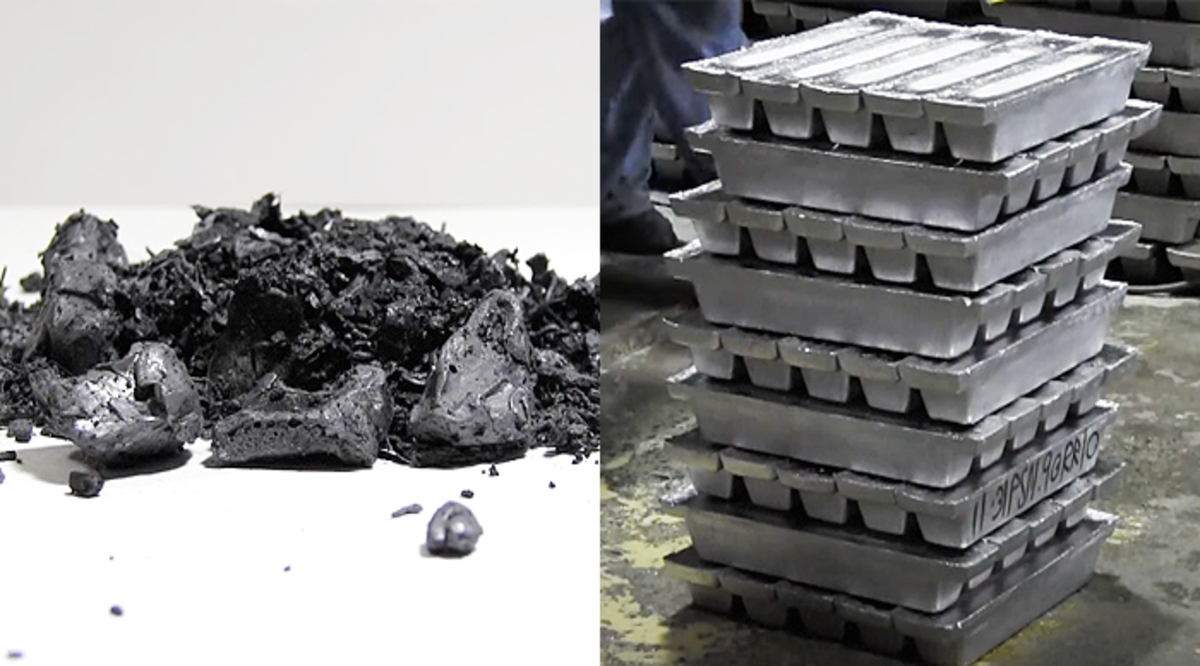
Those batteries can have a useful life of 2 to 5 years, but all of them need to be replaced at some point. What happens to the old ones when they are no longer serviceable? They get melted down to recover the lead in them, which can then be used to make new batteries. In the US, that work often gets outsourced to other countries. According to a recent report by the New York Times, Nigeria is one country that has a flourishing battery recycling sector. Mexico is another.
It is heavy, dirty work for those who have jobs in the industry. But it also takes a toll on the environment. That shouldn’t be a surprise to most folks. What may be a surprise, however, is how the auto industry has attempted to deflect attention away from the problem for decades. Just like the tobacco and asbestos industries, automakers and their suppliers have gone to great lengths to avoid demanding that recycled lead be produced in a way that is environmentally safe and does not make workers sick.
The Green Lead Initiative
“Each year, lead poisoning is estimated to kill more than 1.5 million people, most of them in developing countries,” the New York Times reports. It says in 2005, Phillip Toyne, an Australian lawyer, warned auto industry executives the lead inside car batteries was poisoning people. He had a solution — a program he called Green Lead that would verify which lead recycling operations were operating in an environmentally responsible fashion.
The Green Lead proposal was discussed within the industry, but ultimately the companies decided not to embrace it. A review of industry records and interviews with auto executives conducted by the New York Times showed that automakers and their suppliers have known about the problem with lead recycling for almost three decades.
“Time and again, car and battery manufacturers opted not to act and blocked efforts to address the problem. When the world’s largest car companies wrote their environmental policies, they excluded lead. They did so even as a patchwork of shoddy factories in Ghana, Nigeria and Tanzania provided more lead for their batteries,” the Times reports claims.
Bernd Gottselig, a retired Ford executive who was involved in talks about Green Lead, told the Times that addressing lead pollution and other environmental problems was “financially challenging” for the company. “Several ideas would have required setting up completely new and unique supply chains,” he said.
Michael Rae, who was working on a program to certify metals and minerals in the jewelry industry, was involved in some of those meetings about Green Lead. The problem was, if the companies touted Green Lead, that would imply there were other forms of lead that were not certified as responsibly processed and that could pose a public relations dilemma for the companies. “My recollection is that there was active resistance from the motor vehicle industry to the idea of saying ‘green lead’ because of the implication that there was ‘bad lead,’” Rae said.
Politics Rears Its Ugly Head
Bob Holcombe is a former director with the General Services Administration who was responsible for more than 600,000 US government vehicles. Concerned about more stringent environmental regulations applicable to motor vehicles, he contacted ASTM International and asked them for help crafting standards for battery recycling.
ASTM’s rules only required a simple majority to form a committee, and anyone who attended a meeting could vote. In December 2012, the organization was considering whether to establish a committee to look into the lead recycling issue. Stricter standards would inevitably lead to higher production costs and increased scrutiny of automotive supply chains. The industry wanted no part of those new rules.
At that time, Johnson Controls was the largest manufacturer of batteries. It sent 50 representatives to the meeting. 30 more came from other battery companies. Of the 98 people in the room, 80 were from companies in the battery industry. “It was pretty clear in the room that we had gathered to do this and then Johnson Controls decided they didn’t want it,” said James Meinert, who represented the Natural Resources Defense Council. The vote to form a committee failed.
Car Companies Look The Other Way
All major car companies now identify minerals and metals that are known to harm the environment and human health if they are obtained irresponsibly. Lead is not on many of those lists, the New York Times investigation showed.
Hyundai maintains a list of minerals that are important to the “future and environment of mankind,” and requires its suppliers to obtain those minerals ethically. General Motors has placed six metals under heightened scrutiny. Other companies ignored the requests for information from the Times or offered bland statements about their commitments to buy or recycle all products responsibly.
Volvo and Mitsubishi said they do list lead among the metals they monitor. Nissan said its policy is to phase out the use of lead “where technically feasible.” In July, Ford released its most recent sustainability report, announcing that it was “voluntarily holding itself accountable to a new level of rigor. Supply chain transparency and human rights protection go hand in hand,” Ford wrote, but its report says nothing about lead.
Steven Young, an industrial ecologist and professor at the University of Waterloo in Ontario told the New York Times that companies were motivated by reports of child labor abuse in the DRC, where much of the world’s cobalt is mined. “Some companies said, ‘Holy crap, we don’t want this in our supply chain. What can we do?’ I don’t think lead has had that moment.”
The question is, why not?
Sign up for CleanTechnica’s Weekly Substack for Zach and Scott’s in-depth analyses and high level summaries, sign up for our daily newsletter, and follow us on Google News!
Have a tip for CleanTechnica? Want to advertise? Want to suggest a guest for our CleanTech Talk podcast? Contact us here.
Sign up for our daily newsletter for 15 new cleantech stories a day. Or sign up for our weekly one on top stories of the week if daily is too frequent.
CleanTechnica uses affiliate links. See our policy here.
CleanTechnica’s Comment Policy