

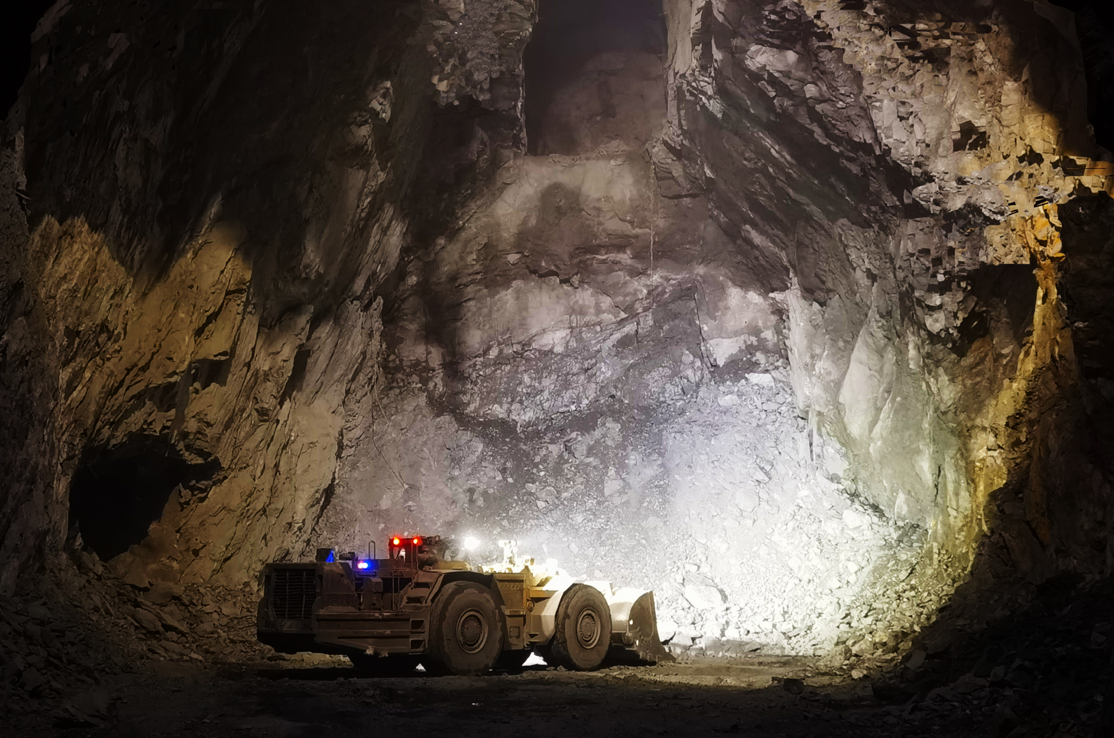
Sandfire’s MATSA Operations are located in the Huelva Province of south-western Spain –the company operates a substantial polymetallic mining complex – one of the most significant in Europe – comprising a 4.7 Mt/y central processing facility that sources ore from three underground mines, namely Aguas Teñidas and Magdalena in Almonaster la Real, and Sotiel in Calañas. The processing facility produces copper, zinc and lead mineral concentrates (containing a silver by-product) that are transported by road to the port of Huelva.
Increasingly, the mining operations have been using the latest remote control, autonomous and digital technology with a focus both on safety and productivity. IM Editorial Director Paul Moore recently had the chance to catch up in person with Sandfire MATSA’s Asset President, Rob Scargill, on this topic.
He states: “People are sometimes surprised that mining in Spain is often just as state of the art as it is in Australia or Canada. The only difference is the language – underground you have the same technology and machinery being used. At Sandfire MATSA, we are pushing the envelope where we can on both teleremote and autonomous operation of our equipment. This includes on our LHDs with RCT, on our production drills with Epiroc, but also on our underground loaders and more recently in partnership with Sandvik on our face drill jumbos as well.”
Sandfire MATSA’s Asset President, Rob Scargill
Aside from the semi-automated and automated fleet, MATSA also uses Volvo road trucks underground for haulage – these receive ore from the ore passes that are loaded by the LHDs and Scargill says have proven very robust and effective over the years.
Today MATSA runs its loaders (LHDs) – where it has a mix of five Sandvik LH621 and four R2900G Caterpillar models – using RCT’s ControlMaster® Automation solution which is well suited to a mixed fleet being OEM-agnostic. The LHDs at both the Aguas Teñidas and Magdalena operations primarily run autonomously from the load point to the dump point with mucking and dumping done with teleremote.
MATSA also utilises Epiroc ABC Total automation on six Simba production drills used at both Aguas Teñidas and at Magdalena; with the more recent Sandvik drill jumbo project involving the use of AutoMine with twin boom DD422i smart face drilling rigs – there are now two of these running at Aguas Teñidas. There is only direct intervention if there is an issue like a hole deviation plus the tramming from one face to another.
Scargill adds: “The main benefit for our autonomous production drilling systems is that we are able to keep drilling through shift changes – about 20% of our drilling today is done when the mine is empty for firing – which is three times a day. During these periods they are running fully autonomously. While we have only been running the development drill jumbo for less than a year, we are increasingly using it in automated mode during these firing periods as well.”
In addition to production and face drilling, during FY25 MATSA also completed a record 95 km of underground infill and extension drilling and developed additional ventilation and paste fill infrastructure.
Scargill: “We continue to review how remote operations and automation can add to the productivity and safety of our workforce. In addition, we are considering how machine learning and AI can provide a further wave of improvements.”
Sandfire MATSA maintains the systems on all the machines itself with input from the vendors on the technology itself including software updates and the sensors themselves. MATSA has full fibre optic WiFi throughout both the Aguas Teñidas and Magdalena mines which was done as a future proofing measure even before the automation systems were put in. It is also used for VOIP radio plus pumping and ventilation system control.
Remote control mucking with LHD using RCT’s ControlMaster®

All staff also carry a mobile phone underground which run off the WiFi are equipped with various apps including the mine safety and risk assessment systems. Supervisors also carry tablets to give them access to additional sets of reference data including short loop scheduling updates, so they know what they have to do in real time in terms of meeting shift targets.
The underground mines use the Micromine Pitram mine control and fleet management solution (FMS) for capturing, managing, analysing and optimising mine site activity.
Move to climate change and emissions targets, Sandfire has indicated in previous reports that it has considered BEV options for some underground machines; including potentially electrification of the Volvo heavy truck fleet. But like other underground operators, it is not rushing into any electric decisions until it is clear what the right path is.
Volvo trucks are used for ore haulage underground

Scargill: “We are still looking at how to best apply available low or zero emissions technology to meet our Scope 1 goals with a lot of planning and studies ongoing. Sandfire was very involved with the Electric Mine Consortium in Australia, for example, so we learnt a lot from that plus of course we are regularly talking to the major OEMs and other technology providers about what is out there and how fast things are moving. We will make a move when it is appropriate for us to do so based both on what is operationally realistic.”
He adds: “In some cases today, introducing battery power would mean a reduction in payload so clearly that is something we need to keep in mind, as we need to maintain our current efficiency levels. And that applies to battery charging and changing as well – as most of the options today involve different battery types, sizes and chemistries across different machines even within the same OEM. We are saying within our fleet, where would be get the most value in going electric. And some of that value isn’t just in diesel reduction, it is also in diesel particulate reduction from reducing the amount of diesel engine idling – this applies to a lot of utility machines from chargers to shotcreters to light vehicles, so these are a current consideration for us as well.”
Scargill concluded: “As a company we are committed to decarbonising our business. But for an all-electric mine, including the primary loading and haulage, we don’t currently see a viable pathway to it with currently available technology.”
However, he did say that there a lot of potential opportunities to reduce diesel use on surface, such as the trucks that currently haul on surface for 8 km from the Magdalena mine to the plant. This could be achieved by rehandling the ore and switching from diesel to electric trucks in the area where the trucks emerge from the decline and could allow consideration of more options as there is no longer restriction of the heading size – such as using larger trucks or even a pantograph system. “On surface its an easier option as we are not moving 40 t 630 vertically, we are running the trucks on flat roads so the power requirements in that duty cycle are much lower.”
On Scope 2, Sandfire MATSA has made big wins already. It has advanced two power related initiatives in support of GHG emissions reduction targets. At MATSA, permitting of a 33 MW solar facility has been completed and it is expected to be operational in FY27 working closely with Endesa. While this investment won’t improve the emissions profile, as 100% of MATSA’s needs are already currently met by renewable sources purchased directly from the grid, it will provide even greater energy security at a very competitive cost.
Looking at overall production, MATSA copper equivalent production is expected to rise in FY26 by 2%, within a range of 91,000 t to 101,000 t, with the processing facility expected to achieve record plant throughput of 4.6 Mt. Contained copper production is expected to remain largely unchanged at approximately 55,000 t, while contained zinc production is forecast to increase by 9% to 99,000 t, with an 11% increase in poly ore feed anticipated across the year.
Recently the mine had a visit from the Ministerio para la Transición Ecológica y el Reto Demográfico (MITECO) and the Junta de Andalucía, after having been recognised as the first mining company in Spain to obtain an Energy Savings Certificate (CAE). This distinction, awarded by MITECO, recognises actions that promote energy efficiency and contribute to the transition towards a more sustainable production model. Scargill pointed out during the visit: “This recognition reflects our commitment to promote modern, responsible and efficient mining, which adds value to communities and the socioeconomic development of the territory.”
The post Sandfire MATSA – deploying the latest tech in the Iberian Pyrite Belt appeared first on International Mining.