

Saudi Arabia’s surface mining industry is growing rapidly, and contracting groups are playing an important role in providing mining services both to Maaden as the leading mine owner and operator in the Kingdom, but also to others. IM Editorial Director Paul Moore here reviews the three leading surface contractors in the country – Jac Rijk Al-Rushaid, EPSA and Saudi Comedat.
Their activities are today focused on phosphate and gold mining operations but in the future there are obviously other opportunities in other commodities as the mining industry in the Kingdom grows and develops.
Starting with phosphate, there is a very vertically integrated phosphate business model in Saudi Arabia. Phosphate mining takes place at the Al Jalamid and Al Khabra sites in the far north of the country, which produce approximately 11 Mt/y and 12 Mt/y of phosphate ore, respectively. Ore from Al Jalamid is transported 1,200 km to Ras Al Khair for processing into phosphate fertiliser. Meanwhile, ore from Al Khabra is processed into phosphate concentrate at the Wa’ad Al Shamal industrial city, then railed to Ras Al Khair for processing into phosphate fertiliser.
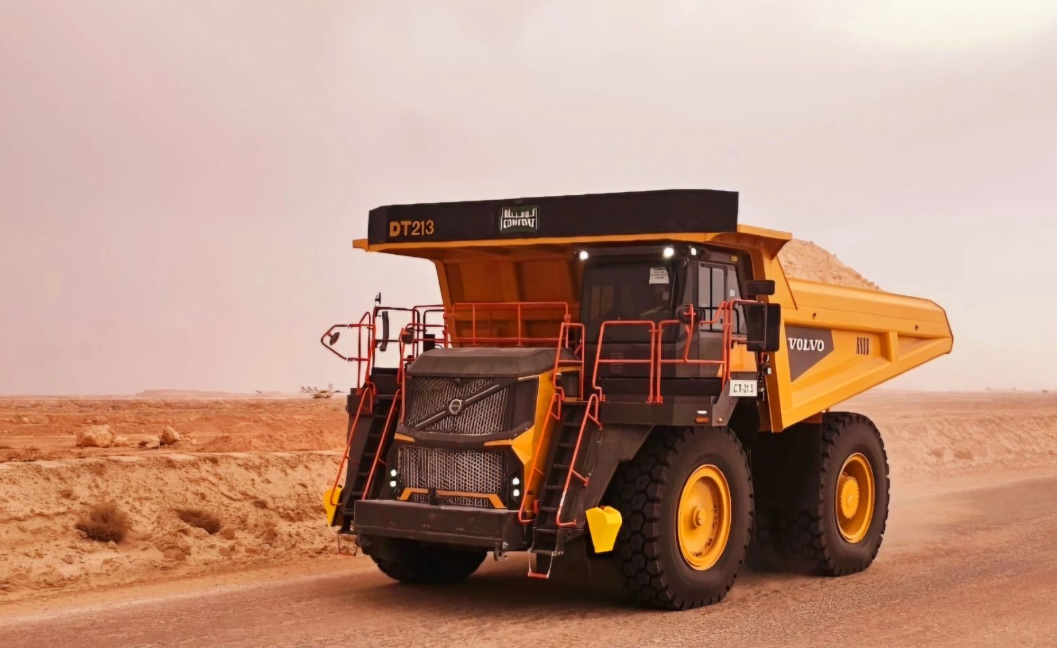
Contractor Saudi Comedat operates the Al-Jalamid mine which is located near to the Kingdom’s borders with Iraq and Jordan in the northern province. The contractor is mining around 27-30 MBcm per year of material – both overburden and phosphate. That makes it the largest single mine in the Kingdom in terms of volumes of material moved.
Comedat has a training program with the Saudi Mining Polytechnic where it works with them to train up 50 students – and as of 2025 this has been divided 50-50 between men and women which is an indicator of how women are increasingly becoming part of heavy industry employment sector in the Kingdom. This has involved changes to allow for cultural norms in the country – such as the female workers have their own accommodation camp – and all the contractors – not just Comedat are on this road – but it represents a major step forward.
Comedat is looking at a number of different technologies to help optimise its mining fleet operations. These include the latest fleet management and data management system technology but it has also deployed simulators to help in training and recruitment of operators.
One of its core competencies is an ability to maintain its mining equipment to a very high standard – allowing it to run for as long as possible at a high performance level thanks to major refurbishment programs, with a lot of its own rebuilds done onsite in its own maintenance shop, which includes using OEM rebuild kits from Caterpillar and others. It has an O&K RH120 excavator with more than 100,000 hours – which is still providing high uptime and availability.
The Comedat truck fleet is going through an upgrade process at the moment – it had 40 Terex TR100 trucks which were operating for some years but in 2023 it began replacing these with 10 new Volvo R100 trucks and in 2025 added another 11 of these units, making it one of the largest single mine users of this truck globally. Overall, the Al-Jalamid mine requires around 35 trucks to maintain its required production levels – so once the latest batch of R100s is all running, 21 of those will be R100s and the remaining 14 the remaining Terex TR100 machines. In 2025, Comedat also added a nearly new Caterpillar 6030 hydraulic face shovel to its fleet which joined the older RH120 machine and another Caterpillar 6030. The mine also has Cat 992 wheel loaders and D9 dozers.
The next big move for phosphate mining in the Kingdom is the Phosphate 3 expansion, for which the contract was awarded to a second major contracting company – Jac Rijk Al-Rushaid – in February 2025. Phosphate 3 will increase Saudi Arabia’s total phosphate production capacity to 9 Mt annually. Jac Rijk Al-Rushaid’s extensive portfolio already includes major gold projects at As Suq, Ad Duwayhi, and Mansourah & Massarah, as well as significant participation in NEOM’s The Line and Connector Projects.
Jac Rijk Al-Rushaid operated Cat 6018 hydraulic shovel
The JV between Al-Rushaid Group and Jac Rijk BV brought together two partners – one local and one international. Jac Rijk, a Netherlands headquartered company had already been successfully operating mines in Africa for eight years along with other locations including Suriname in South America as well as in Germany. The original project won by the JV was in 2012 at the As Sug gold mine initially development and then into production in 2014.
After that it has grown in the Kingdom organically, and was given a second gold project at Ad Duwayhi. And then most recently it was entrusted with the gold mining at Mansourah and Massarah. This is currently by some distance the largest gold mine in the country. The JV provides a full service in terms of drill and blast, ore and waste load and haul, haul road construction and other infrastructure development, general fleet operations and maintenance plus some mine technical design.
Jac Rijk Al-Rashaid has a large fleet – it is Saudi Cat dealer Zahid Cat’s largest customer for reference and its mining division has grown along with them. Its line-up includes 100 t class Cat 777 trucks plus smaller 775/773 models as well as 740 ADTs; along with hydraulic excavators up to 300 t – the Caterpillar 6030 – as well as the 6020, 6018 and 6015 plus the Komatsu PC1250 and PC850 as well as others. Plus a Sandvik DI650i Leopard/ DP1100 and Epiroc T35 crawler drill fleet and an auxiliary fleet of Cat D8 and D9 dozers as well as a powerful wheel loader fleet including the Komatsu WA500, Cat 980L and Cat 966H.
This includes all service and support – any major refurbs and rebuilds are done by the OEMs with associated warranties. The contractor also works with third party companies the client is engaging with on certain technologies – for example Hexagon’s Operator Alertness fatigue management system is installed on a number of its machines plus it is using their OP Pro fleet management system (FMS). These run off the mine’s 5G network which is from STC using Huawei technology. Together with the customer, it is also using AI platforms to analyse all the FMS and other data which is producing impressive reporting results – and this is on top of the usual benefits from FMS like better scheduling, optimisation and utilisation plus things like fuel efficiency. And it is using Hexagon’s Blast Movement Monitoring to precisely plan and carry out blasting on-site, using fewer explosives.
Jac Rijk Al-Rashaid has invested significantly in its operations in the Kingdom and in fleet terms sources new equipment where possible, but also carries out a lot of rebuilds and refurbs. The oldest equipment at Mansourah and Massarah has about 14,000 hours but at other sites it has machines with over 40,000 hours.
The third main player in Saudi surface contracting is Spanish company EPSA, which is the contractor at the Al-Khabra phosphate mine where it utilises a fleet of Komatsu HD785-7 mining trucks. EPSA is also the contractor at Sukhaybarat gold mine and like Jac Rijk Al-Rushaid is also involved in the NEOM project. Its equipment fleet also includes large hydraulic excavators like the Komatsu PC2000 and PC5500 plus the Liebherr R 9350.
EPSA entered the Middle East market, including Saudi Arabia, in 2011

Looking to future opportunities and staying with gold, Ar Rjum is a Tier 3 gold asset for which a Final Investment Decision (FID) was made in 2025 – and in October Bechtel was named as the EPCM and is managing the development of the open-pit mine and processing facility in the Makkah Region. It is approximately 200 km northeast of Ta’if and is projected to produce 3.6 Moz of gold over a 12-year life of mine period. The project will include an open-pit operation and a state-of-the-art processing facility capable of handling a throughput of 8 Mt of ore. The mining contractor for Ar Rjum has yet to be announced.
Long term, a lot of major mining houses from ERG to Zijin, First Quantum, Hancock, Vale, Ivanhoe Mines and others are also investing in potential future projects and opportunities, there is huge potential for more surface contracting in the Kingdom – as well as underground. Byrnecut has been working at the Jabal Sayid underground copper mine for over 15 years, most of it with the Jabal Sayid Joint Venture between Maaden and Barrick which was set up in 2014.
Of course, contracting has its challenges and one of those today is the diesel price in Saudi Arabia which went up by over 44% for 2025 compared to 2024 – and in the medium term may see contractors look towards battery or hybrid machines, especially as there is a rapidly increasing availability of renewable power at the mines. This also ties into Maaden long term commitments to sustainability – which are carbon neutrality by 2050, and a 60% reduction in Scope 1 & 2 GHG emissions intensity by 2040. Maaden recently joined the ICMM and has therefore also committed to ICMM’s Mining Principles which define good practice Environmental, Social and Governance (ESG) requirements for the mining industry through a comprehensive set of 40 performance expectations.
The post Saudi Arabia’s surface contract miners appeared first on International Mining.