
Scientists Discover Hybrid State of Matter in Molten Metal Nano-Droplets Where Solids Meet Liquids

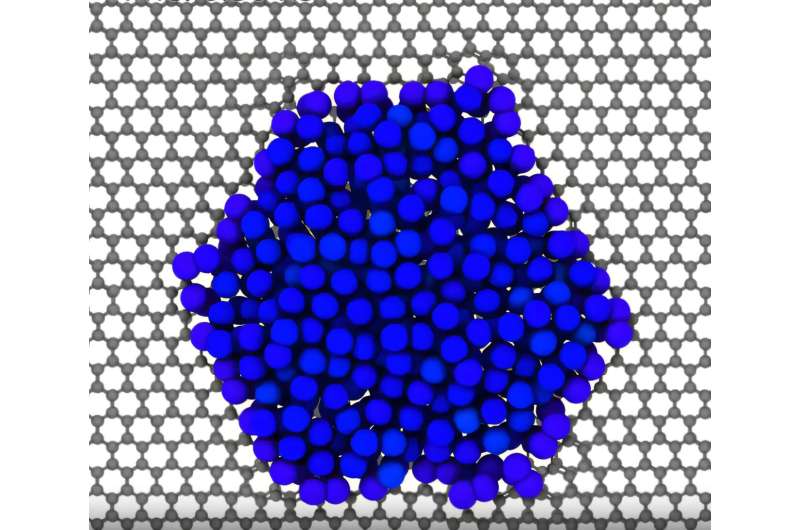
In a groundbreaking advancement in materials science, researchers have identified a new hybrid state of matter within molten metal nano-droplets—one that blurs the line between solid and liquid. The discovery provides unprecedented insights into how matter behaves at the nanoscale and could open new pathways for innovations in electronics, energy storage, and advanced manufacturing.
The research team found that when metal droplets are shrunk to the nanometer scale and heated to a molten state, they begin to exhibit both solid-like and liquid-like characteristics simultaneously. Unlike conventional melting, where a material transitions completely from solid to liquid, these nano-droplets retain ordered atomic structures even as they flow and reshape.
Scientists describe this phenomenon as a “dual-phase nanoscale state,” where atoms at the surface behave like a liquid, while atoms in the interior maintain a rigid, lattice-like arrangement—creating a hybrid state not previously observed in metals.
“This is a truly unique form of matter,” one of the lead researchers explained. “It challenges traditional definitions of solid and liquid phases and gives us a new lens through which to study material behavior at extremely small scales.”
The findings have immediate implications for several high-tech sectors. Controlled nano-droplets could enhance precision in semiconductor fabrication, improve nanoscale 3D printing techniques, and enable new types of catalysts or heat-resistant coatings. Moreover, understanding this hybrid state could help scientists design materials that function reliably under extreme temperatures or conditions.
Researchers plan to continue exploring the thermal, electrical, and structural properties of this newly discovered phase to determine how it can be harnessed for real-world applications.
The breakthrough marks a major step forward in the ongoing quest to uncover and understand the exotic states of matter that emerge at the smallest scales.