

Support CleanTechnica’s work through a Substack subscription or on Stripe.
Or support our Kickstarter campaign!
In a study published January 14, 2026, in the journal Advancing Earth And Space Sciences, an international team of researchers examined all current geoengineering proposals to assess what their impact on the ocean might be. One of the strategies they examined involves cultivating the growth of seaweed. Why? Because just like trees on land, seaweed is a living organism that soaks up carbon dioxide when it grows. More seaweed can sequester more carbon.
Now a new study by researchers at the University of South Florida published on January 19, 2026, finds the ocean may be geoengineeering itself. Here are the three principal findings contained in that report:
- AI analysis of 20 years of satellite data shows floating macroalgae blooms expanding worldwide, with rapid growth beginning around 2008–2010.
- The researchers used deep learning and high-performance computing to detect algae that often make up less than 1 percent of a satellite pixel — a task not possible without artificial intelligence.
- While floating algae can support marine life offshore, large blooms threaten coastal ecosystems, tourism and local economies when they reach shore.
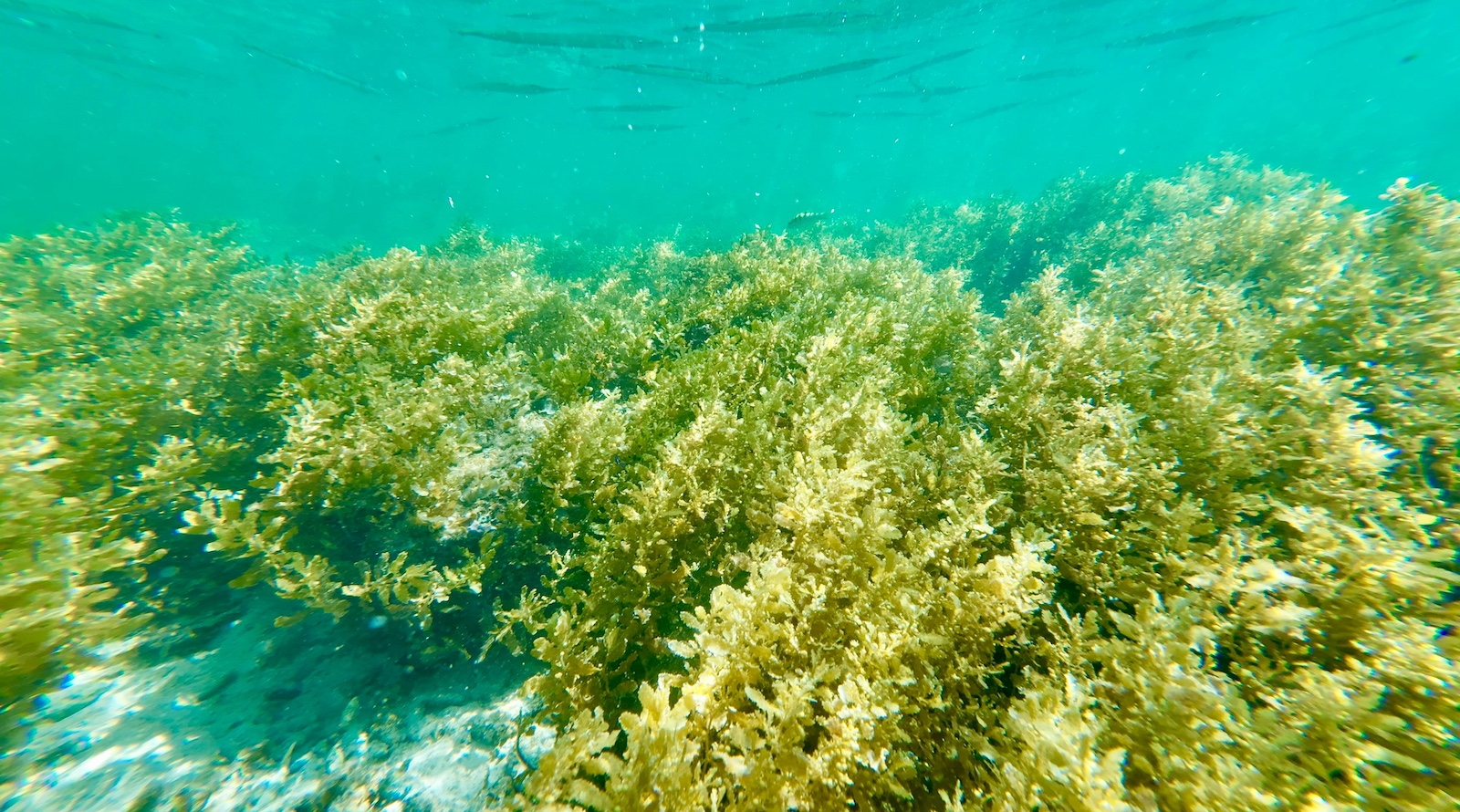
“While regional studies have been published, our paper gives the first global picture of floating algae, including macroalgal mats and microalgal scum,” said Chuanmin Hu, professor of oceanography at the USF College of Marine Science and senior author of the paper. “Our results show that the global ocean now favors the growth of floating macroalgae. Before 2008, there were no major blooms of macroalgae [seaweed] reported except for sargassum in the Sargasso Sea,” he said, “On a global scale, we appear to be witnessing a regime shift from a macroalgae-poor ocean to a macroalgae-rich ocean.”
Hu refers to macroalgae such as seaweed as a double-edged sword. In open water, they can provide critical habitat for marine life and have a positive impact on fisheries while serving as nurseries for many species. But once the algae reach coastal waters, the decaying biomass can cause considerable harm to tourism, economies, and the health of people and marine life.
The Spread Of Seaweed

The Guardian reports the best known example of large seaweed areas is the Great Atlantic Sargassum Belt, which stretches from the Gulf of Mexico to the mouth of the Congo River. It is so large, it can be seen from the International Space Station. Other blooms include a ring around the Chatham Islands off the coast of New Zealand and the “red tide” that has occurred along the Gulf coast of Florida.
Shhhh … don’t tell Ron InSanetis, the governor of Florida who has forbidden all state agencies — including institutions like USF — to utter the words “climate change” or “global heating.” If we close our eyes, block our ears, and stamp our feet, maybe all this hoopla about an altered environment will just go away. And please don’t tell him some guy with a foreign sounding name is employed at a state university. He will send his personal goon squad to arrest him and transport him to Alligator Alcatraz!
The First Global Picture
The researchers say their study provides the first global picture of algae floating in the world’s oceans, and found that seaweed blooms increased in area by 13.4 percent a year over the period examined. Blooms of microalgae, such as phytoplankton, also increased, but at a much more modest rate of just 1 percent a year.
“What is noteworthy is that most increases in both floating macroalgae and microalgae scums occurred in the recent decade, in line with the accelerated global ocean warming since 2010,” the authors wrote. They identified tipping points in 2008, 2011, and 2012 for three types of seaweed in different oceans. However, while seaweed such as sargassum has thrived in some regions, phytoplankton have not shown similar responses to the changing environment, suggesting their growth may be more sensitive to shifts in temperature and eutrophication.
The study attributed the bloom expansions to both human activities, such as nutrient runoff into the ocean, and climate variability such as ocean warming, while acknowledging that the reasons may differ among regions.
Science bashers hate such wishy washy findings. “Is it runoff or is it hotter ocean water? You don’t know, do you? Therefore your work is just a scam designed to attract more research funding. Get back to us when you know the answer for certain. Until then, leave is alone!” It isn’t easy being a scientist in an age when attacks on science are rampant.
The Blue Economy
On the other side of the country, a different group of researchers from the University of California, San Diego’s Scripps Institution of Oceanography published their findings in the journal Nature about how damage to the ocean has far greater economic impacts on the global economy than most people realize. As reported by ArsTechnica, global coral loss, fisheries disruption, and coastal infrastructure destruction are estimated to cost nearly $2 trillion annually, which could fundamentally change how we measure climate finance.
“For decades, we’ve been estimating the economic cost of climate change while effectively assigning a value of zero to the ocean,” said Bernardo Bastien-Olvera, who led the study during his postdoctoral fellowship at Scripps. “Ocean loss is not just an environmental issue, but a central part of the economic story of climate change.”
The social cost of carbon is an accounting method for working out the monetary cost of each ton of carbon dioxide released into the atmosphere. “[It] is one of the most efficient tools we have for internalizing climate damages into economic decision-making,” said Amy Campbell, a United Nations climate advisor and former British government COP negotiator. Those calculations have historically been used by international organizations and agencies like the Environmental Protection Agency to assess policy proposals.
A directive from the alleged president of the United States in 2025 instructed federal agencies to ignore the social cost of carbon when making any cost-benefit analyses unless specifically required by law. Apparently ignorance is a vital part of making America great again. “It becomes politically contentious when deciding whose damages are counted, which sectors are included and most importantly how future and retrospective harms are valued,” Campbell said.
A Vital Link
In the introduction to the study, the researchers wrote, “The ocean is key to a thriving society. It provides a range of benefits that support market economies and sustain livelihoods and well being. Some economic benefits derived from the marine environment, such as seafood and maritime transportation, are traded in markets, and their value is observable in market prices. Others are not traded in markets, and their economic values are not directly observable. For example, coastal protection, recreational activities and the values that people place on the existence of marine biodiversity.
“In response, a growing body of academic and policy-oriented literature on the multifaceted concept of the ‘blue economy is highlighting the need for comprehensive frameworks that reflect the critical interdependence of the oceans, people and the economy.
Blue capital can include “fish biomass, living coral coverage, mangrove coverage, and seaports,” for example. Such blue capital provides benefits on a regional or country scale. “The magnitude and composition of ‘blue capital’ is distributed across geographies and socioeconomic groups, but the importance of ‘blue capital’, as a share of GDP, to the economy tends to be highest in low income countries.” Those would be “shithole countries,” according to the Supreme Leader in Washington.
Two thirds of the surface of the Earth is covered by water, yet we know less about the ocean that surrounds us than we do about the dark side of the moon. Ignorance will not prove to be an effective tool for managing the future.
Featured photo by Philippe WEICKMANN.
Support CleanTechnica via Kickstarter

Sign up for CleanTechnica’s Weekly Substack for Zach and Scott’s in-depth analyses and high level summaries, sign up for our daily newsletter, and follow us on Google News!
Have a tip for CleanTechnica? Want to advertise? Want to suggest a guest for our CleanTech Talk podcast? Contact us here.
Sign up for our daily newsletter for 15 new cleantech stories a day. Or sign up for our weekly one on top stories of the week if daily is too frequent.
CleanTechnica uses affiliate links. See our policy here.
CleanTechnica’s Comment Policy