
Southeast Asia Has 5 Proposed Subsea Power Cable Projects By 2040 — But The First Link It Needs Is Governance

Support CleanTechnica’s work through a Substack subscription or on Stripe.
The technical case for subsea power cables connecting Southeast Asia’s electricity systems has long been established. The next challenge is ensuring that governance arrangements evolve alongside the growing scale and complexity of regional electricity integration. A new analysis from Ember finds that ASEAN’s cross-border electricity ambitions will require stronger regional planning, structured approaches to cost allocation and greater coordination across the maritime domain.
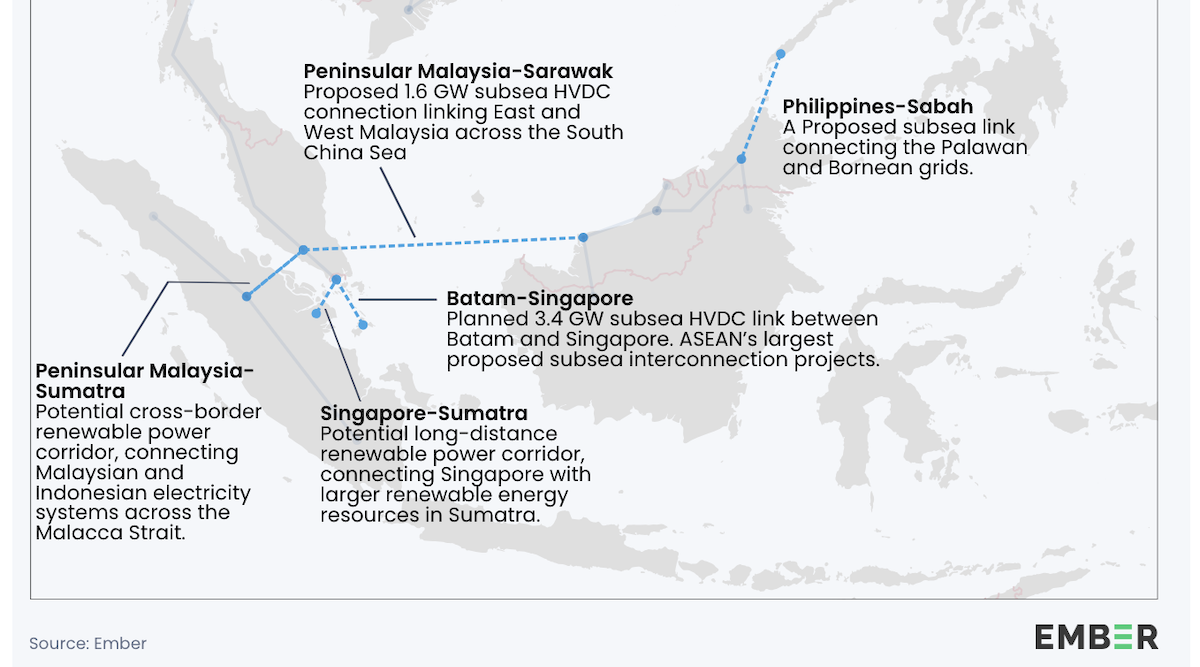
The ASEAN Interconnection Masterplan Study III identified 18 new and existing interconnectors needed to more than double the region’s interconnector capacity from its current 7.7 gigawatts by 2040. Delivering that scale of expansion will require building on existing regional frameworks and translating political commitment into more operational and continuous mechanisms for project development and implementation.
“The challenge of cross-border subsea interconnection in ASEAN is increasingly institutional rather than purely technical. Getting this right would deliver broad benefits across ASEAN by strengthening energy security, improving access to diverse and lower-cost energy resources, enabling cross-border trade, and supporting a more coordinated transition toward low-carbon growth.” —Alnie Demoral, Energy Analyst at Ember
Southeast Asia holds abundant but unevenly distributed renewable energy resources: hydropower concentrated in the Mekong subregion, rapidly expanding solar capacity and growing offshore wind potential. Subsea cables can move that clean electricity from where it is generated to where it is needed, enabling countries to reduce costly fossil fuel imports, lower total system costs and accelerate decarbonisation. Interconnectors linking Great Britain with neighbouring European markets already generate commercial trading value of approximately €375 million per year, rising to around €500 million annually when forward trading, capacity value and ancillary services are included.
ASEAN’s geography makes the case even more compelling. Indonesia and the Philippines are archipelagic nations where subsea transmission is already essential for domestic system integration. The Philippines has long used high-voltage direct current connections to link its major island grids. Drawing on Europe’s experience — home to approximately 25 operational submarine power interconnectors with a combined capacity of roughly 22,290 megawatts as of 2025 — the report identifies three interlocking gaps that must be addressed together.
The first is regional planning: the ASEAN Interconnection Masterplan Study provides an important foundation for identifying interconnection opportunities across the region. As projects become larger and more interconnected, stronger mechanisms for project prioritisation and investment sequencing could help ensure that investments are developed in a way that maximises regional system benefits. That planning function is closely linked to the second gap: cost allocation.
A clearer understanding of the system-wide benefits of interconnection projects provides the basis for determining how costs and benefits can be shared among participating countries. Without a shared analytical framework, the costs and benefits of multilateral projects like the proposed Brunei Darussalam-Indonesia-Malaysia-Philippines Power Integration Project may require lengthier project-by-project negotiations to establish appropriate cost-sharing arrangements, increasing transaction costs and extending project development timelines.
Both gaps are further complicated by a third: subsea cables traverse territorial waters, exclusive economic zones and sea spaces shared with shipping, fisheries and telecommunications infrastructure. This requires coordination across maritime, environmental and other relevant authorities alongside energy institutions, expanding the range of stakeholders involved in project development. The report recommends operationalising the ASEAN Power Grid Generation and Transmission Planning function as the primary near-term priority, with structured cost-benefit methodologies and a dedicated submarine cable working group built on that foundation.
Europe’s own governance frameworks evolved over decades, through incremental learning and policy adaptation, and remain incomplete today. What made that evolution work was the establishment of continuous, adaptive institutions capable of responding as complexity grew.
“As ASEAN advances the operationalisation of the Enhanced ASEAN Power Grid and the development of the ASEAN Submarine Power Cable Framework, this report offers timely and valuable insights on how governance can enable more complex cross-border energy infrastructure. Europe’s experience underscores an important lesson: the success of subsea power cable development depends not only on technological feasibility, but equally on effective coordination in planning, regulation, financing, and maritime governance.” —Undersecretary Felix William “Wimpy” B. Fuentebella, Philippine Chair and SOE Leader
ASEAN already has the foundations. The enhanced ASEAN Power Grid Memorandum of Understanding, signed in 2025, reflects a renewed political commitment to regional energy integration. The ASEAN Centre for Energy, HAPUA, and the APGCC provide credible institutional anchors. The opportunity now is to build on these foundations and strengthen the governance arrangements needed to support the next phase of regional electricity integration.
Article from Ember. Creative Commons Attribution License (CC-BY-4.0).
Sign up for CleanTechnica’s Weekly Substack for Zach and Scott’s in-depth analyses and high level summaries, sign up for our daily newsletter, and follow us on Google News!
Have a tip for CleanTechnica? Want to advertise? Want to suggest a guest for our CleanTech Talk podcast? Contact us here.
Sign up for our daily newsletter for 15 new cleantech stories a day. Or sign up for our weekly one on top stories of the week if daily is too frequent.


CleanTechnica uses affiliate links. See our policy here.
CleanTechnica’s Comment Policy