


Support CleanTechnica’s work through a Substack subscription or on Stripe.
Here is a story about how a few words from a dictator can have powerful consequences. Recently, the so-called president of the United States visited Japan. While there, he noticed those cute little kei cars that are so popular with Japanese motorists. The cars are diminutive in size and engine power, but they are affordable and exempt from many restrictions that apply to other vehicles in Japan.
Wikipedia says a kei car — short for kei-jidōsha or light vehicle — is the smallest category of expressway-legal motor vehicles in Japan.
“The kei category was created by the Japanese government in 1949 to stimulate both car ownership and growth of Japan’s car industry. The regulations were revised multiple times, but since October 1998 the law consistently specifies a maximum vehicle length of 3.4 m (11.2 ft), width of 1.48 m (4.9 ft), height under 2.0 m (6.6 ft), and engine displacement under 660 cc (40.3 cu in). A “gentleman’s agreement” between Japanese automakers and lawmakers also set a maximum power output of 64 PS (63 hp; 47 kW).”
In Japan, new kei cars sell for about $10,000 and used ones go for around $5,000. Under current rules, the used cars can be imported to the US if they are more than 25 years old, and an active group of US citizens have done just that. The kei trucks, with their fold-down sides on the load bed, are especially popular with those who need a vehicle that can haul small loads efficiently.
Kei cars were Japan’s answer to the destruction of its manufacturing base after World War II. In Europe, German and Italian manufacturers also brought micro-cars to market in the post-war era, cars like the Messerschmidt, the FIAT Cinquecento, and the Isetta, the iconic “bubble car” built under license by BMW that passengers entered and exited via a door that was essentially the entire front of the car and had the steering wheel attached to it.
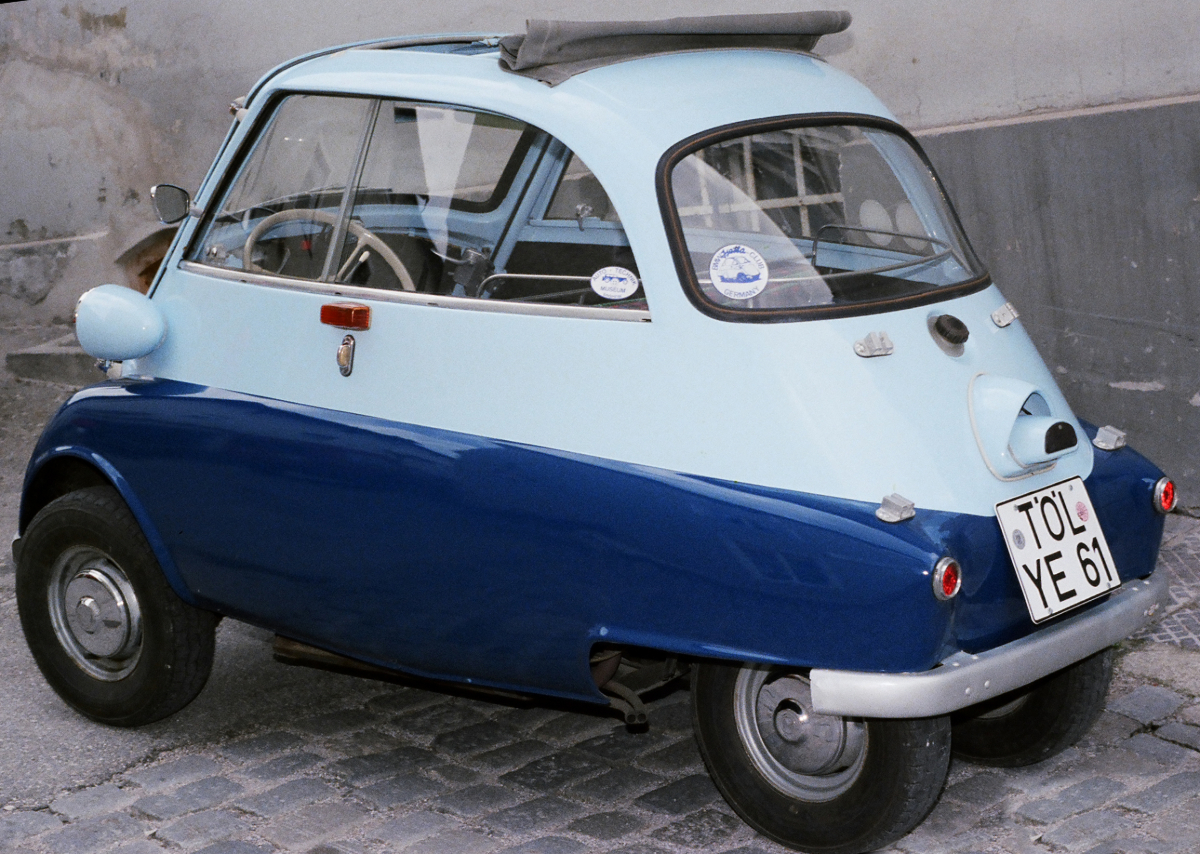
It’s hard to believe that mighty BMW once depended on such humble beginnings following the war for its very existence. By the same token, making kei cars was the basis for the flourishing auto manufacturing powerhouse Japan has become.
How Cute Became A Political Meme
According to the New York Times, when the president saw these diminutive vehicles flitting around Tokyo, he said they were “really cute” and “sort of like the Beetle used to be.” On December 6, 2025, he posted on his personal antisocial media channel, “I have just approved TINY CARS to be built in America.”
At his big meeting with the representatives of the US auto industry, called to celebrate the rollback of exhaust emission standards, he mused about whether America should be building such cars. Sean Duffy, the prancing poodle picked to head the Transportation Department after he came to the attention of the president due to his prowess as a Faux News host, immediately leapt to further ingratiate himself with his boss by telling CNBC they were “much more affordable than other options that are on the market today.”
Indeed they are, but so are cars manufactured in China, which are excluded from the US market. The question of affordability has become part of the political conversation ever since the puling potentate of the Potomac decided to impose grotesque tariffs on most of America’s allies, driving up the cost of just about everything Americans buy.
The Affordability Mirage
The average price of a new car in the US today is now more than $50,000. The MAGAsphere likes to blame that on electric cars, failing to notice that they are just a small fraction of the new car market today. In fact, that same decision by the administration to roll back emissions standards have given US automakers a license to build the biggest, thirstiest, most expensive vehicles possible and they intend to do precisely that while they laugh all the way to the bank.
The folks at Stellantis were part of that confab in the Offal Office, and they quickly carried the news back to their headquarters that the president of the United States was smitten with cars that are small and “cute.” Within days, the powers that be in the home office announced they had decided to import the oh-so-cute FIAT Topolino (“little mouse” in Italian) to the US.
The Topolino is a rebadged Citroën Ami. It features one 8-horsepower electric motor and a tiny 5.5 kWh battery. Doors are an option, although will probably be standard equipment for US versions. Short does not adequately describe the Topolino. It is less than 100 inches long — 43 inches shorter than the already diminutive Fiat 500e.
In Europe, the car is technically a quadricycle, which means it can be driven by people as young as 14 in some countries. Now here’s the kicker. The car has a top speed of 28 mph, which means it cannot legally travel on public roads where the speed limit is 35 mph or higher. There are golf carts that are faster. Many states have a category for so-called neighborhood electric vehicles and gasoline-powered quadricycles and they are quite popular in some communities that are large enough to have their own private roads, such as The Villages in central Florida.
The Topolino sells in Europe for around $12,000. Sharp-eyed readers will note that BYD and other Chinese manufacturers offer real electric vehicles for less than that price, many of which come with a full assortment of driver assistance features. If the objective is to offer Americans more affordable vehicles, those cars would make the most sense, but of course common sense is in markedly short supply in the US today.
During Art Week in Miami last week, Fiat CEO Olivier François told the audience, “I’m happy to share that we’ll be bringing the Fiat Topolino to the U.S., with more details to come next year.” He said the little car has been “creating tremendous excitement among consumers.”
Well, maybe. If the question is cuteness, the Topolino is a sure winner. But if the question is a practical transportation module that is suitable for most daily driving situations, that initial enthusiasm may become somewhat muted. We can only guess what the asking price for the Topolino might be after taking into account shipping costs and tariffs, but around $15,000 seems a distinct possibility.
Will Topolino Move The Needle On FIAT Sales In The US?
FIAT would love to gain a foothold in the US market again. Last year it sold fewer than 2000 vehicles in America. While Olivier François insists the decision to bring the Topolino stateside has nothing to do with the president’s recent remarks about cute cars, the timing suggests otherwise.
The chatter around the froyo machine in the CleanTechnica writers lounge is that FIAT might sell a few thousand of these in the first year to gawkers and those who absolutely need to have the latest new things, but that will likely dwindle to a few hundred in the second year and a few dozen in the years that follow.
If the goal is to bring more affordable cars to American showrooms, this is about the least effective way to accomplish it. That is par for the course from this administration, which reminds us more and more of the movie about the Mafia entitled The Gang That Couldn’t Shoot Straight.
Sign up for CleanTechnica’s Weekly Substack for Zach and Scott’s in-depth analyses and high level summaries, sign up for our daily newsletter, and follow us on Google News!
Have a tip for CleanTechnica? Want to advertise? Want to suggest a guest for our CleanTech Talk podcast? Contact us here.
Sign up for our daily newsletter for 15 new cleantech stories a day. Or sign up for our weekly one on top stories of the week if daily is too frequent.
CleanTechnica uses affiliate links. See our policy here.
CleanTechnica’s Comment Policy