

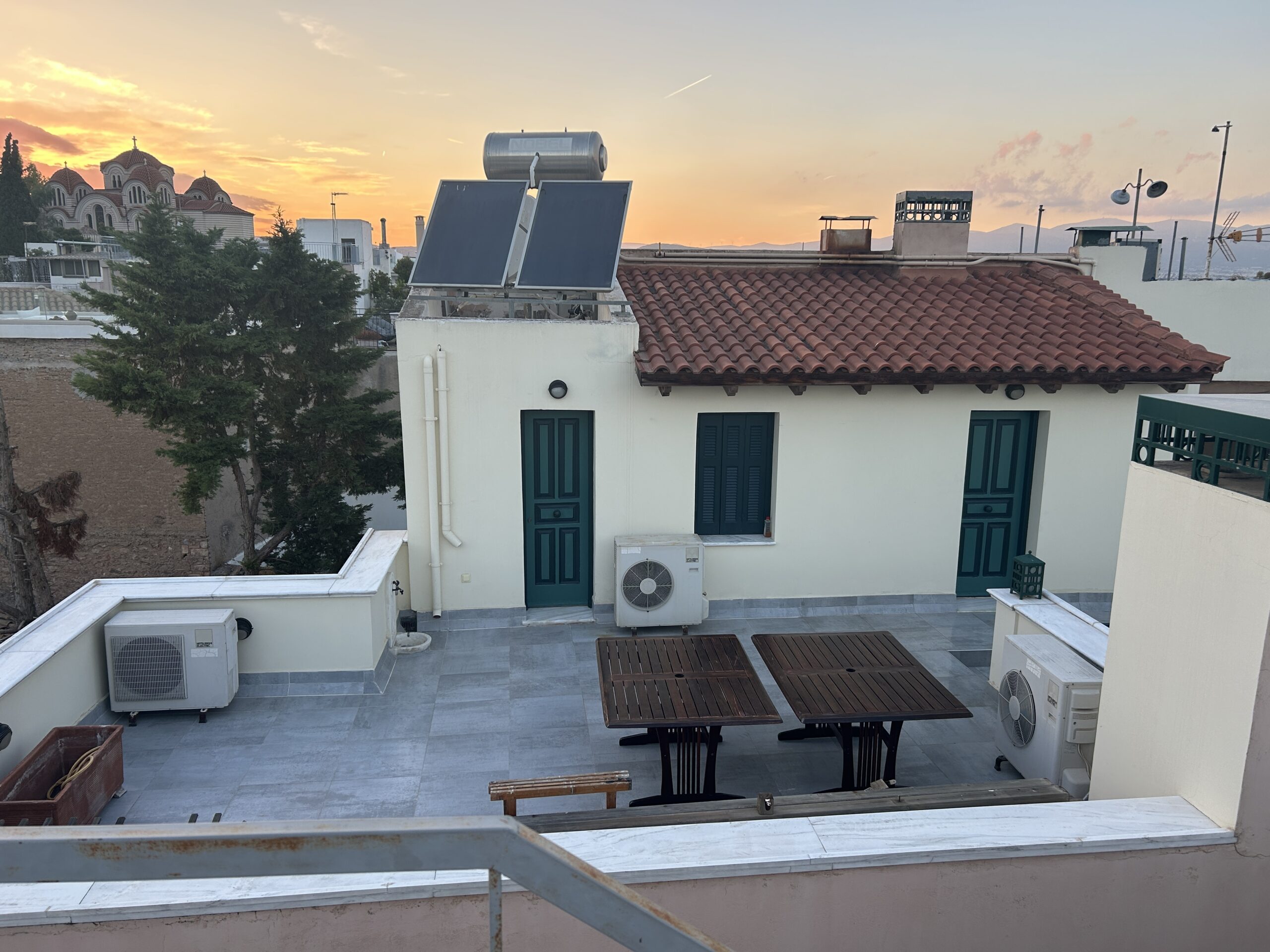
It’s always fun and inspiring to see how other cultures are finding their way out of fossil fuels and towards a resilient, renewable future.
This summer, while traveling in Greece, I saw very similar net zero technologies and strategies to those we have in the US (which center around PV, EV, and heat pumps) but with a unique, Grecian twist. In this warm, Mediterranean country, they are harvesting sunshine in innovative ways and combining its energy with heat pumps to live “Eudaimonia” or the good life.
Heat pumps
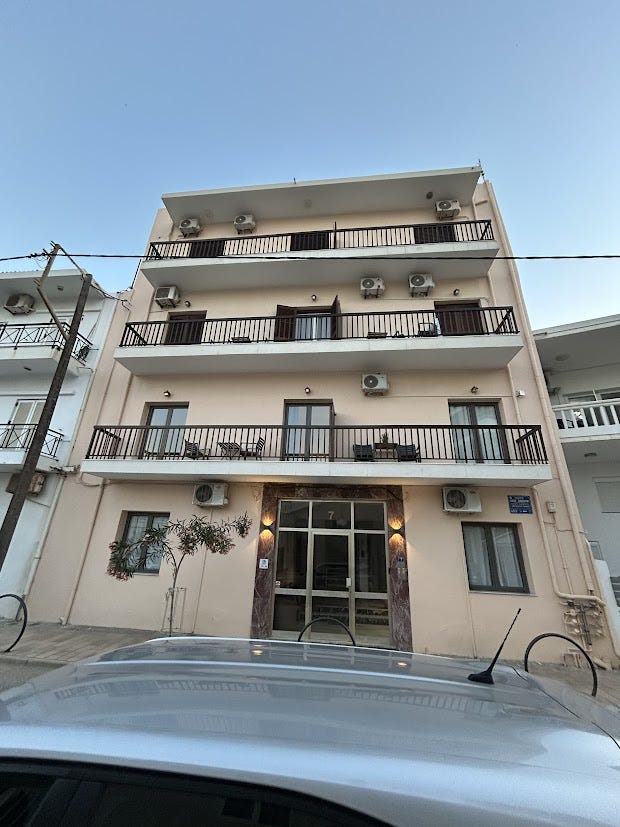
Heat pumps are an easy technology for places like Greece to embrace and the country has done so wholeheartedly. They are the obvious space conditioning choice both because they work well in Greece’s mild climate and because they can be powered by the abundant sunshine that falls on Greece day after day (see below). One sees the side-discharging, ductless heat pump units everywhere; above doorways, sitting on balconies, on rooftops, or just perched on walls. Ductless heat pumps are the most efficient because they don’t lose energy pushing air through leaky ducts and they don’t have backup electric resistance heat.
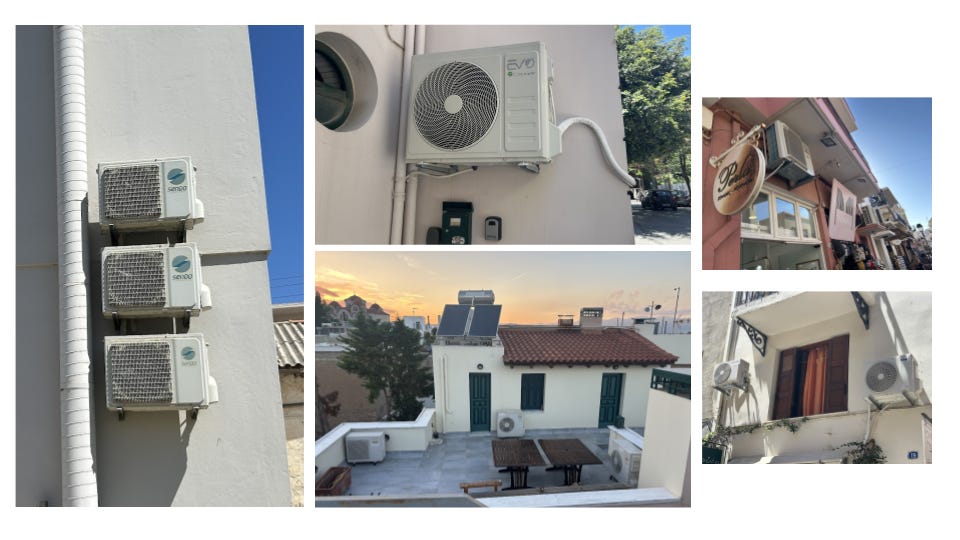
Heat pumps in Greece are primarily used for cooling (as the country has much higher cooling needs than heating) and many of the legacy heating systems still use oil and natural gas. But the heat pump infrastructure is there to cover all space conditioning, and as fossil fuel prices skyrocket and more solar comes online, Greeks can just reach for their handy heat pump remote controls whatever the season.
Sunshine
Head outside midday in Greece and you feel how intense the sun’s energy is — it envelops you with its radiance and warmth. Greece harvests this intense energy in a couple of ways:
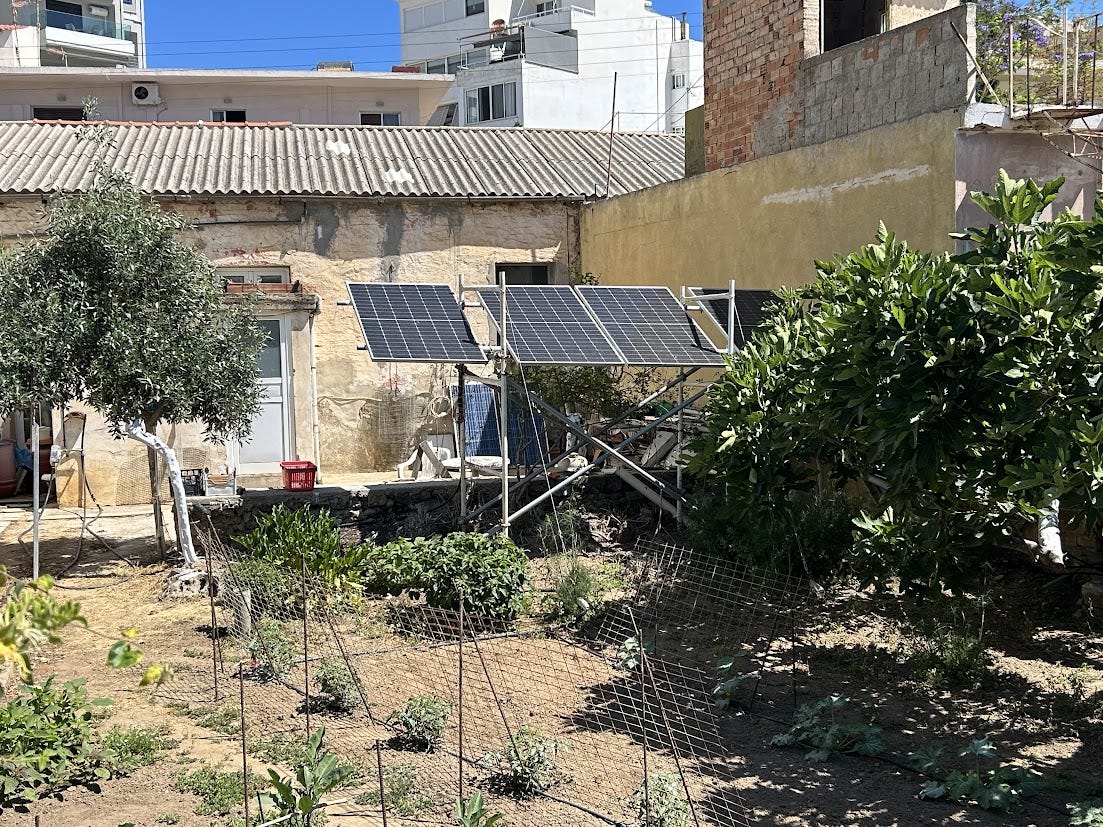
PV — Of course, Greece is participating in the worldwide electricity takeover by solar (or photovoltaic/PV) panels. Energy from solar power is growing by leaps and bounds — growing from 1.5 GW of installed capacity in 2012 to 11.5 GW last year. Solar accounted for 17% of all Greek electricity in 2025, and low-carbon power makes up about half of the Greek energy mix (and is growing fast).
I saw solar arrays along mountain road sides and on rooftops everywhere we went. I even saw them on the portable stairs that allow people to board airplanes.
But Greece harvests two types of solar energy differently than we do in the US.
Clothes drying — one of my favorite uses of solar energy is for clothes drying. I’ve been writing about the lost art of hang drying laundry since living as an exchange student in Italy decades ago. In Greece, like Italy, the dryer is nonexistent. Sunshine is used to dry laundry quickly, and drying racks and clothes lines are everywhere. Laundry waving in the breeze is both iconically beautiful and an easy and efficient use of abundant sunshine. The Greek sun dries clothes in no time at all, saving 3–5 kWh of electricity per load (over electric dryers – heat pump dryers are much more efficient), and best of all, your clothes go back to their drawers smelling like the sea and sunshine.

Solar water heating — What was especially interesting to an admitted water heater nerd was the use of sunlight for solar water heating in Greece. Solar water heating is where refrigerant in a panel collects heat from the sun and uses it to heat water for showers, dishes, etc. Solar water heating technology started alongside PV panels in the ’70s and ’80s as a promising way to harness the sun’s energy. But while solar PV has become the fastest-growing energy producing technology in history, solar water heating has stayed pretty niche in most markets due to high equipment and installation costs and complexity. For example, in the US in 2023 (the last year ENERGY STAR unit shipment reports are available), 190,000 heat pump water heaters (HPWH) were sold while only 6,000 solar water heaters were sold (out of a total of 10,000,000 water heaters sold nationally).
But in Greece, solar water heating is ubiquitous; every single building I saw had a solar water heater on top. Tiny Greece is 6th in the world for solar water heating installations, and as of 2021, 35% percent of Greek homes had a solar water heater. Compare that to the US, where only 2% of homes installing water heaters (a fraction of the overall housing stock) are currently installing efficient HPWHs.
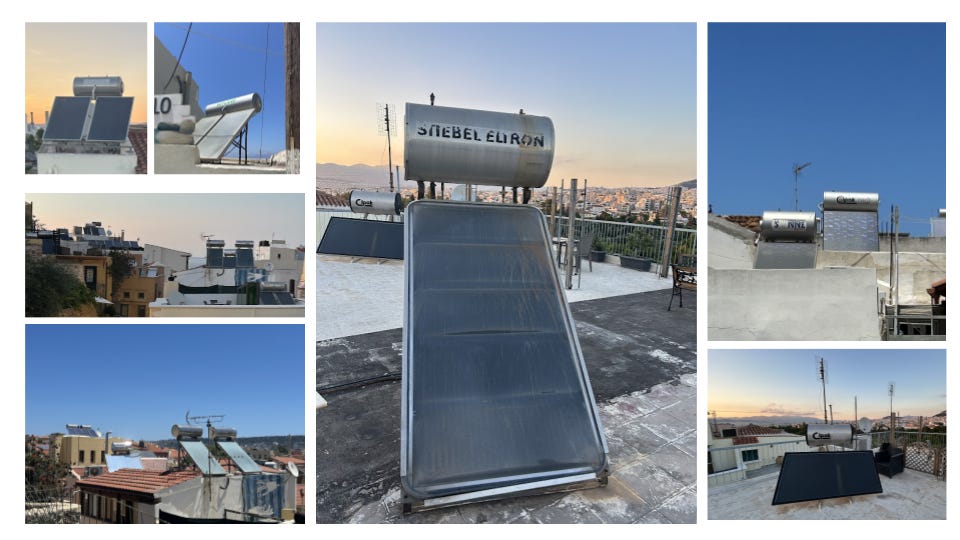
Solar water heating means essentially free fuel (sunlight) to heat your water — a savings of $400–$600 annually over gas and electric water heaters.
Greece has somehow cracked the installation and equipment upfront cost barrier. Equipment costs only 350–1000 euros and there are usually rebates that bring this down by half. Amazingly, one Greek resource estimates that installation of a solar water heating system costs only 200–250 euros!! Compare that to the thousands of dollars installers are charging for heat pump water heater installations in the US and we can see what a mature, low-cost, decarbonized water heating market looks like.
EVs more expensive, and charging was a nightmare

The other key tech in the triad, complementing solar energy and heat pumps, is of course electric vehicles. Here I found Greece to be a bit behind.
EVs accounted for 6.2% of the auto-market in Greece in 2025, which is roughly a third of the European average. We had to pay nearly four times more ($300 vs. $80) to rent an electric vehicle than a comparable gas car during our week in Crete.
While we saved a lot of money by not having to fill our vehicle with $8/gallon gasoline, it was unfortunately a nightmare to find charging on the island of Crete. We got a Smart electric car with 400 kilometers of range and only needed to charge at the end of our week on the island. But we went to 7 different charging stations, most of them were full of other cars charging, one was ICE’d, and the final fast charging station we went to before throwing in the towel was open but made us go through a 20 minute process of downloading an app and signing up only to then not work. In the end, we had to hypermile it back to our rental car location at the airport with 5% battery and charge there. I’ve never had such a hard time charging an electric vehicle and we’ve been proud EV owners since 2017.
But while EV infrastructure was lacking, it was thrilling to see that in Greece, heat pumps are ubiquitous and solar energy comes in many flavors — it produces electricity and directly dries clothes and heats water. Greece is a country where clean energy and the technology to harvest it are the norm and both the population and planet benefit. I found lessons for us in the US, especially for those states with warmer climates, on how to maximize harvesting bright, blazing, clean, and abundant sunlight.