

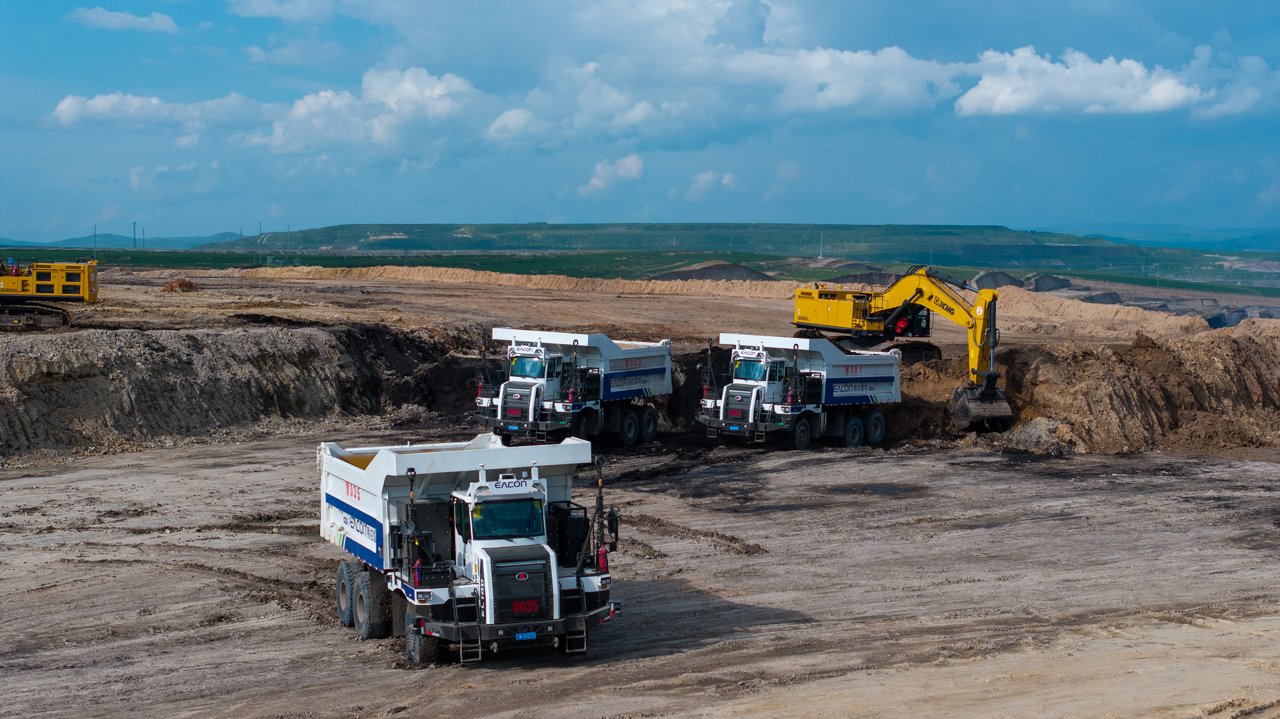
In mid-2025, IM Editorial Director Paul Moore spent a week with EACON Mining Technology in China, visiting its main offices, plus a major mining customer site, a quarrying customer operation and met with three of its truck OEM partners – Tonly, NHL and Yutong.
The aim was to get a better understanding of what makes EACON different. After all, there are today many autonomous haulage technology providers in China, including but not limited to CIDI, Huawei, TAGE Idriver, WAYTOUS, Boonray, CRRC, RockAI, YUEX, MaxSense, MainFunc plus systems from some of the leading truck OEMs themselves like SANY and XCMG.
But EACON has so far been able to maintain its position as the most successful of them all – today it has well over 2,000 trucks running in the domestic Chinese market, spread across more than 25 sites – and an estimated 54% of the total market share; and it includes coal, copper, gold, iron ore, copper, zinc and limestone quarrying sites supplying cement operations. That figure is even more impressive when you consider that hardly any of these are diesel trucks – about 2%, with about 73% being hybrids, and 25% all battery trucks.
Right to left: IM Editorial Director Paul Moore with Elaine Jin, EACON Australia COO and Evelyn Zhu, EACON Mining Business Support Lead at the Zhahanaoer Coal Mine in Inner Mongolia
Another interesting insight comes from the powerful companies that have invested heavily in EACON – two of the largest investors are battery technology major CATL and Zijin Mining, the largest Chinese metallic miner – which is now by some measures the largest global mining company after Rio Tinto and BHP. EACON and CATL have also just announced a strategic partnership with a focus on developing electric, autonomous systems. Zijin is deploying EACON’s AHS at many of its sites.
EACON says one of the ways in which it is different in the Chinese market is because it not only set out to provide autonomy to remove operators from hazardous working conditions and to show that it could be done, but to also apply autonomy in the context of production needs at the mines with a high priority given to mine efficiency. A lot of early AHS projects in China focused mainly on the ability to automate for automation’s sake, and partly to begin to satisfy general mine mine intelligence and innovation goals.
EACON’s growth was initially slow – it was founded in 2018 with some trials and pilots in 2019. It then entered two minesites officially in 2020 and then focused on those sites and getting the functionality proven, but by 2023, it had already demonstrated that its automomy worked, and worked well, and after that the growth was very fast – to over 2,000 autonomous trucks in less than three years – when it has taken Caterpillar and Komatsu over a decade to achieve less than half of that. But it is also about scale per site – EACON has five sites each with over 100 autonomous trucks running. This includes two mines each with more than 400 trucks, one of which is Guanghui Energy’s Baishihu open pit coal mine.
The footprint, journey and powertrain excellence
EACON has three major R&D offices in Beijing, Shanghai and Zhengzhou – with other locations in China in its key deployed mining fleet regions in Ordos and northwest China. So far, its only overseas location is in Perth, Western Australia which is supporting its Australian growth plans, including a tripartite partnership agreement with Thiess and Norton Gold Fields to deploy autonomous haulage technology in Australia.
Elaine Jin, COO at EACON Australia accompanied IM on the visit and had this to say on its approach: “From the very beginning, EACON has been focused on autonomous driving, but we knew we also had to have a very deep understanding the trucks and the truck OEMs – at that time the OEM drive by wire systems and the support for them in China was still very basic. So, we started to hire our own engineers to look at that, and a lot of them actually came from the low emission powertrain backgrounds – the companies producing hybrid and battery trucks – so as a result we gradually accumulated this green powertrain development and knowledge capability as well.”
Tonly truck factory fitted with EACON autonomy system, at Tonly factory near Xi’an

She adds: “We could also see the trend towards electrification and so we also hired talent for this purpose. What a lot of people don’t realise is that we have a big vehicle engineering team. I think that’s a major difference compared to other startups in mining AHS in China. In some cases, hybrid or electric powertrain design improvements come from EACON, plus the integration design with drive by wire and autonomy layer – and then the truck OEM installs these elements to their main truck and chassis design. We mainly assist OEMs so that we have a better base truck to apply autonomy to – we are not a truck manufacturer.”
The perception orchestra of ORCASTRA®
EACON supplies the drive by wire technology for the truck ORCASTRA®, the full stack autonomy system. In all cases it brings its own advanced fleet management system, which it calls ORCASTRA CONDUCTOR – which like other FMS solutions manages everything from vehicle dispatch to production targets; the difference being that it is an FMS designed for autonomy. ORCASTRA PILOT is the brain of EACON’s autonomy system – with intelligence located on the automomous trucks themselves, not in the control room. It uses an on-board automotive grade computer linked to the truck multi-sensor perception system. Finally, ORCASTRA CREW is a unit for manned vehicles which permits the operation of autonomous and non-autonomous fleets together. All of the software and AI algorithms behind these systems was developed in-house.
CONDUCTOR is the umbrella system which manages the autonomous production goals, the autonomous operating zone (AOZ) mine map and the real time data on cycles and loads – either overseen by EACON’s own team as part of an Autonomy as a Service contract or where the mine manages the control room themselves with EACON oversight and training. That is not to say that EACON could not work with other FMS – it can do so – but CONDUCTOR has proven to be the most efficient option given that it was designed specifically to work with the other ORCASTRA elements.
Jin: “We designed this full stack and combined it with an in-depth vehicle understanding, including and in particular low and zero emission trucks, and also worked hard on understanding the mine operations themselves in terms of how they plan and schedule plus different types of load, haul and dump scenarios for different mine types and designs.”
Autonomous night operations at Zhahanaoer Coal Mine

About 30% of EACON’s deployments today are Autonomy as a Service, which evolved organically, as at the very beginning, many mines in China did not believe that autonomy would really work efficiently as they were used to dealing with AHS companies that had only offered autonomy with safety drivers on small numbers of trucks following pre-determined routes.
“So to get experience and get into the mining space EACON then began with this autonomy contracting model – and it was a major success strategically for several reasons – it allowed EACON to iterate its system very quickly with real experience and to develop a deep mining understanding especially in relation to situational algorithms required for the AHS to become even more efficient and productive.”
The nature of the contract also varies – it could just be coal or ore handling, or just waste overburden, or both. In many cases, this also means that the autonomous trucks have to operate on the same haul roads, loading and dumping areas with manned vehicles.
In the overseas market – EACON has the option of still offering a comprehensive autonomy contracting model, including working with partners like Thiess to provide it. And this is one of the reasons EACON has focused on developing close relationships with contractors.
A comprehensive solution
For the trucks themselves, EACON’s fleet is almost all wide body trucks, as that has been the focus of green powertrain trucks with autonomy, it can also offer a rigid truck retrofit, which it is doing with Norton Gold Fields on their Komatsu HD1500s. It also has a rigid truck project in China today with Zijin Mining’s Julong copper mine on 240 t class NHL NTE240 trucks at the mine which are running at the same mine as a fleet of wide body trucks, also equipped with EACON autonomy technology.
The majority of EACON’s wide body truck AHS fleets have been supplied with the system factory fitted, but a number of customers are now opting to retrofit EACON autonomy on to their existing trucks, especially as mines with existing and older fleets look to gain autonomy benefits as well.
Another important upside is that the full stack applies not just to the tech side – EACON can do the whole AHS delivery, including training, the process and change management – plus the control room itself. And its OEM partners include all of the main Chinese players – Tonly, SANY, XCMG, Yutong and LGMG – but Tonly and LGMG have been the most dominant in terms of numbers to date.
A typical control room image from EACON’s ORCASTRA CONDUCTOR

The largest new powertrain growth to date has been in hybrids, but all battery electric truck deployment is increasing – notably with the deployment of 60 factory-fitted battery trucks at the Zhibula copper mine, also part of the Julong mining complex. These are SANY trucks – in this case EACON is supplying the autonomous driving system and the drive by wire design. The powertrain, power battery and vehicle control unit were all provided by SANY. SANY is also responsible for the overall vehicle control logic, while EACON is responsible for the control logic in autonomous driving mode.
Elaine Jin said of EACON deployment advantages for clients: “I think it has a lower adoption barrier – not only related to speed of deployment but also the fact that the system is really adaptable and flexible, so they don’t have to make major operational changes on their side. For example, we don’t require them to widen the mine roads to be able to use it but of course, if you want to get the best efficiency, then a wider road will bring better results. Basically, our AHS mine road specification doesn’t require anything beyond the Australian mining standard. This is important as some of the Tier 1 miners have not deployed AHS at a number of sites as they were restricted by the truck OEM autonomy system limitations on haul road width.”
Bringing a new breed of AHS to the world
Talking about the overseas market, which does not yet know EACON well, what are the main concerns of major miners already running traditional AHS? Jin: “I would not say concerns – the desire to have a new approach to autonomy that does not lock them into an OEM-led solution is very strong – typically as seen elsewhere in mining there is conservatism in being the first or an early adopter. Plus, there are questions around our ability to handle the change management in their processes and train their people, but this is in our DNA and we are already doing it Norton Gold Fields. Of course, there remain strong ties between the Tier 1 miners and the truck OEMs which supply the existing AHS systems – but mindsets towards Chinese mining technology groups are changing fast, as shown by the collaboration between Tonly and Rio Tinto for example, as well as other collaborations between XCMG with BHP, Fortescue and Rio Tinto.”
EACON’s system can also handle multiple minesites and large numbers of trucks for the same customer, plus monitoring personnel requirements are low compared to the OEM led systems, which also means lower operation costs. One controller on average manages 40 trucks in EACON’s Chinese deployments.
As mentioned, EACON also supports low emissions from an autonomy point of view whereas for Caterpillar and Komatsu as an example, this is still very much under development. “We already understand hybrid and battery power delivery and its logic in terms of autonomy, and how to make the best of the system in a real minesite.”
The selection of Australia as a first overseas market is not accidental – there is a real appetite for a new wave of OEM-agnostic autonomy there. Added to the fact that AHS in mining first really took off there, so there is a deep understanding of the productivity upside of AHS. In addition, from EACON’s side there is a feeling that Australia is a very exacting market and that it if can succeed there it will be able to handle deployments pretty much everywhere else.
Distributed architecture, customisation and perception power
In IM’s opinion, this already existing experience in green powertrain operation and its performance with autonomy – and that means the trucks managing their own state of charge and trips to charging stations autonomously, while also factoring in their own load status – is one of EACON’s two major differentiators in the market today. The actual charging plug in or battery swap still involves an operator in the same way as a diesel fuelling station.
The other one is definitely its speed of AHS customisation capability to address particular operational scenarios at a customer site. Jin: “Some sites need special things and we can customise ORCASTRA features to tailor the system accordingly.” While the majority of sites are similar, some have unique features, such as weighbridges, or a tunnel, or a very tight unloading area with fixed crushers, where EACON is able to supply a customised solution with new algorithms very quickly. It has also been done to accommodate truck wash areas and fixed crushers with a steel structure that trucks have to drive into to unload. EACON’s architecture, combined with powerful onboard algorithms also ensures reliable performance even in GPS-denied environments. These specific features can be developed and proven and rolled out to the customer in as little as three to nine months.
Autonomous battery electric Yutong EY70 truck unloading at CNBM Pingyin quarry showing ability of EACON autonomy to handle enclosed dumping stations

EACON’s performance and flexibility is mainly because of its distributed architecture. Jin: “A distributed architecture, which basically places all decision-making and safety functions onboard each individual vehicle, rather than relying on a central control platform. This approach uses high-performance edge computing and vehicle-to-vehicle (V2V) communication to enhance safety & adaptability, and reduce network reliance.” This also means it is less complex from a system point of view to have a mixed autonomous and manned fleet using EACON’s AHS plus the CREW system on other vehicles.
The reason EACON’s autonomous and manned machines can get close is not only because of the CREW system. “It’s also because of our level of perception from the onboard Pilot system and high precision planning capability. It uses multiple LiDARs per truck along with additional radar sensors to offer 360 degree coverage with sensor fusion and detect all the surrounding objects, including vehicles with CREW or other obstacles, and based on our AI algorithms the trucks make their own decision on where they should go.”
All of EACON’s trucks also have cameras – these are used for control room visibility and remote control operation but in addition, in EACON’s 4th Generation of Perception Strategy (already deployed on some trucks), cameras are included as an input to the fusion perception system. Mullti sensor fusion capability is also useful in dusty mining conditions as well, if the truck is only using LiDAR without radar.
Jin added: “These kinds of advanced perception and environmental understanding give our autonomous trucks a greater capability to navigate safely, including in mixed fleet areas, so there is no need to have an additional CAS installed. Also in CREW, there is also a collision avoidance function anyway to alert the driver when they are too close to surrounding equipment.”
In addition, ORCASTRA can track non autonomous vehicles and predict their future path and, if needed, initiate a stall or stop but then still keep operating. “Our truck will also determine if it has space to drive around the obstacle concerned. With ORCASTRA, the intelligence is on the trucks not in the control room – they make their own path planning; and the control room is making only limited decisions relating to the trucks; it is primarily a dispatch room managing the map and production targets, data reporting and dealing with any stoppages that cannot be resolved by the truck itself.”
In terms of truck speeds, most Chinese mines have speed limits set for all vehicles which is normally 30 or 35 km/h, but in EACON trucks can safely operate at higher speeds than manned machines if the site regulations allow for it. Another interesting capability with ORCASTRA is that you don’t have to send someone into the pit if a truck needs to be recovered – referred to as remote driver assist, where the truck is remotely driven from a remote driver station in the control room.
All of the manned vehicles in EACON autonomous operating areas have CREW and all the unmanned vehicles have PILOT. CREW can be installed on the manned machines either before or after the PILOT equipped machines are deployed. All of the PILOT equipped autonomous machines share their information through 4G LTE or 5G to the control room, but they also talk to each other directly. On the topic of networks – in most cases the mines in China already have high bandwidth networks in place from China Mobile, China Telecom or Unicom, the three main state-owned telecomms groups.
Closer proximity and productivity
Advanced perception also has other benefits in that EACON autonomous trucks can operate really close to each other, down to as little as 2.5 m to avoid slow downs, which increases traffic efficiency on hauls roads and reduces the hanging time of the shovels. Also when this truck leaves, it will immediately update the loading area boundaries and the loading face information with other trucks in proximity to it. So, the next one knows where to back up to immediately.
EACON uses a totally different and less restrictive AHS philosophy. “We call it a local path planning capability. If a truck is loaded and another truck or even a large rock is blocking its way, it will decide itself to bypass it. For us, the loading area is an automated but also a very dynamic area.” This is less labour intensive for system controllers and also means much higher efficiency.
The trucks are also able to handle efficient traffic flow through narrow areas. Vehicle-based calculation of right-of-way plus predicted trajectory allows for more efficient passing. Another upside is adaptability – EACON autonomous trucks can operate even on relatively poorly maintained haul roads – anything that a human driver can drive on, ORCASTRA can cope with as well. Better maintained haul roads will still bring better results, but it is not an operational constraint for the AHS.
EACON at Zhahanaoer Coal Mine
IM visited the 18 Mt/y Huolinhe Zhahanaoer Coal Mine of SPIC in Inner Mongolia, where EACON mobilised at the project in June 2024 with an initial batch of 17 trucks – at the point of the visit there were 135. It is a mixed fleet of LGMG EL100 and Tonly TLH135 trucks – both of which are hybrids and with a 100 ton payload. At this site, the mine uses two contractor fleets plus has an owner operator fleet. The owner operator fleet is mainly used for coal haulage with the contractors assigned primarily to waste removal, and it is with one of these that EACON has applied its autonomy solution – so the mine has the full EACON system with some EACON staff in place with the contractor staff in the control room.
Interesting aspects of mining there include the fact that conditions in the winter can be quiet wet – creating carryback issues. EACON developed an autonomous addon for the truck fleet to counter this where the trucks automatically drive to a cleaning spot and raise the dump body to be scraped clean by an excavator.
All the excavators at this mine are manned, but at some sites, EACON trucks are also loaded by remote controlled shovels – however these systems are not supplied by EACON but by BuilderX and others that EACON will then partner with. At this mine EACON currently manages waste removal from one main bench, where the stripping ratio is 1:5.2. One of the challenges at this site are the narrow roads and close proximity of the trucks to each other, but the EACON system is capable of handling this. In this case a customisation was also added because at one point the road is so narrow that the trucks are not able to pass each other and so one has to wait for the other truck to pass – so there is an algorithm that controls the traffic rules related to that pinch point – how the trucks navigate from double lane traffic to single lane and back to double lane.
The mine also has very soft road conditions, so the trucks also use a rut prevention feature where the trucks take slightly different paths to avoid ruts building up. EACON’s performance at the mine was recently referenced by the mine management.
Xu Yongchao, General Manager, emphasised recently how EACON’s autonomous solution has been a key contributor to maintaining steady operations throughout the peak production season: “EACON’s fleet of over 100 autonomous trucks has moved 8.5 million cubic metres of overburden, ensuring smooth and reliable operations even under harsh conditions such as snowfall. This efficiency has enabled the mine to build a stockpile that supports shipments for at least seven days.”
EACON’s evolution from a high level
IM also discussed things from a high-level view with EACON on AHS growth in Chinese mining and growth for EACON’s solution specifically. Jin emphasised the very positive macro environment in China in recent years and pointed out that mine electrification is already a megatrend in China, and it is this which has laid a solid foundation for the development of autonomous haulage, because electric vehicles actually helped foster and also boost the development of autonomous driving, plus the price of the batteries are now dropping and also their performance has rapidly improved. This is in contrast to mining in the rest of the world where OEM-led AHS has been deployed first with the use of green powertrains still in its infancy in mining.
A second point EACON made is the much larger available talent pool in China for software and AI-algorithm related development plus fundamental powertrain and mechanical engineering. This has also helped the whole mining AHS industry grow at the rate in which it has. Within EACON, the team has also been very stable with a much lower turnover of staff than others in the industry. Overseas it needs to build up a significant local team to have its own resources in place. But it is actively doing that and very successfully.
A real additional strength is that EACON has complete confidence in its solution because it is backed up by millions of hours proven on thousands of trucks at a large number of mines. And with electric trucks, Jin says the cost of AHS can be lowered, plus in the same way, AHS has made the cost of electrification lower. “And autonomous electric trucks will help the mining industry achieve its ESG targets quicker. Even if the Western miners want to stick to their diesel fleet for now, we can also help them and deploy our solutions on the diesel fleet as well – even on multiple brands and ages of machines and including both wide body and rigid trucks. Once they are ready for hybrid or electric trucks then we have proven solutions for them.”
The hybrid fleets grew very fast because initially a lot of the Chinese mines didn’t have very good charging infrastructure and also the battery prices were not as competitive, and also the battery performance was not that good yet. “A lot of mines have now built up their infrastructure, especially at coal mines where going all electric is also allowing them to take advantage of their own surplus power generated from the coal-fired plants. In addition, many of the coal mines own adjacent or nearby large renewable solar or wind projects that can also power the electric mining fleets.”
The post The EACON factor – on-board perception and AHS’s next generation appeared first on International Mining.