

Support CleanTechnica’s work through a Substack subscription or on Stripe.
Try as he might, President Donald Trump just can’t stop the vehicle electrification movement from digging its claws into the US. Clearly he did not get the memo about cross-border industry collaboration. Last week, for example, Ford dropped word that its domestic EV battery manufacturing plans are getting an assist from the Chinese firm CATL, and the Canadian firm Graphite One described a supply chain plan that enables US battery stakeholder to onshore a key material. In the latest development, the California startup QuantumScape aims to accelerate its solid-state battery technology into the market, in partnership with the leading Japan-headquartered automaker Honda.
What Is QuantumScape Up To Now?
QuantumScape is a familiar face on the pages of CleanTechnica, going back almost as far as the company’s launch in 2010 with a focus on solid-state lithium-metal EV battery technology. In contrast to the volatile liquid electrolyte that anchors conventional EV batteries, a solid electrolyte has the potential to pull the same duty, only with fewer toxic inputs, higher performance, and less risk of fire (see more solid-state background here).
Cracking the code from labwork to commercial application is a tough row to hoe, considering that 16 years after launch the market has yet to see an off-the-shelf version of a QS solid-state battery. Still, the new R&D partnership between QS and Honda is an indicator of substantial progress. QS announced the new agreement on June 18, noting that the new program is a multi-year effort that includes fine-tuning the manufacturing process in addition to battery development.
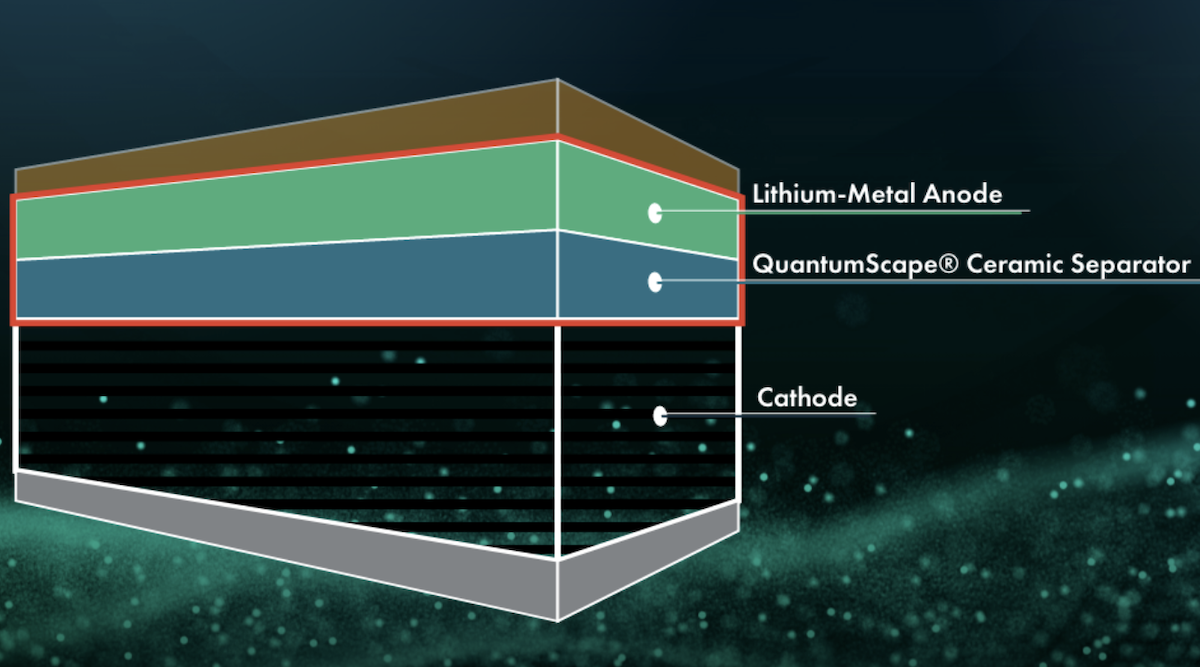
The manufacturing side is significant because QS has developed a process that enables the anode to self-form when the battery charges up for the first time, eliminating a costly fabrication step.
“The agreement follows Honda’s successful completion of a technology evaluation agreement with QS, which included an in-depth, hands-on technical study of QS’s solid-state technology platform as well as competitive benchmarking across a range of standard technical tests,” QS notes.
Next Steps For The Solid-State EV Battery Of The Future
The press announcement was rather thin on detail, but a lookback at other recent news from QS provides further insight into the potential for a commercial-level breakthrough.
The company also has a longstanding relationship with Volkswagen, which eventually migrated over to the automaker’s PowerCo branch. More recently, last September QS hooked up with the New York-based legacy materials science firm Corning.
That announcement was also short on specifics, but Corning has indicated that its new Ribbon Ceramics manufacturing process is in play. Based on familiar roll-to-roll technology, the new process is designed to fabricate new, ultra-thin materials, which are compatible with solid-state lithium-metal batteries.
As if on cue, last November the San Jose-based firm Ensurge announced a Ribbon Ceramics partnership with Corning, though not at the EV battery end of the industry. Ensurge specializes in microbatteries for smart devices.
Catching Up With QS
In another sign of acceleration towards the solid-state EV battery of the future, on June 3 QS announced that Tesla Motors co-founder and former CTO JB Straubel has joined the company’s Strategic Advisory Board. After leaving Tesla, Straubel went on to found the advanced energy storage and battery recycling firm Redwood Materials.
Straubel’s relationship with QS is not a new development, considering that he joined the firm’s Board of Directors since 2019. In his new position, Straubel is expected to help accelerate the company accelerate its transition to commercial operations.
“His unparalleled expertise in battery innovation, manufacturing scale-up and supply chain development will be invaluable as we apply our no-compromise solid-state technology to automotive, AI data centers, aerospace and beyond,” The company’s CEO and president, Dr. Siva Sivaram, noted in a press statement.
Another indication that QS is gearing up for volume production is the addition of Mark Marbury to its Strategic Advisory Board earlier this year. Among his string of credits is a stint as US Air Force Chief Scientist and a 27-year string of senior positions at the national security advisory firm MITRE Corporation. His current occupation dovetails neatly with QS’s commercialization journey.
“Dr. Maybury currently serves as Vice President of Commercialization, Engineering and Technology at Lockheed Martin, where he leads the transition of cutting-edge research into scalable products for commercial and defense applications,” QS explained in a press statement dated April 8.
Follow The Money
To be clear, not all is sweetness and light on the domestic EV battery manufacturing scene. In March, the Federal Reserve Bank of Dallas surveyed the damage and noted that 10 or so battery projects totaling $10 billion in investments have been delayed or canceled outright in recent months.
Still, other battery stakeholders have survived. In addition to those mentioned at the top of this article, the California startup Anthro Energy recently announced next steps in its elaborate plans for a sem-solid state electrolyte factory in Kentucky, and Nevada-based Dragonfly Energy affirmed its intention to introduce an Asian-style battery fabriation model to the US.
Another electrification angle of interest is the fast-growing demand for electric drones. In May, the Massachusetts EV battery innovator Factorial Energy affirmed its interest in the drone market, laying the groundwork for its listing on the Nasdaq Stock Market on June 8.
“The transaction implies an equity value of approximately $1.3 billion and provides more than $100 million in gross proceeds to support continued commercialization of Factorial’s next generation batteries for defense & aerospace, hyperscale data centers, and e-mobility,” the company explained.
Factorial drew particular attention to its emerging businesses in the June 8 announcement, with CEO Siyu Huang describing the company’s initial focus on EVs as the springboard for expansion. “That foundation positions us to scale, providing power to drones, robotics, and next generation energy systems,” Huang said.
That doesn’t necessarily mean Factorial is putting its EV battery business on hold. The company did mention passenger cars in the June 8 announcement, while emphasizing that its commercialization strategy is “designed for rapid, scalable deployment.”
Image: The US energy storage startup QuantumScape is among the domestic EV battery innovators marching steadily towards commercial-level production, despite the sharp U-turn in federal electrification technology (solid-state lithium-metal battery schematic courtesy of QS).
Sign up for CleanTechnica’s Weekly Substack for Zach and Scott’s in-depth analyses and high level summaries, sign up for our daily newsletter, and follow us on Google News!
Have a tip for CleanTechnica? Want to advertise? Want to suggest a guest for our CleanTech Talk podcast? Contact us here.
Sign up for our daily newsletter for 15 new cleantech stories a day. Or sign up for our weekly one on top stories of the week if daily is too frequent.

CleanTechnica uses affiliate links. See our policy here.
CleanTechnica’s Comment Policy