
The Long US Goodbye to New Gas Connections and the Legal Tools States Are Using to Get There

Support CleanTechnica’s work through a Substack subscription or on Stripe.
Gas bans in new buildings moved from obscure municipal policy to national legal conflict in a remarkably short period of time. For most of the past decade, city ordinances limiting or prohibiting new natural gas hookups were treated as a local matter tied to building codes, air quality, and long term planning. That changed when the Trump Administration in his second term chose to intervene directly, reframing what had been a question of local infrastructure choice into a federal preemption dispute. The escalation matters because it reveals a deeper conflict over who gets to manage the decline of fossil fuel systems during electrification and how early decisions shape costs and risks decades into the future.
Banning new gas hookups is frequently misunderstood as a prohibition on existing homes or a forced retrofit program. It is neither. These policies apply almost exclusively to new construction, where design choices are made once and then embedded for 40 to 80 years. A new gas service line installed today is expected to operate well past 2060. At the household level that means furnaces, water heaters, and stoves with typical lifetimes of 15 to 25 years will be replaced multiple times while the pipe in the ground remains. At the system level it means utilities add capital that regulators allow them to recover from ratepayers over several decades. Stopping new hookups is about preventing new long lived commitments, not about taking something away from existing customers.
The economic logic behind this follows what utility economists describe as a death spiral, a self reinforcing feedback loop driven by fixed costs and customer attrition. Gas distribution utilities recover the majority of their revenue through fixed charges tied to infrastructure, not through the volume of gas sold. Pipes, meters, pressure regulation stations, and safety systems must be built, maintained, and depreciated regardless of whether a customer uses a lot of gas or very little. Once those assets are in the ground, their costs do not fall just because demand declines.
As electrification accelerates, customers begin leaving the gas system, typically starting with newer buildings and higher income households that can afford to switch. The infrastructure, however, remains largely unchanged. A gas main serving a neighborhood must still be inspected, repaired, and operated even if half the homes disconnect. If a utility has 1 million customers supporting $20 billion in distribution assets, that represents about $20,000 of infrastructure per customer. If electrification reduces the customer base to 700,000 while the pipe network remains mostly intact, the same $20 billion must now be recovered from fewer people, raising the effective burden to nearly $29,000 per customer.
At that point, rates rise, not because utilities are mismanaging the system, but because the math of fixed costs demands it. Higher bills then push more customers to electrify or disconnect, especially those who were already considering the switch. Each additional departure further concentrates costs on the remaining customers, triggering another round of rate increases. This is the core of the gas utility death spiral. Declining customers lead to higher rates, which lead to more declining customers, with no natural stabilizing mechanism.
Allowing new gas hookups during this period makes the problem worse, not better. Each new connection adds capital to the rate base, often with an expected recovery period of 40 to 60 years, precisely when long term customer counts are expected to fall. These new assets do not create resilience. They increase the size of the system that future customers must pay for while doing nothing to stop attrition elsewhere. The result is a larger stranded asset problem and sharper rate shocks later.
The distributional effects are predictable. Households with the least flexibility, renters, low income customers, and residents of older buildings, are the last to leave the gas system. They end up paying the highest bills for an aging network that serves fewer and fewer people. In this context, ending new gas hookups is not about punishing gas users or forcing change. It is about stopping the expansion of a system that is already entering a contraction phase, and protecting future ratepayers from inheriting costs created by present decisions that no longer align with where the energy system is going.
Climate considerations reinforce this economic case. The idea of natural gas as a bridge fuel depended on assumptions that no longer hold. Methane leakage rates across production, transmission, and distribution systems are higher than once believed, and even a 2% leakage rate erodes most of the climate advantage gas once claimed over coal. Methane’s warming impact over 20 years is roughly 80 times that of CO2. A new gas hookup adds methane emissions immediately and locks them in for decades, directly conflicting with 2030 climate targets that require rapid reductions. Electrification of space and water heating is already occurring at scale, supported by falling heat pump costs and cleaner electricity grids. Adding new gas infrastructure today increases near term warming and delays the transition that is already underway.
Health and safety impacts provide another strong rationale. Gas appliances emit nitrogen dioxide, carbon monoxide, and fine particulates directly into indoor environments. Multiple peer reviewed studies link gas cooking to higher rates of childhood asthma, with some estimates attributing around 12% of childhood asthma cases in the United States to gas stoves. Ventilation can reduce but not eliminate these exposures, and real world usage often falls short of best practice. Electric appliances eliminate indoor combustion entirely. From a safety perspective, gas systems introduce risks of explosion, fire, and carbon monoxide poisoning that do not exist in all-electric buildings. Building codes have long regulated materials and systems based on fire and health risk. Choosing not to introduce combustion into new buildings is a clear extension of that logic.
From a construction and operating cost standpoint, all-electric new buildings increasingly come out ahead. Eliminating gas piping, meters, vents, and combustion air requirements reduces upfront costs, often by several thousand dollars per unit. Operating costs depend on local electricity prices, but in many regions modern heat pumps deliver space heating at lower annual cost than gas, especially when accounting for rising gas delivery charges tied to shrinking customer bases. Hybrid buildings that install both electric and gas systems pay twice for infrastructure and face future retrofit costs when gas systems are eventually retired. Designing for electrification from the start avoids these inefficiencies.
Grid planning also benefits from electrification. Electric loads can be managed using demand response, thermal storage, and time of use pricing. A heat pump water heater with a 300 liter tank can shift several kWh of load without affecting occupants. Gas systems operate outside this integrated planning framework. Consolidating energy demand onto electricity simplifies system optimization and reduces the need to maintain parallel distribution networks. Planning for electrified load growth is more straightforward than planning for simultaneous expansion and contraction of gas systems.

Against this backdrop, the federal legal turn is striking. For decades, local governments regulated building fuels through zoning, fire codes, air quality rules, and infrastructure planning without federal intervention. Oil heating was phased out in many cities. Wood burning restrictions were imposed to address particulate pollution. None of these actions triggered lawsuits from the Department of Justice. The first major legal challenges to gas bans came from private industry groups, most notably the restaurant industry, arguing that local ordinances were preempted by federal appliance efficiency law. In 2023, the Ninth Circuit Court of Appeals accepted this argument in a case involving Berkeley, California, interpreting the Energy Policy and Conservation Act as preempting a local gas infrastructure ban because it indirectly affected covered appliances.
That ruling provided a proof of concept. What followed was not congressional clarification or regulatory guidance, but direct federal lawsuits against cities, even where ordinances were no longer being enforced. This marked a shift from passive acceptance of court outcomes to active federal enforcement. The statute at the center of this conflict was enacted in 1975 to set minimum efficiency standards for appliances and to prevent states from creating a patchwork of differing efficiency requirements that would burden manufacturers. It was not designed to guarantee access to specific fuels or to govern building infrastructure choices. Applying it to gas hookup bans requires an indirect chain of reasoning that treats the absence of gas infrastructure as equivalent to regulating appliance energy use.
The selective nature of this application becomes more revealing when tested against alternative explanations. If the federal government were acting from a neutral commitment to appliance law coherence, enforcement would apply symmetrically across fuels and technologies covered by the statute. Electric appliances are equally within the scope of federal efficiency standards, yet mandates, incentives, and code pathways that strongly favor electric systems have not drawn comparable federal legal action. Nor have long standing local prohibitions on oil heating in urban areas, bans on new wood burning appliances due to particulate pollution, or restrictions tied to fire safety and air quality been framed as unlawful preemption. These policies directly affect appliance choice, yet they have been treated as legitimate exercises of local and state authority for decades.
Testing the pattern against ideology produces a clearer signal. Federal intervention appears only when local action threatens the future growth of the gas distribution system. The legal arguments are activated not by novelty or statutory inconsistency, but by direction of travel. Electrification policies that expand electricity’s role are tolerated, while policies that constrain gas expansion are challenged. That asymmetry aligns closely with ideological commitments to preserving fossil fuel markets rather than to abstract principles of federalism. States’ rights arguments are invoked in many domains, but here federal supremacy is asserted selectively to block local decisions that would otherwise accelerate the decline of a fossil fuel network.
The pattern also holds when examined through the lens of political economy. Gas utilities and upstream gas producers face a long term demand problem as electrification accelerates. New construction represents the last reliable source of customer growth. Preventing cities and states from closing off that channel protects future throughput, asset utilization, and revenue recovery. From that perspective, the use of an appliance efficiency statute looks less like routine enforcement and more like regulation hunting, a search for any viable federal lever that can be used to slow structural demand loss. The statute did not change. What changed was the perceived threat to gas system expansion and the willingness to repurpose an existing law to address it.
Taken together, these tests point in the same direction. The legal theory may be plausible, but its deployment is narrowly targeted, temporally specific, and economically aligned with fossil fuel interests. Federalism concerns surface only when local action constrains gas. Appliance law coherence is cited only when it can be used to preserve gas access. This combination strongly suggests that the conflict is not primarily about statutory interpretation in the abstract, but about defending the continued expansion of a particular energy system during a period when its long term viability is increasingly in question.

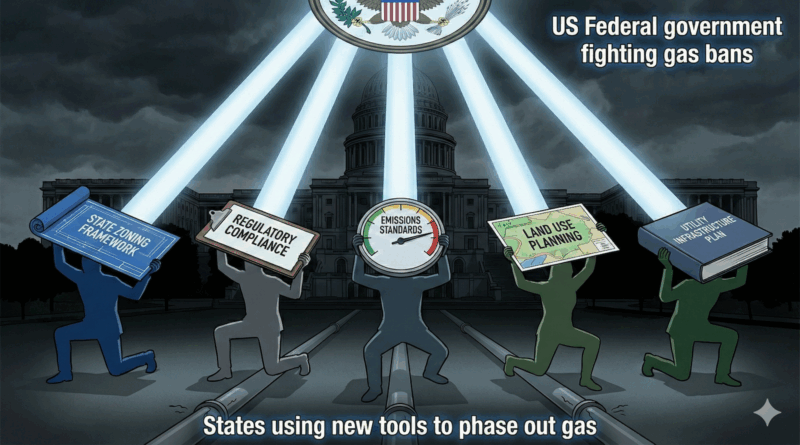
States are not limited to blunt prohibitions when shaping the transition away from gas in new buildings. In fact, the most durable policy tools are those that operate upstream of appliance choice, focusing instead on systems, infrastructure, and outcomes. Federal preemption risk increases when local rules are framed as fuel or appliance restrictions. It falls when states regulate areas that have long been within their core authority, such as utility planning, public health, land use, and building performance. Designing policy around these domains allows states to guide electrification while avoiding the legal traps that explicit bans can trigger.
One of the most effective tools available to states is authority over utility infrastructure and cost recovery. Gas distribution systems exist only because regulators allow utilities to build assets and recover their costs from ratepayers. States can require utilities to justify any new gas mains as used and useful under long term demand forecasts that incorporate electrification trends. They can limit or eliminate subsidies for new line extensions, ending the practice of socializing connection costs across existing customers. They can also shorten depreciation periods for new gas assets or require higher evidentiary thresholds for approval. None of these actions regulate appliances. They simply recognize that extending a declining network creates financial risk that regulators are obligated to manage.
Building performance standards provide another powerful pathway. Rather than dictating fuels or technologies, states can set maximum energy use or emissions thresholds for new buildings. These standards apply to the building as an integrated system and are technology neutral on their face. Developers are free to choose any combination of envelope, equipment, and controls that meets the target. In practice, meeting stringent performance or emissions limits with gas systems becomes difficult or uneconomic, especially over time as standards tighten. Because these rules regulate outcomes rather than appliances, they sit well outside the scope of federal appliance efficiency law.
Public health and safety authority is similarly robust. States have long regulated buildings to reduce fire risk, improve indoor air quality, and protect occupants from hazardous materials. Combustion appliances introduce known risks, including nitrogen dioxide exposure, carbon monoxide, and explosion hazards. States can ground electrification policy in formal health findings, agency rulemaking, and updated safety codes that address these risks directly. When policies are tied to documented health outcomes rather than energy preferences, courts are far more deferential. Federal law does not preempt state police powers in these domains.
Land use and planning authority also offers states and cities wide latitude. Zoning decisions, development approvals, and conditions placed on new construction have always shaped infrastructure outcomes. States can authorize local governments to require lifecycle cost analysis, emissions disclosure, or system compatibility as part of permitting for new developments. They can mandate all-electric construction on public land or for publicly financed housing, setting market norms without regulating private appliances directly. These approaches influence what gets built without triggering the framing of a ban.
Finally, states can strengthen their position by acting at the state level and then delegating authority downward, rather than relying solely on municipal action. Courts are generally more deferential to statewide energy and infrastructure policy than to fragmented local experimentation. Clear legislative findings that distinguish infrastructure regulation from appliance standards, coupled with severability clauses and administrative records grounded in economics and health, reduce the risk that a single adverse ruling collapses an entire policy framework. The lesson emerging from recent litigation is not that phasing out gas is legally impossible, but that policy design matters. States that focus on systems rather than symbols retain far more control over their energy futures.
States have begun responding by applying the tools already described, shifting away from explicit bans and toward mechanisms that shape outcomes through infrastructure economics, system performance, and regulatory authority. The most common entry point has been gas utility regulation. New York provides a clear example. By repealing the long standing 100 foot rule, which required existing gas customers to subsidize the cost of connecting new customers, the state removed an implicit incentive that had quietly encouraged gas system expansion for decades. Public filings by state regulators estimated the subsidy at hundreds of millions of dollars over time. Ending it did not prohibit gas hookups, but it changed the economics enough that many new developments now default to all-electric designs. Oregon and Washington have implemented similar reforms through utility commission decisions that phase out or sharply limit line extension allowances, forcing new customers to bear the real cost of new gas infrastructure. California has taken this approach further by tightening oversight of gas utility capital planning and ending electricity line extension subsidies for mixed fuel new construction, aligning utility incentives with long term electrification goals rather than short term load growth.
Building performance standards represent a second major pathway. Colorado and Maryland have adopted statewide requirements that large buildings meet declining energy or emissions intensity targets over time. These rules are framed around system performance rather than fuel choice. Developers and building owners retain flexibility in how they comply, but continued reliance on on site combustion becomes increasingly difficult as standards tighten. Massachusetts uses a different but complementary approach, enabling municipalities to opt into state defined stretch and specialized energy codes that set higher performance thresholds for new construction. Cities choosing these pathways do not ban gas directly. They adopt building wide standards that are easier to meet with electric systems. California has also leaned heavily on this tool, updating building codes and utility rules to favor high efficiency electric equipment while removing legacy assumptions that once advantaged gas.
Public health and safety authority has been used more quietly but remains important. States including California, New Jersey, and Massachusetts have updated indoor air quality standards, fire codes, and building safety requirements in ways that increase scrutiny of combustion systems in dense residential construction. These changes are typically justified through health department findings and safety analyses rather than energy policy. While they rarely make headlines, they influence design decisions early in the permitting process and reinforce the shift away from gas without invoking fuel specific mandates.
Land use and planning authority rounds out the toolkit in practice. States such as California, Washington, and New York have expanded the ability of local governments to condition development approvals on lifecycle cost analysis, emissions disclosure, and infrastructure compatibility. Public land development requirements have been particularly influential. Mandating all-electric construction for state funded housing, schools, and government buildings has normalized electrification in the construction industry and reduced perceived risk for private developers. These decisions shape markets through precedent rather than prohibition.
Taken together, these examples show that states are not improvising in response to federal pressure. They are methodically applying established tools in ways that steer new construction away from gas while reducing legal exposure. Utility regulation constrains expansion of gas infrastructure. Building performance standards make combustion increasingly unattractive. Health and safety rules elevate the risks of indoor combustion. Planning and procurement policies shift market norms. The result is a coordinated but decentralized phase out of new gas hookups that relies on governance fundamentals rather than symbolic bans, and that increasingly defines the leading edge of energy policy in the United States.
These pockets of the future share a common trait. They regulate systems, infrastructure, and outcomes rather than appliances or fuels. They rely on state authority over utilities, land use, and public health, areas where federal preemption is weaker. They also recognize that the energy transition is not only about adding clean supply but about managing the decline of legacy systems in a way that minimizes harm.
At its core, the debate over new gas hookups is about governance during transition. Allowing new connections is often framed as preserving consumer choice, but in reality it commits households and ratepayers to a system that is becoming more expensive, riskier, and misaligned with climate and health goals. Preventing new hookups is not radical. It is a conservative approach to infrastructure planning that avoids creating future stranded assets and public liabilities.
Every new gas connection built today increases the scale of the problem that must be solved tomorrow. States and cities that act early have more options and lower costs. Those that delay face sharper tradeoffs later. The legal conflict unfolding now is not just about statutes and preemption. It is about whether governments can act on clear economic, health, and climate signals before long lived infrastructure locks in outcomes that no one ultimately wants to pay for.
Sign up for CleanTechnica’s Weekly Substack for Zach and Scott’s in-depth analyses and high level summaries, sign up for our daily newsletter, and follow us on Google News!
Have a tip for CleanTechnica? Want to advertise? Want to suggest a guest for our CleanTech Talk podcast? Contact us here.
Sign up for our daily newsletter for 15 new cleantech stories a day. Or sign up for our weekly one on top stories of the week if daily is too frequent.
CleanTechnica uses affiliate links. See our policy here.
CleanTechnica’s Comment Policy