
Toyota & Daihatsu Roll Out Shared Electric Kei Vans for Japan’s Last-Mile Logistics

Support CleanTechnica’s work through a Substack subscription or on Stripe.
Or support our Kickstarter campaign!
Toyota and Daihatsu Motor Co., Ltd. have begun rolling out battery-electric kei commercial vans in Japan, using a shared platform and powertrain aimed at accelerating electrification in the country’s last-mile logistics sector.
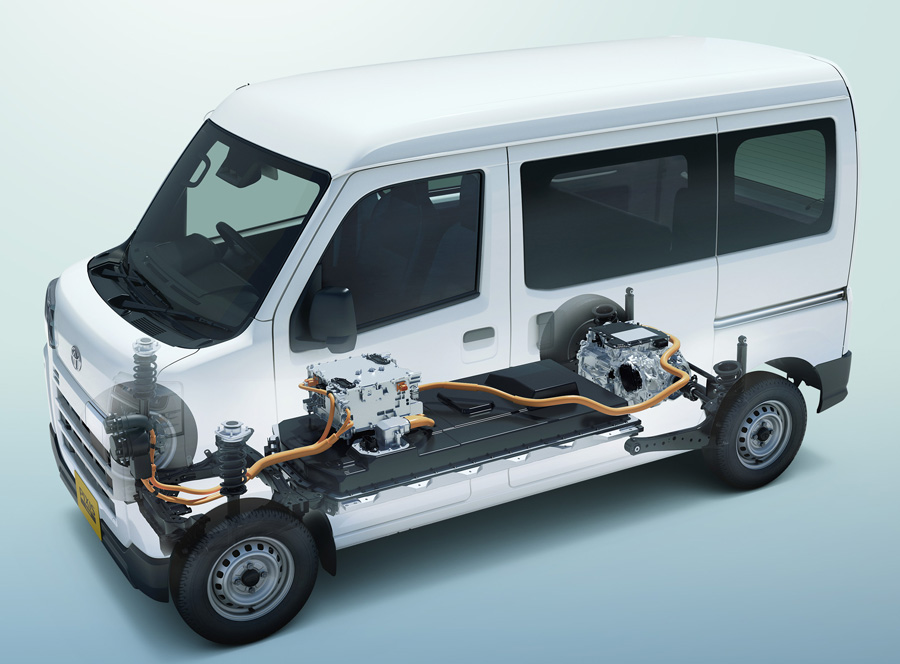
Toyota’s contribution comes in the form of the Pixis Van BEV, while Daihatsu will sell its own versions as the e-Hijet Cargo and e-Atrai, with nationwide sales starting February 2. Though marketed under different brands, the vehicles are mechanically identical, reflecting long-standing badge-engineering and OEM supply arrangements within Toyota Group.

The electric vans were jointly developed by Toyota Motor Corporation, Suzuki Motor Corporation, and Daihatsu, combining Suzuki’s and Daihatsu’s expertise in kei-vehicle packaging with Toyota’s electrification systems. Planning also involved Commercial Japan Partnership Technologies Corporation, a multi-company initiative focused on improving logistics efficiency and reducing emissions.
All versions are powered by Daihatsu’s e-SMART ELECTRIC system, featuring a 36.6-kilowatt-hour lithium-ion battery mounted beneath the floor and a rear-wheel-drive e-axle integrating the motor, inverter, and reduction gear. Output is rated at 47 kilowatts and 126 Newton-meters of torque, while maximum payload remains unchanged at 350 kilograms, matching gasoline models.
The vans deliver a WLTC cruising range of 257 kilometers, currently the longest claimed among electric kei commercial vans in Japan. Toyota and Daihatsu say this is sufficient to cover a full day of urban delivery work, a key requirement in a segment where vehicles operate on narrow streets and make frequent stops.

Kei commercial vehicles form the backbone of Japan’s small-scale logistics network. According to Toyota, they account for about 60 percent of the country’s commercial vehicle fleet as of September 2025. Daihatsu, which has manufactured mini commercial vehicles since the launch of the three-wheeled Midget in 1957, positions the new BEVs as the electric continuation of its role as a “working partner” for industries ranging from agriculture and construction to parcel delivery.
Structural reinforcements and a redesigned trailing-link rigid rear suspension were introduced to support the added battery weight while maintaining ride comfort and stability under load. The electric configuration also enables quieter operation, which the companies say is advantageous for early-morning and late-night deliveries.
Charging equipment includes a standard DC fast-charging inlet, allowing the battery to reach about 80 percent charge in roughly 50 minutes under optimal conditions. AC charging at 6 kW takes about six hours, based on in-house measurements. The vans also support vehicle-to-load (V2L) functionality through a 1,500-watt AC outlet, and vehicle-to-home (V2H) capability for emergency power supply, though additional hardware is required.
Cargo space is unchanged from gasoline versions, with one of the largest load areas among kei cab-over vans. The cargo bay measures 1,920 millimeters long, 1,270 millimeters wide, and 1,250 millimeters high, with a low floor to ease loading. Interior equipment includes wipe-clean seat upholstery, overhead storage, automatic air conditioning, a multi-information display showing battery status and energy use, and USB charging ports.
Pricing for the Toyota Pixis Van BEV starts at JP¥3.146 million (about US$20,100), including consumption tax, excluding recycling fees. Daihatsu has not positioned its e-Hijet Cargo and e-Atrai as distinct technical alternatives, instead emphasizing common specifications and manufacturing efficiency.
Production of the electric vans will take place at Daihatsu Motor Kyushu’s Oita (Nakatsu) Plant No.1, where they are built alongside gasoline vehicles on existing lines, without dedicated BEV equipment. The approach reflects the group’s broader multi-pathway strategy, prioritizing scalable electrification of high-volume work vehicles as Japan moves toward carbon neutrality. For fleet operators, the rollout means a familiar kei van—now electric—regardless of whether it wears a Toyota or Daihatsu badge.
The real question now is, seeing the photos of the Pixis and the e-HiJet, did they just edit the badge, nameplate, and background?
Support CleanTechnica via Kickstarter

Sign up for CleanTechnica’s Weekly Substack for Zach and Scott’s in-depth analyses and high level summaries, sign up for our daily newsletter, and follow us on Google News!
Have a tip for CleanTechnica? Want to advertise? Want to suggest a guest for our CleanTech Talk podcast? Contact us here.
Sign up for our daily newsletter for 15 new cleantech stories a day. Or sign up for our weekly one on top stories of the week if daily is too frequent.
CleanTechnica uses affiliate links. See our policy here.
CleanTechnica’s Comment Policy