

Support CleanTechnica’s work through a Substack subscription or on Stripe.
A massive round of renewable energy whack-a-mole is under way in the US, where President Donald Trump has been paying (some say bribing) wind industry stakeholders to walk away from their federal offshore leases, while right behind his back a torrent of solar power continues to flood the US grid with clean kilowatts. In the latest development, the leading solar-plus-storage firm Origis Energy has nailed down a massive haul of $900 million in new financing to accelerate its activities, bringing its total to more than $1.4 billion over the past three months.
Oh The Irony, It Burns
You can say that again. Oh the irony, it burns. In his desperation to score a win, any win against the steady march of decarbonization, Trump has taken the highly unusual (and possibly illegal) step of throwing billions of taxpayer dollars away on re-purchasing offshore wind leases, even as private sector dollars keep flowing into the solar industry.
Origis Energy is a case in point. The firm states that it has more than 20 gigawatts of solar and storage projects in its pipeline, include near-term projects totaling 5 gigawatts. If that sounds like a lot, it is. The activity level was much lower just 24 months ago. Origis has quadrupled its operations in the period leading up to and following Trump’s return to office last year, despite the sudden shift in federal energy policy.
The global financial community is also brushing off the sharp U-turn, at least in the solar power and energy storage systems space. Origis’s latest haul consists of $650 million in funded credit facilities and a $250 million Letter of Credit. In both cases, the arrangements enable Origis to accelerate the assignment of funds for a series of similar projects, without going through a cumbersome financial application and review process for each one.
The total of $900 million is the work of many hands among the leading lights of the US and global financial communities. Origis lists First Citizens Bank, ING Capital, Natixis, and Santander as Joint Bookrunners and Coordinating Lead Arrangers, with the US-headquartered, global-facing firm EIG nailing exclusive claim to the notes issued within the transaction.
“First Citizens Bank is serving as Administrative Agent and HSBC as Collateral Agent and Coordinating Lead Arranger. Bank Hapoalim, Bank Leumi, and MUFG [the Japan-based firm Mitsubishi UFJ Financial Group] are serving as Coordinating Lead Arrangers, Regions Capital Markets as Joint Lead Arranger, and Celtic Bank and TD Bank as participating lenders in the Facility,” Origis adds.
More Financing For More Solar Power…In Texas
The $900 million in financing follows a similar but smaller round in March, when Origis secured $545 million to support its 700-megawatt solar power pipeline in Texas. The total includes two Swift Air Solar II and Swift Air Solar III, which closed their financing last year.
The Texas angle is no surprise to those of you following the confluence of energy policy and partisan politics. Despite the bellowing, bloviating stream of hot air funneling from the red-state side of the Texas state legislature, Texas has emerged as a leader in installed solar capacity (here’s one recent example).
The blistering hot pace of solar power in Texas has also come back to bite Trump’s pledge to restore coal power. Texas State Attorney General and US Senate candidate Ken Paxton has fallen all over himself in an attempt to assist the President, only to encounter a tsunami of solar. In fact, by 2024 utility scale solar-sourced electricity was beginning to outpace coal on the Texas grid on a monthly basis. With community solar projects chipping in around the edges and no new coal power plants in sight, energy analysts anticipate that solar will beat coal on an annual basis this year.
Texas Is Sending Solar Power All Over The Country
The last time we checked, much fo the lignite coal mined in Texas goes to fuel the remaining coal power plants in the state’s notoriously isolated grid, and the state still has to import additional coal from Wyoming and elsewhere.
In contrast, solar is an exportable industry for Texas. The state has a solid, and growing, footprint on the solar manufacturing side, which means it is exporting solar equipment all over the country, to red and blue states alike, regardless of the limitations of its grid and regardless of state or federal policy obstacles, too.
The pace of domestic solar manufacturing, in Texas and elsewhere, could put a crimp in red-state plans for building new coal power plants. Alaska and Wyoming are among those aiming to host the first new coal power plants to be built in the US since 2013, when the 9332-megawatt Sandy Creek power plant finally went online in Texas after suffering through a series of damaging incidents that delayed its commissioning date by two years.
Perhaps those state policymakers should take another look at the Sandy Creek timeline before they chase pell-mell after coal power. From the start of construction in 2008 to its 2013 commissioning, developers spent five years bringing the plant to life, far surpassing the typical 12-18 months of shovels-in-the-ground work required to get utility scale solar power plants up and running.
Adding insult to injury, in April of 2025, just 12 years after operation commenced, Sandy Creek suffered a major, disabling failure that forced it to shut down completely. A return to operation is not expected until March of 2027, upon which the plant will earn the unenviable title to a full two years of idle time.
Solar Power Is Not The Only Power (Nor Is Wind)
Circling back around to Trump’s persistent attacks on offshore wind, blue East Coast states from Virginia on up to Maine are clearly getting the short end of the renewable energy stick. That’s particularly so in densely developed New Jersey, where space for new utility-scale solar power plants is limited but offshore wind is available in abundance.
New Jersey also lacks any in-state hydropower resources worth mentioning, but other East Coast states have demonstrated how to acquire out-of-state hydropower. Specifically, in January a transmission line connecting New England to hydropower plants in Canada kicked into gear, and earlier this week New York Governor Kathy Hochul announced the official commissioning of a massive hydropower transmission line from Canada to the Queens borough of New York City, accounting for up to 20% of the metro region’s electricity demand all in one blow.
Additionally, Massachusetts has launched a cross-border collaboration with Canada focusing on the development of offshore wind resources in the North Atlantic, so stay tuned for more on that.
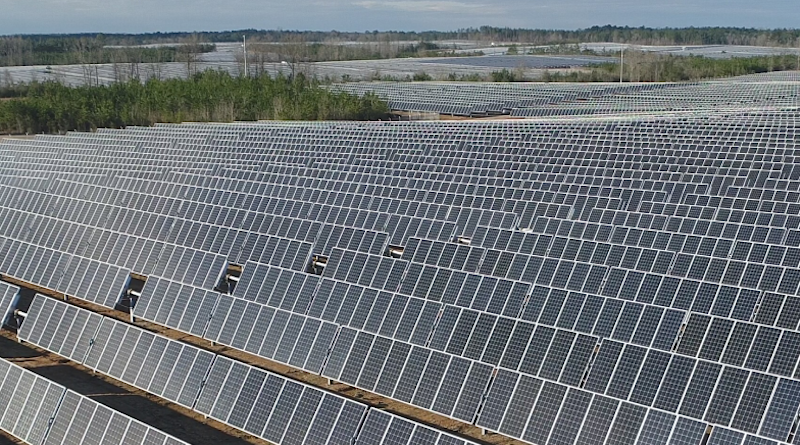
Photo: The Florida-based firm Origis Energy is accelerating its solar power plant pipeline with a new round of $900 million in financing, despite the sharp U-turn in federal energy policy (cropped, courtesy of Origis Energy).
Sign up for CleanTechnica’s Weekly Substack for Zach and Scott’s in-depth analyses and high level summaries, sign up for our daily newsletter, and follow us on Google News!
Have a tip for CleanTechnica? Want to advertise? Want to suggest a guest for our CleanTech Talk podcast? Contact us here.
Sign up for our daily newsletter for 15 new cleantech stories a day. Or sign up for our weekly one on top stories of the week if daily is too frequent.

CleanTechnica uses affiliate links. See our policy here.
CleanTechnica’s Comment Policy