
Validation of Equivalent Strength Methods on Stone Column-Stabilised Tailings Dam

From Complex 3D to Practical 3D: Revolutionising Tailings Dam Stability Assessments with Data-Backed Methods
Tailings storage facilities continue to evolve as operators look for more robust, data-backed methods to support long-term stability. In this technical case study, SRK Consulting presents a detailed numerical validation of Equivalent Strength Methods for a stone column-stabilised tailings dam. The paper focuses on how different modelling approaches compare in practice and how they can influence geotechnical decision making.
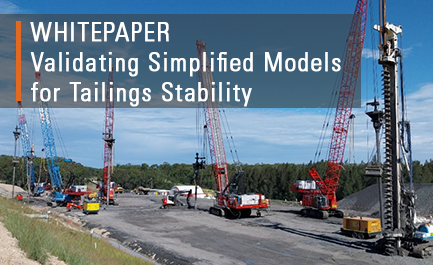
The study reviews a real project where stone columns were installed to reinforce a tailings dam foundation. Using advanced numerical modelling, the authors evaluate how Equivalent Strength Methods perform against more detailed representations of the ground improvement system. The results highlight where simplified approaches align with real behaviour and where they can diverge, particularly under complex loading conditions.
A key contribution of this work is in showing how Equivalent Strength Methods can be applied while maintaining a high standard of engineering reliability. The paper explains the implications for design accuracy, model calibration and safety factors while also addressing the practical trade-offs considered by engineers during project planning.
For operators, owners, and geotechnical teams, the findings offer guidance on when simplified models are appropriate and how to validate them effectively. The case study provides clarity on selecting modelling approaches that balance efficiency with technical rigour and outlines scenarios where a more detailed analysis may be warranted.
This whitepaper − authored by Mauro Giuliano Sottile (AR), Joe Rola (AU), Alejo Sfriso (AR) and A. Hubaut (AU) – is well suited for tailings engineers, geotechnical consultants, mine planners and decision makers seeking evidence-based approaches for reinforcing and validating tailing dam stability.
The post Validation of Equivalent Strength Methods on Stone Column-Stabilised Tailings Dam appeared first on International Mining.