
Want To Create A Viable And Sustainable Community Garden? These Folks Can Show You How


He wears a straw floppy hat, gray tee shirt, black shorts, and topsiders. His round face and easy smile belie his tenacity and vision. Bernie McBee has led an incredible mission to create a sustainable community garden in an economically disadvantaged area of Fort Pierce, Florida. With the support of the First Church parish, the community garden project, “Harvesting Hope & Seeding Solutions,” is up and running, generating 4500 pounds of produce this year.
For those of us with access to big box stores and corporate groceries, this might not seem like a big thing. However, the area around the church is a food desert.
The community garden launched in 2022 with three target groups in mind: senior citizens and individuals with disabilities who live in an adjacent high rise; a Hispanic church-within-the-church group; and food dispensaries at Sarah’s Kitchen and the Mustard Seed. Since then, another group, unhoused recipients of dignity showers on Saturdays, have been added to the list, and they take away personal bags of lettuces and other produce after each visit.
This community garden, now in its fourth year, is different from many others. It’s an example of sustainable agriculture, and efforts continue to expand the infrastructure so that year-round produce can be grown off-the-grid.
The garden exterior is ringed with marigolds and other flowers to attract pollinators. As I entered the fenced community garden footprint, I saw retired USDA workers tending the gardens. The project is driven entirely by 47 volunteers, who donated over 4500 hours in the past twelve months.

This southeastern Florida community garden’s growing timetable is a bit different than northern visitors might realize.
- Spring: cleanup.
- Late summer: garden preparation.
- October: planting season.
- Winter months: harvesting.
On this late spring day, as the long growing season comes to an end, peppers and tomatoes are the primary remaining crops — and these two vegetables are also peacock deterrents. The squawking, vibrant blue males and iridescent green-chested hens escaped a walled yard decades ago and now roam free in the Peacock District streets and neighborhoods. And they would love to munch on the community garden bounty if allowed. Neighbors in the nearby high rise building are welcomed to reach through the peacock-fence and pick peppers.

Sustainable Agriculture in a Volunteer-Led Community Garden
As in any garden, pests can decimate a crop. So the community garden incorporates biologicals as soon as blooms occur: lady bugs, lacy mites, predatory mites — the larva of which climb the plants and eat bugs. Flowering hemp attracts bugs and helps to keep the community garden as organic as possible. New bat houses may help, too.
Soil nutrition looks to 10-10-10 mixtures: nitrogen, phosphorous, and potassium. Composting helps and is divided into two sections: yard waste and food waste. The food kitchens can bring their scraps for the full circle of growing to food prep and return to the soil now.
The volunteers harvest heirloom seeds for next year’s crop, as hybrids don’t produce seeds. The produce distributed in its entirety includes lettuce, broccoli, cauliflower, tomatoes, tomatillos, Swiss chard, okra, romaine, eggplant, peppers, beans, collard greens, cilantro, mustard greens, kale, and cabbage. Beets and onions are new experiments, extending into root crops that may not be hardy for a sub-tropical climate.


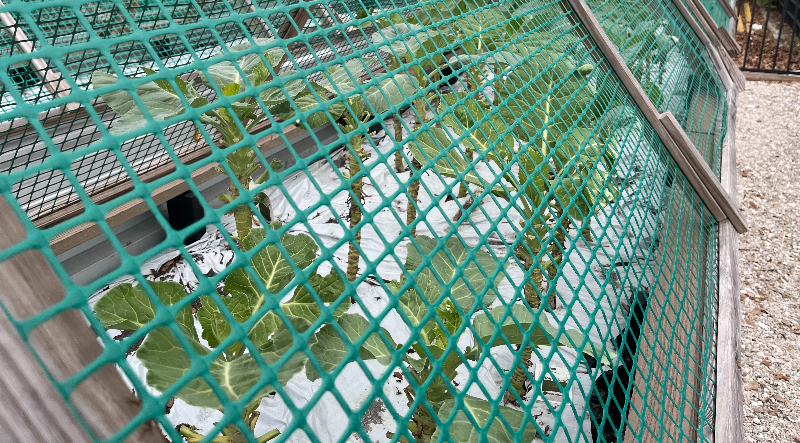
Harvesting and maintenance days at the community garden are Tuesday, Thursday, and Saturday at 9:30 am. Activities at the garden, which is located across the street from the Church (515 Ave. A) on Avenue A, include planting, watering, harvesting, weeding, and deadheading. In late summer, garden prep includes awakening the beds with additions of composed chicken manure and molasses. The beds are flooded, then covered with plastic. Deprived of oxygen, the beds create ammonia and kill bugs.
The Technology behind the Sustainable Community Garden — Now and in Coming Years
The piece-de-resistance is the combined solar and battery storage system. The solar array is engineered to withstand 160 mph winds. Six Tesla batteries produce 27 kW of power — enough to satisfy four homes. The system is so successful that the community garden sends electricity back to the City — it’s the third largest utility in the City, in fact.
Another innovation is in a moving bed: a biofilter. Fish swim in circles and peer out at me from a window. With nearly fifty blue tilapia on site, fish waste is plentiful. It is converted with bacteria to nitrate and nitrite, considered the best fertilizer.
Next is a recent state-of-the-art air conditioned, multi-purpose space. A three-door refrigeration unit keeps freshly picked produce cool prior to distribution. A fourth door is a freezer. The room is also used for weighing of harvested crops — part of the checks-and-balances for grant funding. A new hydrator allows for heirloom seed drying.

A “hoop house” is the current project under construction. It will allow for year-round crops, as plants must experience 74 degree temperatures for at least two hours per day in order to set fruit. Those temps don’t often occur in Fort Pierce in the summer months. Set 52″ away from sidewalls, vertical hydroponics will nurture lettuces and other leafy vegetables. Injected fertilizers will keep out pests in 9″ water beds, which will duplicate the beds currently in place in the community garden.

Several volunteers answer questions during our visit. Our tour group leader, Bernie, who is retired from the citrus industry, outlines other visions to expand the First Church community garden project. He’d like to see transitional housing: motel-like nightly rooms for unhoused folks. There would be a grocery store, where veggies from the garden would be distributed to neighbors. A greenhouse with climate-controlled growing would be added. They’d add another solar system.

This vision would require about $2 million for the purchase of two adjacent buildings and the construction of the necessary infrastructure. Once in place, the site could become an emergency location, as a 50 amp plug could be used for FEMA’s roaming refrigerated RV.
Thanks to the Sponsors
The original goal to assist food insecure people through the community garden was to reach 735 individuals over its four-year first phase. Year one alone saw 500 people served. The USDA designation helps, as an additional 2500 pounds of produce were gleaned from USDA experimental farms west of the City. An anticipated 10,000 pounds of produce is likely to be distributed by the end of the grant cycle.
As our tour comes to an end, the church bell gongs the hour, followed by the carillon song. First Church is grateful to the number of project partners who have made the community garden possible and who have helped to provide local access to fresh, healthy food for those who are struggling with food insufficiency.
- The USDA.
- Master gardeners.
- The Community Foundation Martin – St. Lucie.
- ACE Hardware.
- Pat Murphy.
- The Fort Pierce Garden Club.
- United Health.
- Countless members of the First United Methodist Church of Fort Pierce.
Resources
“Ribbon cutting.” First Church Fort Pierce.