
Waymo: Aim to Become “World’s Most Trusted Driver” and “New Reference Model for Human Collision Avoidance”


Support CleanTechnica’s work through a Substack subscription or on Stripe.
With the launch of the 2026 FIFA World Cup, Waymo is on a publishing spree this week.
Yesterday, it published a scientifically oriented article on a “new reference model for human collision avoidance.” This is the result of joint research with TU Delft, and a resulting paper was published in the journal Nature Communications. It centers around not just an average driver’s response to traffic conflicts, but standout drivers who are “careful and confident.” I presume this is the same as what we’d typically call a “defensive driver” — at least, that’s the term I learned when I was learning to drive nearly three decades ago.
Earlier today, the company also published an article on its mission of becoming the “world’s most trusted driver,” including why some of the Waymo staff work there.
These pieces are quite scientific and quite personal, respectively, so I’m sharing them in full below just as the Waymo team wrote them.
Introducing Waymo’s New Reference Model for Human Collision Avoidance
Today, we are proud to share that Nature Communications has published our joint research with TU Delft, advancing a breakthrough active inference framework to model human crash-avoidance behavior. This work marks a significant leap in enhanced capabilities and increased realism for our established methodology, providing a careful, competent human driver benchmark for collision avoidance. At Waymo, we call this model ReD (Reference Driver) and use it to assess the Waymo Driver’s ability to avoid crashes.
ReD represents the latest advancement in Waymo’s safety research, which includes a dozen published papers on behavioral reference models. It is built upon the same predictive processing framework that powers our established NIEON (Non-Impaired driver with Eyes ON the conflict) model and an earlier active inference model of adaptive human driver behavior, ensuring continuity in our approach. The central idea underlying these models is that human driving behavior can be generally understood as the minimization of surprise. While NIEON focuses on modeling when a human might react to a threat, ReD expands upon these capabilities to model the full closed-loop cognitive process. ReD simulates how a careful and competent human driver updates their beliefs as a situation evolves, manages uncertainty about other road users’ intentions, and selects the evasive maneuver, whether that is braking, swerving, or a combination of both.
For decades, the automotive industry has used physical and virtual crash dummies to evaluate a car’s safety features, including its hardware and structural integrity. ReD evolves this concept, serving as a behavioral benchmark for autonomous driving systems able to realistically represent reasonable expectations on how a careful and competent human driver responds to traffic conflicts.
As a general model, ReD can be applied to various scenarios and environments, including those with significant uncertainty, for example, where the intentions of other drivers are unclear. Crucially, unlike many traditional models that focus on last-second reactive maneuvers, ReD can model proactive avoidance, showing how a competent driver anticipates potential risks to avoid entering into a conflict in the first place.
“By grounding our model in active inference, we’ve achieved a holistic representation of human collision response,” says Arkady Zgonnikov, assistant professor at TU Delft. “This allows us to simulate the internal ‘surprise’ a driver feels during a conflict, providing a more human-like benchmark for autonomous driving systems that was previously impossible to automate at scale.”
The profound impact of this framework is echoed by Professor Karl Friston, a world-leading neuroscientist and the creator of active inference. Reviewing the fundamental research published in Nature Communications, Friston said: “This is a remarkable piece of work. It is exactly what active inference was built for: namely, to equip autonomous artefacts with situational awareness and the kind of constrained information-seeking both our driving—and daily lives—turn upon. Technically, this is a tour de force, in terms of the generative modeling and scenarios considered. It showcases the importance of multiple constraint satisfaction; here, elegantly embedded in a norm-conditioned particle filter (for planning as inference). It is also pleasing to see such a fecund collaboration between academia and industry—in the service of our common good (and safety).”
One of the most powerful aspects of ReD is its scalability. Because it is built on first principles from neuroscience, it can be extended to modeling a wide range of road user behaviors beyond collision avoidance, for example adaptive driver behavior and road user interactions. Furthermore, rather than relying on manual, hand-coded rules and human annotations, ReD is fully automated, thus potentially allowing for application on large test sets with thousands of scenarios. The model can represent and evaluate numerous complex, real-world crashes in a virtual environment, identifying performance improvements with unprecedented speed and efficiency.
“Evaluating AV safety is multifaceted, and understanding how a human handles conflict is a critical piece of the puzzle,” says Mauricio Pena, Chief Safety Officer at Waymo. “By establishing this reference model of a competent human response, we can help the industry move toward a shared, scientifically grounded approach for evaluating collision-avoidance behavior.”
Safety is a collaborative effort. We are actively working with researchers, regulators and standards organizations like SAE to establish consensus around the application of driving behavior reference models in the context of AV evaluation. To support this mission, we’re making the research code for our active inference model available* under an academic license. By sharing our research and establishing a transparent, scientifically grounded benchmark for what constitutes a competent human response, we can help the entire autonomous vehicle industry move toward a safer, more predictable future on the road.
*The code is provided under a non-commercial license that permits use for research, teaching, personal experimentation, and scientific publication. This includes use of the licensed materials for benchmarking in academic or applied research publications.
Today, we are launching our new national campaign, “Because,” and we want to invite you to join a conversation about the future of driving. We are excited to share our mission to be the world’s most trusted driver, and we are equally eager to hear your thoughts.
For more than 16 years, Waymo has been developing autonomous technology to complement our transportation system with additional safe and accessible options. As our service has grown, we’ve collaborated with local officials, community organizations, and neighbors to understand how we can best serve them. Now, as autonomous vehicles become an everyday staple, we want to open that dialogue even further.
Today, Waymo provides hundreds of thousands of fully autonomous trips every week. As people see our vehicles driving around their neighborhoods, we want to talk openly about why we do this work and who we are building for. At its core, the message of “Because” is simple: Waymo is working to make roads safer, not because humans aren’t enough, but because to us, they’re everything.
Road safety remains a critical challenge, with car crashes injuring over one million people every year in the U.S. Driving requires intense, continuous focus—yet we all experience everyday distractions, fatigue, and stressful moments. Being human means we aren’t perfect, but it also means we have a remarkable capacity to create extraordinary technology to protect our loved ones and communities.
We know that conversations about autonomous vehicles can bring uncertainty and skepticism. That’s completely understandable. While we provide hundreds of thousands of trips each week across the country, this technology is still new to many. “Because” is our invitation to engage openly—whether you already ride with us every day, rely on the driver-assist features in your own car, or are still forming your opinion.
While there isn’t a human behind the wheel of a Waymo vehicle, this technology is built by people, for people. We know that creating meaningful change takes time and immense dedication. That is why we are constantly refining our technology and pursuing a safer path forward.
When people join the Waymo team, we always ask them: Why do you care about autonomous driving? Thousands of employees later, we’ve amassed a library of deeply personal stories from the people building our service, and we invite you to take a look.
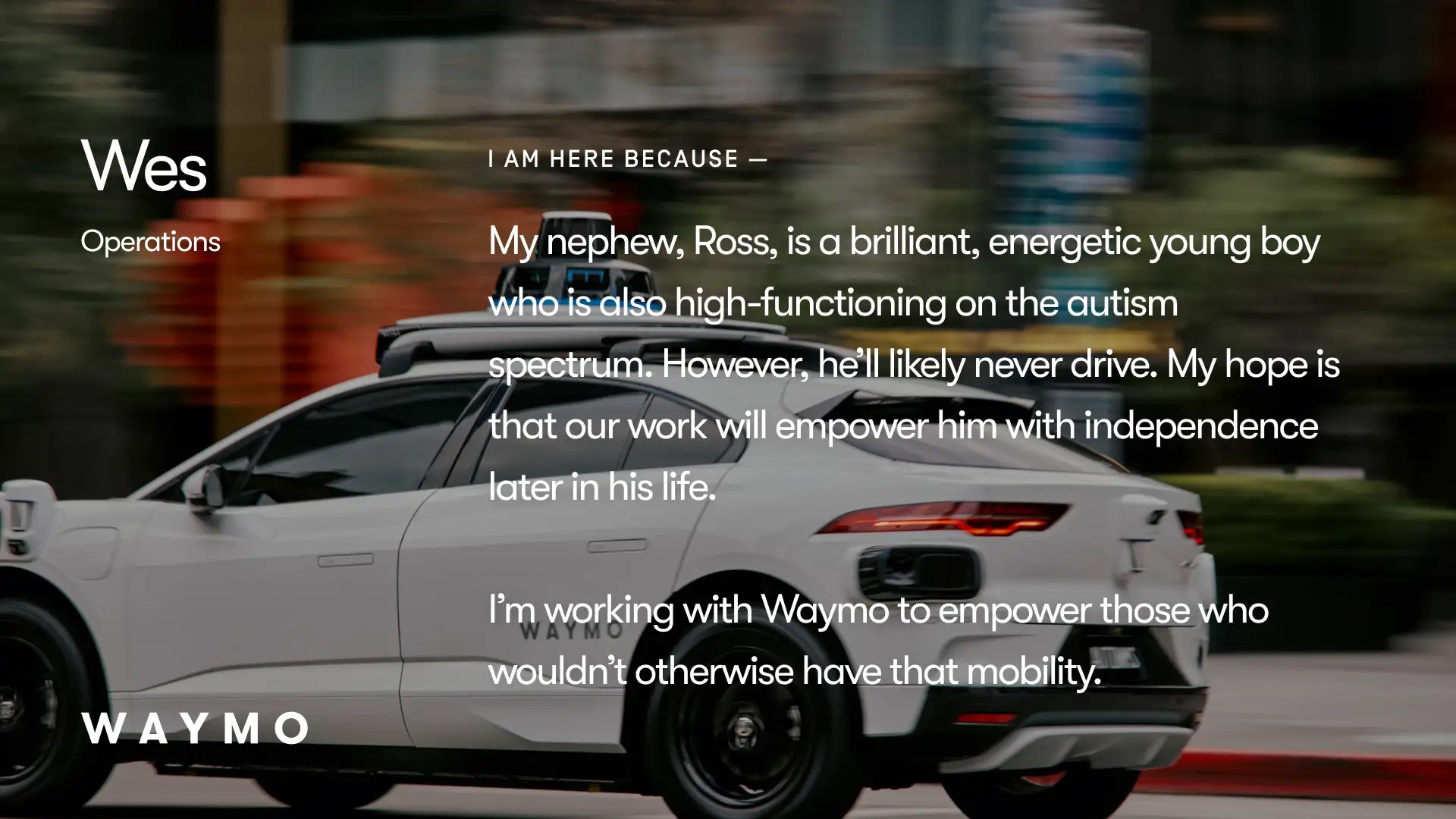

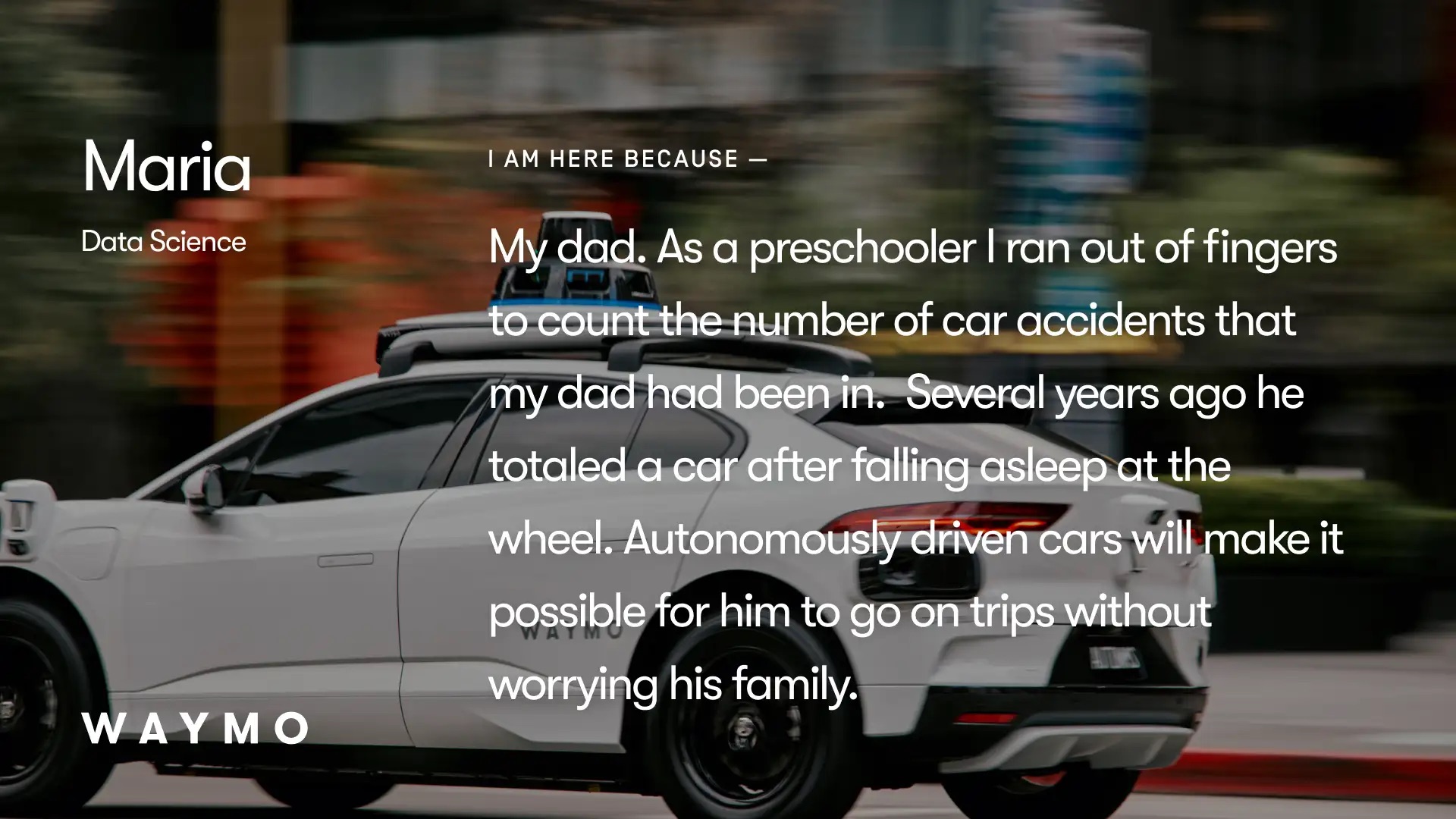
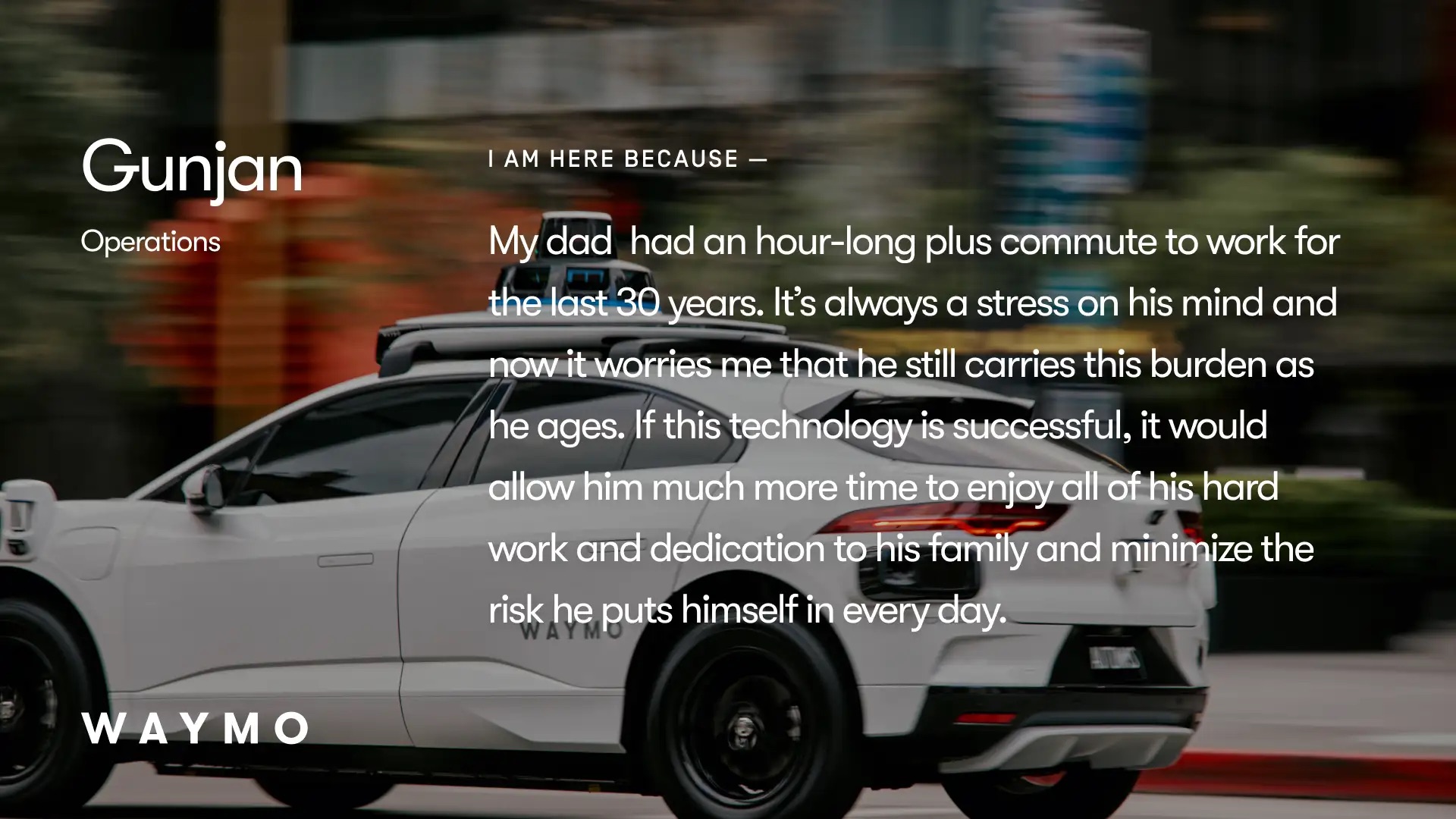


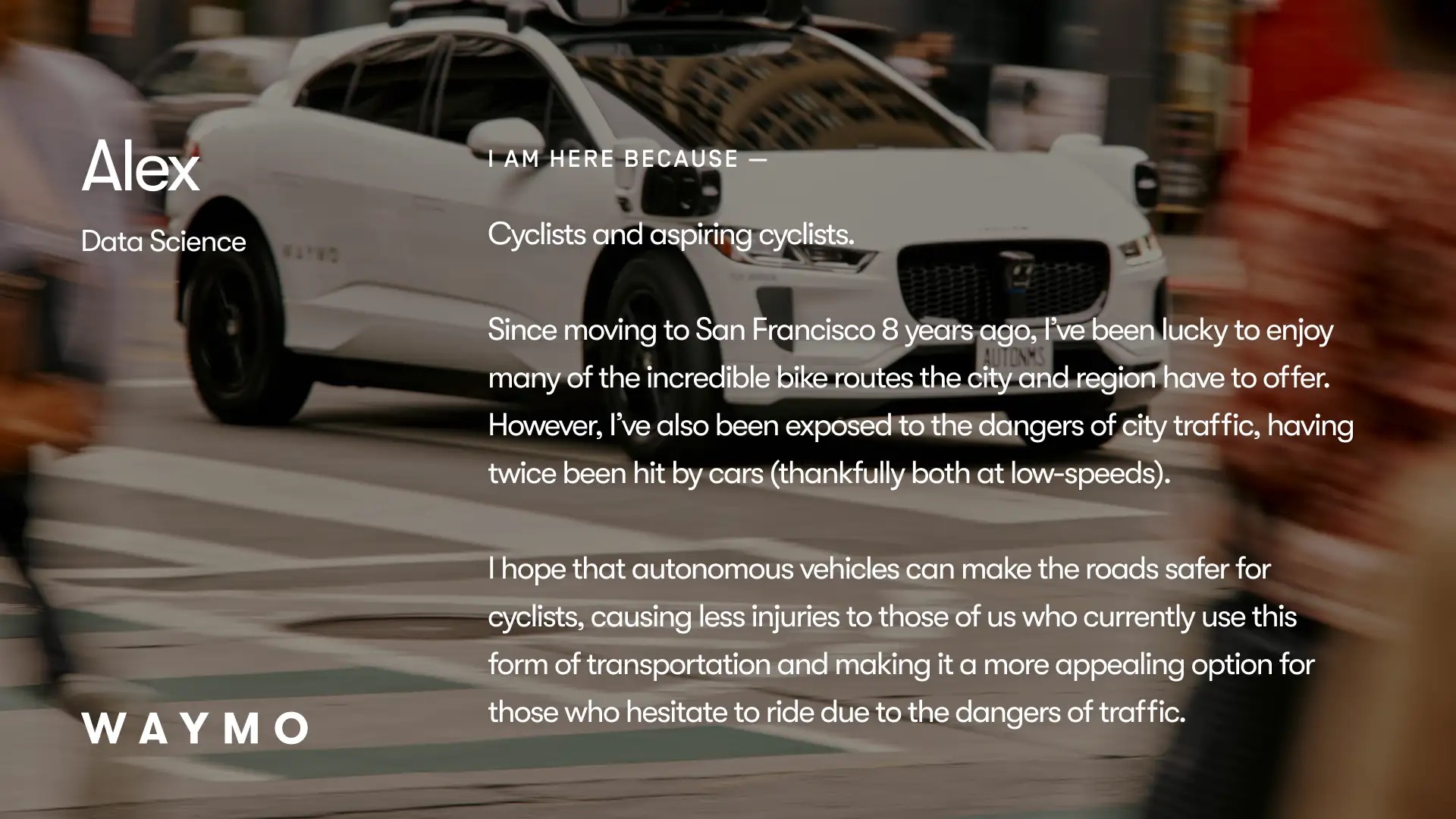

As we share our “Because” with the world, we invite you to share yours. Use the hashtag #MyBecause to tell your story. When we open up this dialogue, we quickly realize just how much the shared belief that protecting human life and making our communities safer brings us together.
Sign up for CleanTechnica’s Weekly Substack for Zach and Scott’s in-depth analyses and high level summaries, sign up for our daily newsletter, and follow us on Google News!
Have a tip for CleanTechnica? Want to advertise? Want to suggest a guest for our CleanTech Talk podcast? Contact us here.
Sign up for our daily newsletter for 15 new cleantech stories a day. Or sign up for our weekly one on top stories of the week if daily is too frequent.


CleanTechnica uses affiliate links. See our policy here.
CleanTechnica’s Comment Policy