
We Need To Take Steps To Protect Ourselves From AI And Other Forms Of Digital Surveillance

Support CleanTechnica’s work through a Substack subscription or on Stripe.
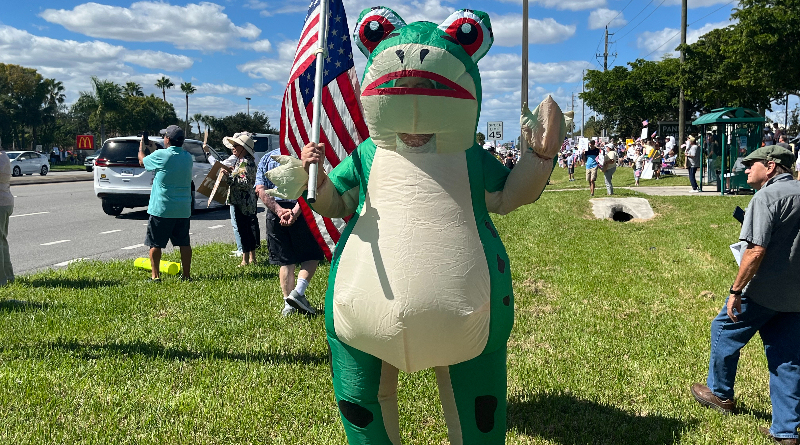
My pals and I have attended several protests to make transparent President Donald J. Trump’s abuse of power. We’re concerned about the Administration’s withdrawal from the Paris climate agreement, corruption at the highest levels of the US federal government, executive orders that contradict the US Constitution, job cuts to federal workers, threats to the autonomy of the Federal Reserve — oh, and so much more. While we’re standing out on busy streets, symbolizing the mass grassroots mobilization to defeat authoritarianism, though, we make ourselves vulnerable as targets — of renegade drivers who might swerve into the crowd, yes, but also because of digital surveillance. The evidence is clear: if we’re joining any protests, as is our right under the First Amendment, we need to protect ourselves from AI.
Think you’re exempt from AI’s long eye? Think again. Chuck DeVore writes on Fox News this week with the intention to explicitly instill fear in his readers.
“The radical left is escalating its tactics in a calculated bid to create martyrs. We’ve seen this before, but today’s ideological fervor, backed by deep-pocketed donors and foreign influences, makes it far more dangerous … Backing down would hand the left a victory, emboldening further defiance and eroding the rule of law. Instead, smart enforcement will drain the swamp of fraud, secure our borders, and deny radicals their prized martyrs. America has faced down worse threats. Resolve wins the day.”
Such comments seed mistrust against US citizens who legally organize and rebel against those in power. AI draws from this pool of disinformation to draw conclusions.
The media plays an essential role in the social reaction to events of national significance. The fear generated by some media outlets constructs an altered perception of reality, so that some audiences come to believe that the world is more dangerous than it actually is. Murat Selvi at the TRT Research Centre says this manipulated perception can shape individuals’ understanding of everything from “violence and illness to human rights, freedom, and democracy.” The effect can be to sustain a state of perpetual social alarm.
While it’s important to access a range of credible sources to help us make good decisions about health, the environment, economics, and politics, not everyone has the time or inclination to do so. So reconstructed digital reality can “eclipse the physical world, drawing people into a false and alarming narrative that often seems more appealing and coherent than the truth itself.”
What can we do to make it more difficult for the government to intercept our communications, determine our real-time location, or gain access to your private information? The team at Wired has outlined two key elements of digital surveillance for protesters, noting, “You should be mindful of both.”
- One is the data that authorities could potentially obtain from your phone if you are detained, arrested, or they confiscate your device.
- The other is surveillance of all the identifying and revealing information that you produce when you attend a protest, which can include wireless interception of text messages and more, and tracking tools like license plate scanners and face recognition.
Robert Reich captures the zeitgeist and our need to protect ourselves from AI — and our US federal government. “What’s at stake isn’t just American democracy,” he writes. “It’s also your safety and security and that of your friends and loved ones. This is personal — to every one of us.”
It Starts with your Smartphone
Should you bring your phone to a protest? It’s necessary for those of us who want to document that critical mass of people and sentiments. Others become citizen journalists and documentary filmmakers. We’re also accustomed to using our phones to locate friends in a crowd. What if we get arrested? We need our phone to call a lawyer.
But every time we carry our smartphones, we are sharing identifying information with others like law enforcement officials. Our phones combine cellular, GPS, and Wi-Fi information, so they’re highly trackable. In other words, traditional calls and text messages are vulnerable to surveillance.
For example, ICE has bought access to a social media and phone surveillance system that is designed to monitor a city neighborhood or block for mobile phones, track the movements of those devices and their owners over time, and follow them from their places of work to home or other locations. An investigation by 404 Media indicates that the surveillance will continue as part of the Administration crackdown on protected speech.
“This is a very dangerous tool in the hands of an out-of-control agency. This granular location information paints a detailed picture of who we are, where we go, and who we spend time with,” Nathan Freed Wessler, deputy project director of the American Civil Liberties Union’s Speech, Privacy, and Technology Project, told 404 Media.
The team at Wired emphasizes the importance of encrypting your smartphone’s contents and remind us that “iOS devices have full disk encryption on by default if you enable an access lock.” The Surveillance Self-Defense guide to protecting yourself from electronic surveillance for people all over the world suggests you turn off the functionality of biometrics, as there is currently less protection against compelled face and fingerprint unlocking than there is against compelled password disclosure.
An inexpensive Faraday bag is also a good investment. It blocks all of its radio communications through electromagnetic wave management.
Surveillance is More Sophisticated Today than You Might Think
More broadly, everyone who attends a protest needs to consider—perhaps more than ever before—what their tolerance for risk might be, from mere identification to the possibility of arrest or detention. Law enforcement also uses a whole lot of technology these days to determine who is protesting and to monitor the nature of those protests. These devices include cameras, facial recognition, geolocation, and data mining. Demonstrators can be picked out of a crowd, arrested, or even detained without cause.
Face masks and sunglasses not only protect against picking up a transmittable illness, they also make it more difficult for police to identify you using facial recognition technology. Wearing a face mask and sunglasses is a start, but a Halloween mask is even better. Police use automated license plate readers to track protesters. If you can ride a bicycle or walk to the protest, you may prevent your license plate from being tracked.
Authorities can come to your online presence by looking for information about you in particular and also draw upon bulk data analysis tools for real-time monitoring that connects people to their online activity. Your written posts on social media may contain metadata like time stamps and location information that could help authorities track protest crowds and movement, say the Wired authors.
This week Chris Armitage of The Existentialist Republic compels us to take action. “Don’t let anyone make you feel stupid for demanding justice. Don’t let anyone tell you we can’t have accountability.” Yet people must assess the risks of every demonstration or other situation and judge for themselves the benefits of maintaining their personal privacy against the need to document the actions of government agents.
Want to read more about AI’s insidious influence on our lives? CleanTechnica’s senior writer, Steve Hanley, has recently released a three-part series — Part One, Part Two, and Part Three— that offers a deep dive into AI and how it is altering our communications.
Resources
- “Fear as a tool: From public opinion to public hysteria.” Murat Selvi. TRT World Research Centre. May 6, 2025.
- “How to protest safely in the age of surveillance.” Andy Greenberg and Lily Hay Newman. Wired. January 8, 2026.
- Inside ICE’s tool to monitor phones in entire neighborhoods.” Joseph Cox. 404 Media. January 8, 2026.
- “Left seeks martyrs to fuel anti-Trump uprising as ICE enforcement operations ramp up nationwide.” Chuck DeVore. Fox News. January 12, 2026.
- “My first 72 hours in Minneapolis and how I got an ICE agent to scream “MAKE AMERICA GREAT AGAIN.” Christopher Armitage. The Existentialist Republic.
January 12, 2026. - “Security news this week: ICE can now spy on every phone in your neighborhood.” Lily Hay Newman and Matt Burgess. Wired. January 10, 2026.
- “Surveillance self-defense guide.” ssd.eff.org.
- “Why are people protesting?” Elena Ianchovichina, Martijn Burger, and Caroline Witte. Brookings. January 29, 2020.
- “You could be next.” Robert Reich. Substance. January 13, 2026.
Sign up for CleanTechnica’s Weekly Substack for Zach and Scott’s in-depth analyses and high level summaries, sign up for our daily newsletter, and follow us on Google News!
Have a tip for CleanTechnica? Want to advertise? Want to suggest a guest for our CleanTech Talk podcast? Contact us here.
Sign up for our daily newsletter for 15 new cleantech stories a day. Or sign up for our weekly one on top stories of the week if daily is too frequent.
CleanTechnica uses affiliate links. See our policy here.
CleanTechnica’s Comment Policy