

Support CleanTechnica’s work through a Substack subscription or on Stripe.
Pulp and paper mills sit at the intersection of several decarbonization pressures. They burn large volumes of fossil gas in lime kilns and recovery boilers. They buy significant amounts of industrial oxygen for delignification and bleaching. They operate in communities where economic continuity matters at least as much as emissions reduction, likely more. This makes them tempting targets for hydrogen developers who are trying to find new markets as other hydrogen narratives lose ground.
In Prince George the firm Teralta attempted what was possibly the only hydrogen-for-energy scheme in British Columbia with a chance of working. Their idea was to capture hydrogen produced as a by-product by the nearby chemical plant Chemtrade (from its sodium-chlorate process), purify and pipe it about 500 metres to a nearby pulp mill owned by Canfor. Under the plan the mill would burn that hydrogen in place of fossil natural gas, displacing roughly 25% of the mill’s gas energy use. Proponents argued this was “zero-emission” hydrogen because it was already being produced, so no new electrolysis was required.
In principle it seemed an elegant, low-cost workaround: reuse an existing waste stream rather than build an expensive electrolyzer. But despite the technical demonstration being completed, the project collapsed—one of seven hydrogen for energy projects that were quietly shelved in the past couple of years in the province—when Chemtrade shut down its chlorate line and Canfor closed the pulp mill. Without the chemical feedstock or the mill demand there was no hydrogen, and the project died, a stark reminder how fragile even the best-conceived hydrogen plans can be when they hinge on narrow industrial supply chains.
The Kamloops Clean Energy Centre proposal which crossed my screen today with its announcement is a clear example of hydrogen for energy types desperately seeking for any reason to exist. It is presented as a modern solution for industrial decarbonization, led by an Indigenous economic development corporation, with a promise of cutting natural gas use at the mill. It reads well at a distance. When the engineering and economics are examined, the picture looks different. The structure resembles an expensive oxygen supply project that produces by product hydrogen at high cost, supported by public funding and an expectation of long term regulated offtake.
The Kamloops project centers around a 10 MW electrolyzer that would produce about 4 tons of hydrogen and 32 tons of oxygen per day. The partners include Sc.wénwen, Kruger, and Elemental Clean Fuels. Reporting describes an intent to reduce the mill’s fossil gas use by about 16% by routing the hydrogen to the lime kiln. That is a small contribution to total thermal demand, but it is described as an important step toward decarbonization.
The scale of the proposal matters. A 10 MW electrolysis plant is a major capital investment, usually on the order of tens of millions of dollars. It requires about 240 MWh of electricity per day if it runs steadily. The partners have already secured over $1.5 million in early stage federal and provincial grants to carry out feasibility and engineering work. I think FortisBC is evaluating an offtake agreement that would allow the utility to classify hydrogen as low carbon gas, which would allow the cost to be carried by ratepayers under existing regulation. This combination of public money, utility rate structures, and hydrogen developer ambition is what brings the Kamloops project into focus.
To understand whether this is a rational investment, it is important to look closely at how pulp mills use energy and oxygen. The lime cycle converts calcium carbonate back to calcium oxide at high temperature. The chemistry is simple and unchanged for a century. The kiln requires between 6 GJ and 10 GJ of heat for each ton of CaO. A mill the size of Kruger Kamloops produces about 1,100 to 1,200 tons of pulp per day, from what I can discern from public data. That production requires around 250 kg of CaO per ton of pulp. The kiln energy requirement therefore sits in the range of 1,700 to 2,900 GJ per day. Converting that into electrical terms, it is equivalent to roughly 20 to 35 MW of continuous thermal duty. The electrolyzer’s hydrogen stream carries about 480 to 560 GJ per day. The hydrogen from this project would therefore supply about 20% to 25% of the kiln’s daily heat load. That is a useful fraction, but it is not a full decarbonization path and it requires a high input of electricity per unit of fossil fuel avoided.
The oxygen side of the mill is a different story. Modern kraft mills use oxygen for delignification and reinforced extraction stages. Typical oxygen demand is 20 kg to 30 kg per ton of pulp. With Kamloops production, that works out to 22 to 35 tons of oxygen per day. These volumes are normally supplied in two ways. Medium sized mills often buy delivered liquid oxygen under contract from industrial gas suppliers, and that’s likely what Kamloops is doing, otherwise it wouldn’t be considering installing an electrolyzer.
Larger mills sometimes install an on site cryogenic air separation unit or smaller PSA/VSA oxygen generators. Both systems are mature. They operate at high reliability with commodity parts. They require modest amounts of electricity. A PSA or VSA oxygen generator sized for 32 tons per day draws on the order of 0.3 MW to 0.5 MW. Even a small cryogenic unit would require only 0.3 MW to 0.6 MW. These systems have capital costs in the low single digit millions. They meet mill oxygen needs with high reliability and without complex integration. An electrolyzer sized to deliver the same oxygen produces the right mass flow, but it requires roughly 20 to 30 times more electricity. It also brings a capital burden that is three to ten times larger. The additional cost is carried entirely to produce hydrogen that covers only a fraction of kiln energy.
The energy balance makes the choice even starker. The electrolyzer pathway consumes the full 240 MWh per day of electricity to make hydrogen and oxygen. With realistic system performance, only about 60% of that input shows up as useful heat in the kiln once electrolysis losses and burner losses are counted, so the mill would get on the order of 140 MWh of kiln heat from that 240 MWh. By contrast, a dedicated cryogenic oxygen plant or PSA/VSA system sized for 32 tons per day of oxygen would only need roughly 10 MWh per day, leaving about 230 MWh available for direct process heat. An electric kiln driven by that remaining electricity could convert roughly 90% of it into heat, yielding more than 200 MWh of kiln heat. In other words, the same 240 MWh that is now being proposed to feed an electrolyzer would be enough to supply the mill’s oxygen needs through standard equipment and still provide far more usable heat if it were routed through an electric kiln instead of being turned into hydrogen first.
The difference in reliability between these pathways should not be discounted. PSA, VSA, and cryogenic oxygen plants are standard industrial assets with long established maintenance regimes. Electric kilns, should a mill choose to install them, are also simple machines with few moving parts, stable duty cycles, and predictable availability. The electrolyzer path introduces a long chain of specialized equipment that includes water purification systems, electrolyzer stacks, power electronics, compression, storage, safety systems, and complex controls. Each link adds failure modes. When an electrolyzer goes down, oxygen output stops immediately.
A mill that relies on electrolyzer oxygen for a significant portion of its delignification process must either maintain expensive parallel oxygen capacity or buy spot oxygen under emergency pricing. Spot oxygen delivered outside high volume contracts is costly and becomes a material operating risk. The reliability profile of the hydrogen pathway is therefore materially worse than either a dedicated oxygen plant with electrified kilns. When combined with the higher capital and operating cost, the reliability penalty becomes another argument against the electrolyzer route.
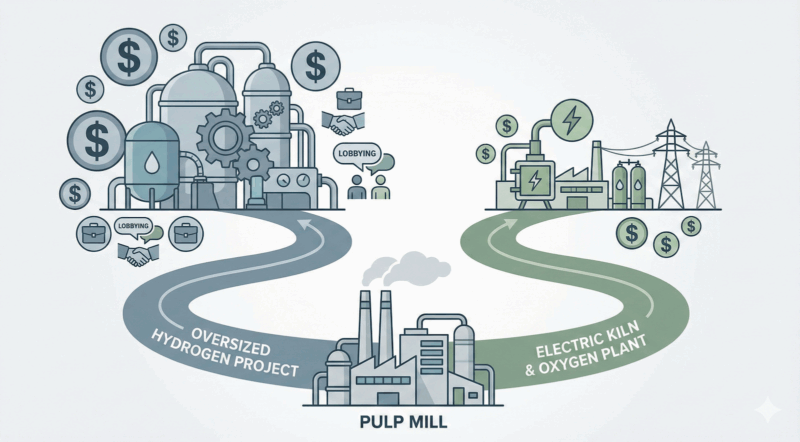
It’s worth stating this bluntly. The mill could avoid the burning of a lot more natural gas by avoiding hydrogen entirely, using bog standard oxygen manufacturing equipment and an electric kiln or two, with more reliable technologies that are more easily serviced, while spending a lot less capital and operating money. The hydrogen pathway is vastly more expensive than the alternative in upfront and operating costs. Just the $1.5 million in engineering and feasibility studies is vastly more than required for similar studies for the standardized equipment because so much of this is novel with no ecosystem in BC and the forestry industry. Sizing oxygen generation systems and electric kilns for pulp and paper is done constantly and has been for a long time.
It is important to ask why a pulp mill would entertain such a pathway. The answer is rarely found in process engineering. It is more often found in institutional incentives. Elemental Clean Fuels and its predecessor Cariboo Clean Fuels, now fully acquired by Elemental from what I can see, position themselves as developers of hydrogen and synthetic fuel projects. Their leadership includes at least one individual with prior experience as a North American executive of Irish firm Fusion Fuel.
Fusion Fuel promoted an integrated concentrated photovoltaic and electrolyzer concept where each solar panel produced hydrogen directly. Independent assessments, including mine when I stumbled across it in northern African green hydrogen proposal, found the approach operationally unworkable and very poorly thought through. The market eventually agreed. The company struggled, did a reverse stock split and has pivoted entirely out of hydrogen.
Elemental’s involvement in Kamloops appears rooted in the vain hope that niche industrial energy settings can anchor early hydrogen projects, even when the energy balance and capital cost tell a different story. The Canadian Hydrogen Association and Hydrogen BC also have visible roles. Their mandate is the advancement of hydrogen projects in any form that can be commercialized, which means with governmental money backstopping efforts. Their presence in the background of this project is unsurprising. These organizations have redirected attention toward industrial hydrogen as transportation and power sector hydrogen concepts have lost momentum.
FortisBC adds another layer. The utility is allowed to procure low carbon gas under the Greenhouse Gas Reduction Regulation. The regulation allows FortisBC to buy hydrogen at premium rates and recover the cost through its rate base up to a limit. This creates an incentive to support hydrogen production that might not otherwise survive scrutiny. A long term offtake agreement would anchor the Kamloops project and reduce risk for the developer. The mill itself would not be the main hydrogen buyer under this model. It would be the gas utility, just as at the failed Teralta project. The mill would instead benefit from local investment, possible energy cost reductions, although that’s deeply unlikely, and association with a decarbonization initiative, although they undoubtedly aren’t considering that hydrogen leaks and is an indirect greenhouse gas. Tk’emlúps gains an economic development asset and access to federal funding streams that prioritize Indigenous participation. From each party’s perspective, the arrangement might look rational even when the overall system economics are completely irrational.
The use of public money deserves careful review. Federal programs under Natural Resources Canada and provincial programs under CleanBC are written to support decarbonization. These programs aim to help industrial emitters reduce fossil fuel consumption. The funding for the front end engineering work and the hydrogen capable kiln burner study fits under those mandates in a literal way. The more difficult question is whether these dollars are going toward the most effective decarbonization options. The opportunity cost is significant. Funds directed toward an electrolyzer based oxygen plant are funds not available for electrification, for process heat optimization, or for higher impact emissions reductions. Policymakers face strong pressure to fund visible projects that combine Indigenous participation, industrial retention, and climate claims. The Kamloops proposal sits at the intersection of these priorities, which helps explain why it moved forward even though the fundamental economics make no sense at all.
It is important to consider what decarbonization pathways are available to pulp mills. Electric kilns are increasingly practical. They offer high efficiency, controllability, and low emissions when paired with clean electricity. Biomass and process residue fuels are also viable, and many mills already use them. These are dispatchable energy streams that fit well with mill operations. An on site ASU or PSA/VSA system for oxygen is straightforward, inexpensive, and reliable. These options allow a mill to meet its oxygen requirements without adding a 10 MW electrolyzer to the electrical load. Hydrogen has roles in industry where it is chemically required, but the lime cycle is not one of them. It burns cleanly but adds a great deal of cost and complexity for a limited benefit.
A recurring pattern appears in these hydrogen oriented mill projects. It begins with a real industrial decarbonization problem. It continues with a developer that brings a hydrogen centered solution rather than examining the full suite of efficiency and electrification options. It draws in policy support because the story fits current themes around hydrogen and, in Canada, Indigenous led development. It gains momentum because the technical details are esoteric and difficult to challenge without domain knowledge. The Kamloops project is not unique in this regard. It sits within a broader effort by molecule oriented organizations to find new markets in an economy that is moving steadily toward electrification.
A disciplined decarbonization strategy starts with a clear comparison of options. It looks at energy balances. It examines reliability. It looks at capital requirements and operating risks. It evaluates public funding in terms of emissions reductions delivered per dollar.
The Kamloops proposal fails under that analysis. It is a high cost pathway to partial kiln decarbonization that depends on large public subsidies and long term utility support. It asks a mill to rely on a complex new system for oxygen that is less reliable than existing solutions. It redirects attention away from electrification pathways that would produce larger emissions reductions at lower cost. The lesson is not that decarbonization is impossible in this sector. It is that the choice of tools matters.
The Kamloops mill and the government should demand that a tiny fraction of that $1.5 million be used to create a simple spreadsheet showing the costs and risks of the direct electrification pathway outlined above vs the Byzantine hydrogen pathway that they are considering. If they did, they would immediately stop wasting time and money on this project. If they don’t, it will inevitably fail, turning into the eighth hydrogen for energy project in BC that’s been abandoned after wasting a lot of governmental money and good people’s time.
Sign up for CleanTechnica’s Weekly Substack for Zach and Scott’s in-depth analyses and high level summaries, sign up for our daily newsletter, and follow us on Google News!
Have a tip for CleanTechnica? Want to advertise? Want to suggest a guest for our CleanTech Talk podcast? Contact us here.
Sign up for our daily newsletter for 15 new cleantech stories a day. Or sign up for our weekly one on top stories of the week if daily is too frequent.
CleanTechnica uses affiliate links. See our policy here.
CleanTechnica’s Comment Policy