


Support CleanTechnica’s work through a Substack subscription or on Stripe.
In writing a recent article on the Iran War, I did some research on how the Tesla Model Y, the new Nissan Leaf, and the new Chevy Bolt are selling and I was surprised that in the first quarter the Tesla Model Y was achieving so many more sales than the other two models in the United States.
First Quarter Sales
Market Conditions Survey
I checked for inventory and incentives offered in my Tampa region.
Tesla Model Y
I checked all the models and half were available (if ordered) in 1 to 3 weeks (in other words, in time for delivery this quarter) and half (the standard all-wheel drive, premium-rear wheel drive, and performance versions) were listed as available in 4 to 6 weeks, or June to July. I also checked the inventory page and it showed only 21 vehicles available within 100 miles of Tampa. I realize that Tesla doesn’t show duplicates of the same trim and color in the same location, but this is still a very low number. None of the inventory units offered any discounts, but the standard rear-wheel drive offers 0% interest financing for 6 years, and the other non-performance trims offer 0.99% APR financing. That subsidy is likely costing Tesla about $6,000 per car! By default, Tesla doesn’t show the local fees and taxes, which makes the initial figures deceptively low, but you just have to check a box to get them added.

Chevy Bolt
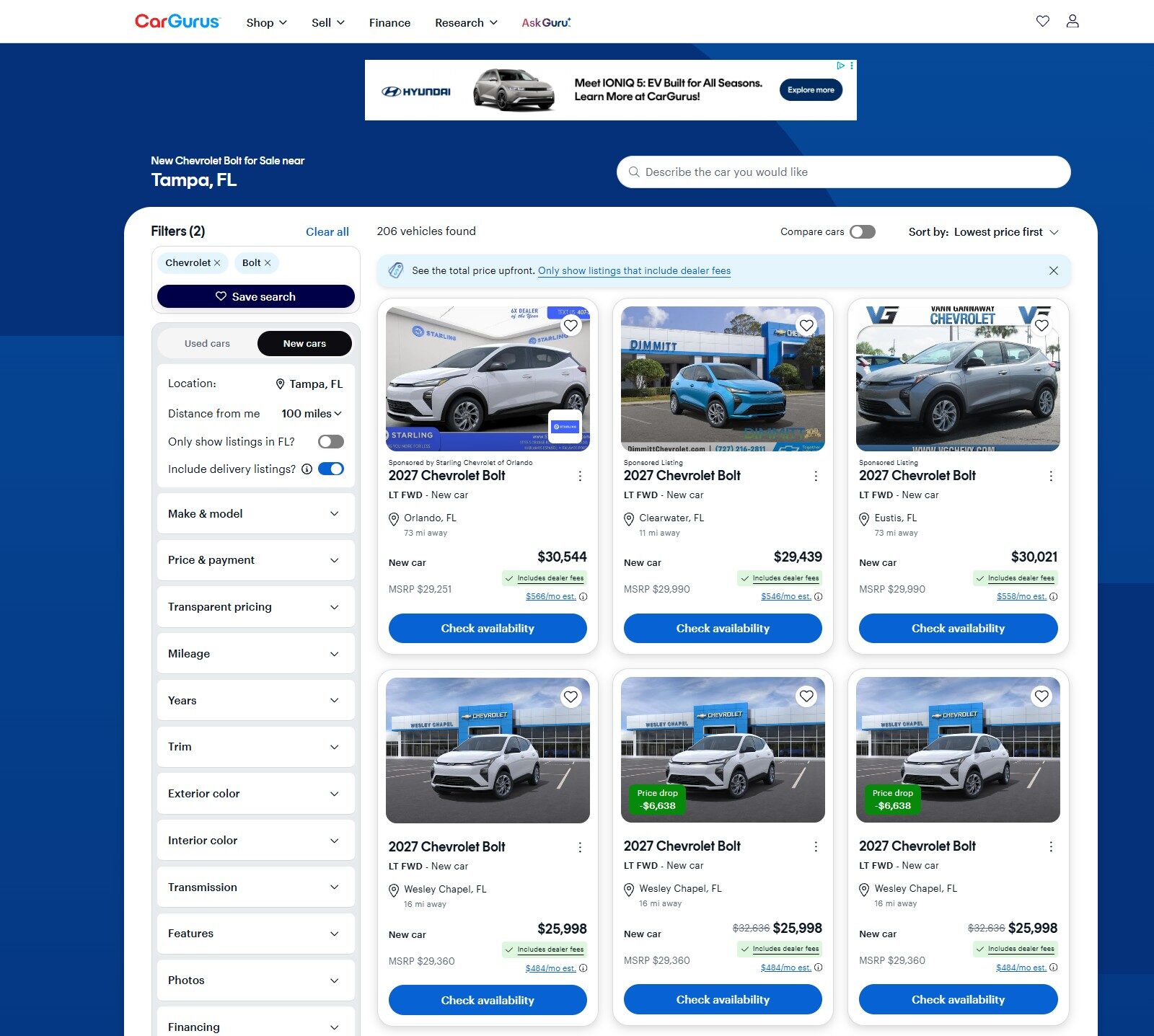
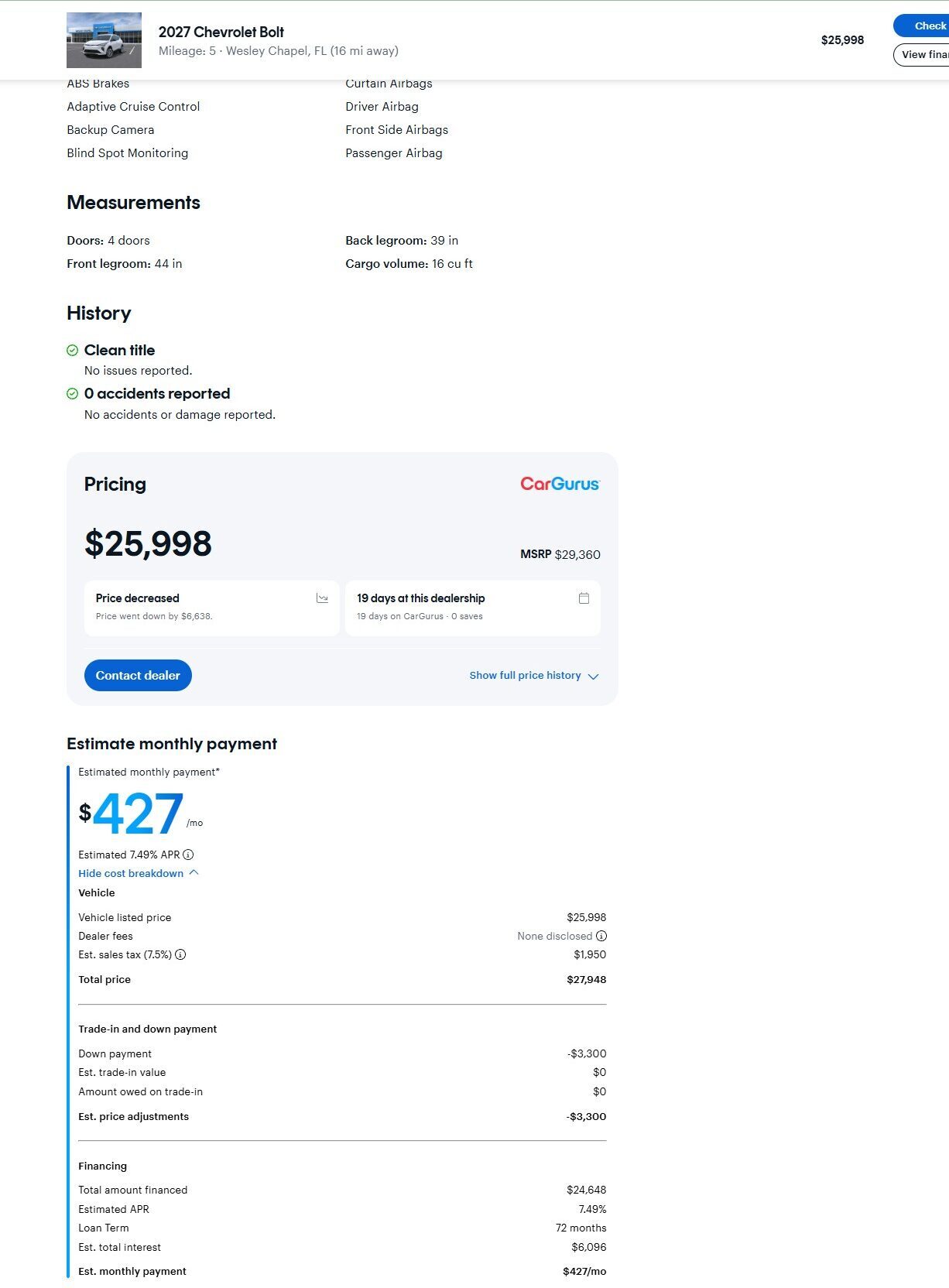
Now, with dealers, pricing is going to vary more than Tesla’s no-dealer network. I noticed that there are 206 Chevy Bolts (as compared to 978 for the Equinox, a car that sells 78 times the volume) available within 100 miles of Tampa. You can see a local dealer is offering a $3,362 discount on the base model. This does make the car about $15,000 cheaper than the base Model Y and about $150 less a month, even with the 7.49% APR. Clearly a good deal for a buyer just looking for transportation.
Nissan Leaf
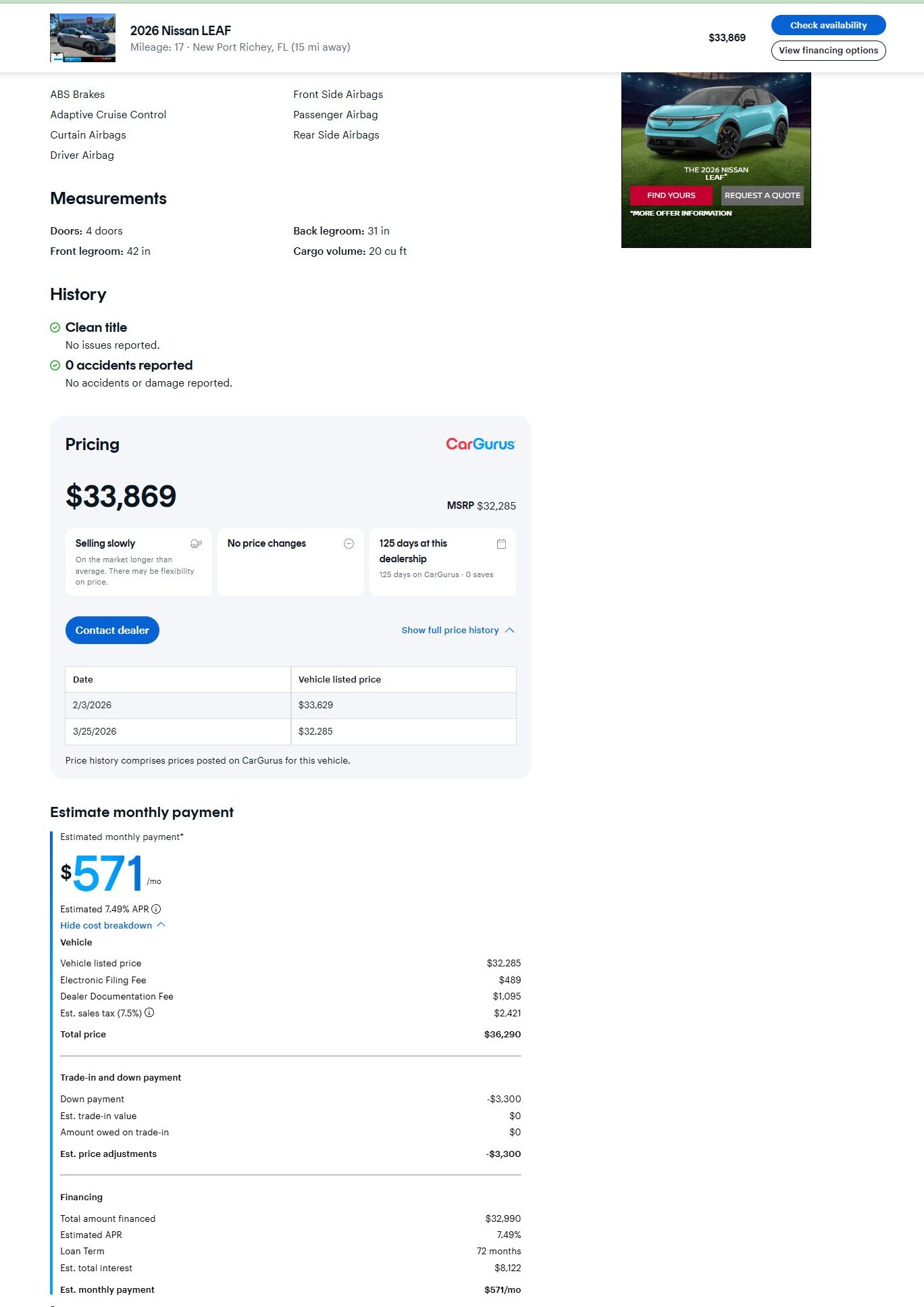
I noticed that there are 44 Nissan Leafs (as compared to 898 for the Rogue, a car that sells 105 times the volume) available within 100 miles of Tampa. You can see a local dealer is offering no discount on the base model. This does make the car about $8,000 cheaper than the base Model Y if paying cash, but only $5 a month less if financing for 6 years at 7.49% APR! So much for being much cheaper than a Tesla Model Y! Not a good deal in my opinion.
Features Comparison
Table below from Grok:

Notes: Specs are approximate and vary by trim/options. Data as of mid-2026. Check official manufacturer sites or dealers for the most current details. Safety ratings for newer models are based on prior generations and expected updates.
I think the big drivers are:
- Tesla has Full Self Driving (Supervised) available, and although progress has been slow, it still is miles ahead of the competition and holds promise of being unsupervised, at least in some areas.
- Chevy Bolt range is about 50 miles less. This may limit its attractiveness to some buyers (although I think the price more than compensates for it).
- The Model Y has substantially more room and cargo capacity than the other two.
- Dealers: “If I had a nickel for every time I heard a story about someone who went into a dealer looking to buy and EV and came out buying a gas car….” We know dealers make most of their money on service and we know EVs don’t need much maintenance or service. So is it a stretch to figure out why they steer you away from electric cars? Obviously, that won’t happen at Tesla. Many also prefer Tesla’s internet buying process to buying from a dealer. I’ve had good experiences with traditional dealers and really don’t find that a huge advantage for me, but it seems to make a difference to many people.
- Compliance cars: I’m not sure I’d call either the Bolt or Leaf a compliance car, but there’s some argument that these vehicles are only produced in relatively low quantities and the automakers are not trying hard to sell them in high volumes — hence not offering something like 0% APR when financing.
The Intangibles
Each of the cars has some attributes that either help or hurt their sales.
- CEO posts: Elon Musk’s posts inspire some buyers and turn off more, but it appears this isn’t hurting sales as much as some predicted. It helps that he doesn’t post as much about politics as he did last year.
- Nissan financial difficulties: Nissan is facing severe financial difficulties and may have trouble continuing without more restructuring. That being said, I don’t think most car buyers realize this, so I don’t think it is hurting their sales.
- Chevy has announced the Bolt is a limited-run model, only in production for 18 months. It doesn’t help, but Chevy has a good track record of supporting discontinued models like the Volt and the previous Bolt, so I don’t think this is impacting sales too much.
- GM took a $6 billion dollar write-down on EV investments, and that doesn’t show a consistent commitment to the technology. Similarly, Nissan has decided to produce gas trucks and SUVs instead of EVs in its Mississippi plant. Tesla is not without its own commitment issues. It refuses to put much money into expanding its lineup since it thinks everyone will quit buying cars and just call a Cybercab when you need to go somewhere.
Conclusion
Tesla wins on a combination of superior technology (especially autonomy and software), better vehicle packaging, stronger brand/ecosystem, and a frictionless buying experience. The Bolt and Leaf are respectable vehicles (especially at their price points), but they’re fighting an uphill battle against a more complete product and a more favorable ownership journey.
If GM or Nissan wanted to promote the Bolt or Leaf, I think they could greatly increase their sales in the US. There are a lot of buyers who don’t care much about self-driving and don’t need the room. But all the buzz is around Tesla — people have an uncle, cousin, or neighbor who has a Tesla and loves it, while many don’t know anyone with a Bolt or Leaf. Both the Bolt and Leaf were early leaders (I ordered a Leaf 16 years ago and loved it for 7 years). GM and Nissan have now updated them to be competitive, but they just don’t have the momentum or dealer network that can push massive volumes.
The regulatory environment also means GM and Nissan don’t really care to sell more EVs in the US. They can make more money selling gas cars. Of course, this is shortsighted, since the US will go electric with or without incentives. Also, every few years we get a different administration. It is quite likely a new administration will pass some form of either EV incentives or mandates.
If you want to take advantage of my Tesla referral link to get up 3 months Full Self Driving, here’s the link: https://ts.la/paul92237 — but if another owner helped you more, please use their link instead of mine.
Disclosure: I am a shareholder in Tesla [TSLA] and XPeng [XPEV]. But I offer no investment advice of any sort here.
Sign up for CleanTechnica’s Weekly Substack for Zach and Scott’s in-depth analyses and high level summaries, sign up for our daily newsletter, and follow us on Google News!
Have a tip for CleanTechnica? Want to advertise? Want to suggest a guest for our CleanTech Talk podcast? Contact us here.
Sign up for our daily newsletter for 15 new cleantech stories a day. Or sign up for our weekly one on top stories of the week if daily is too frequent.
CleanTechnica uses affiliate links. See our policy here.
CleanTechnica’s Comment Policy