


Support CleanTechnica’s work through a Substack subscription or on Stripe.
Or support our Kickstarter campaign!
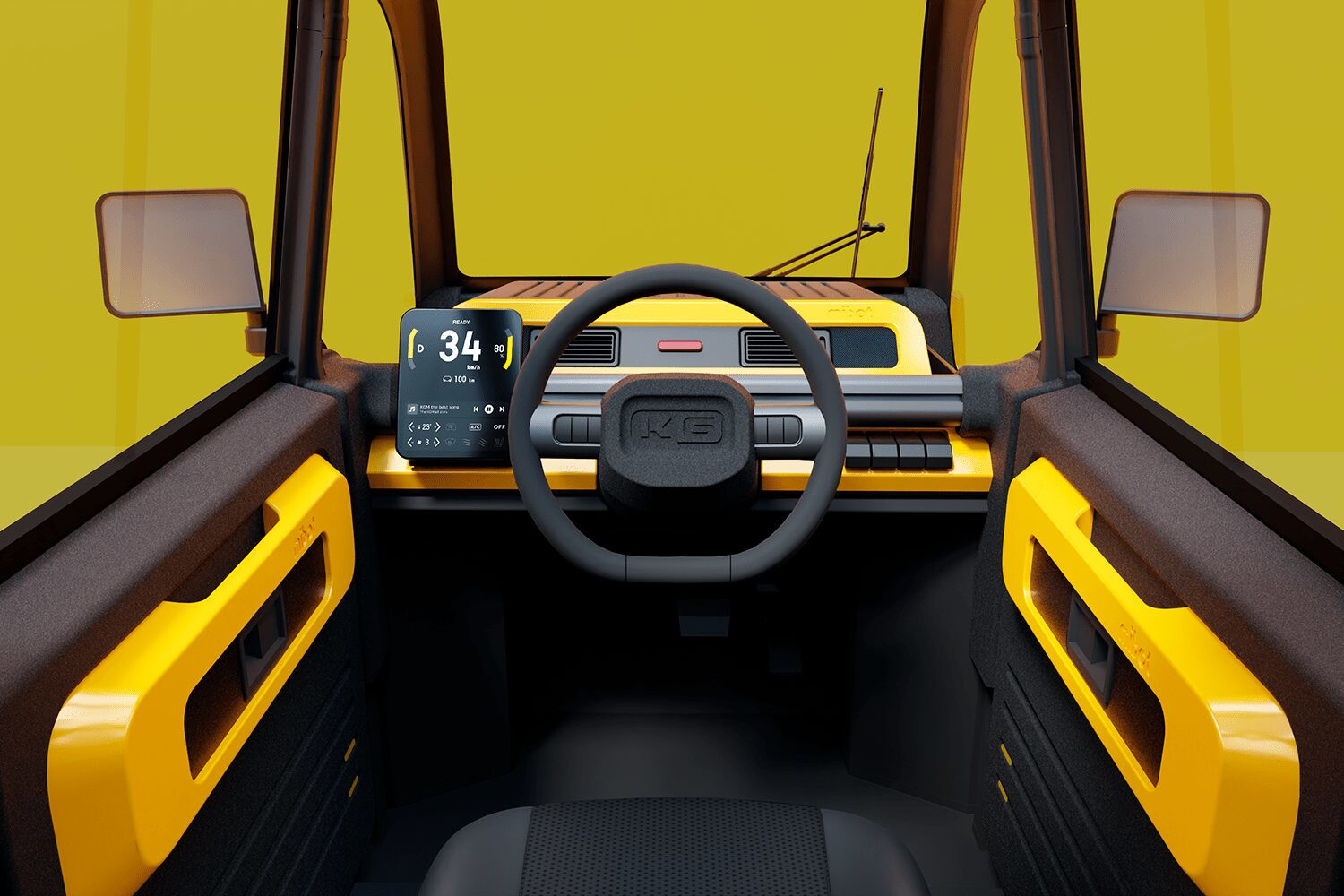
When KG Motors handed over the first customer MiBots on December 30, 2025, it did more than complete a ceremonial delivery. It quietly placed a fully engineered, road-legal micro-EV into real-world use — and set the stage for a production ramp beginning in April of 2026. In one particular case, it even caused a corporate giant in Japan to pay attention to the microcar, so much that it will take care of distribution, charging, and even servicing.
Now comes the more intriguing question: Could Japan’s ultra-compact single-seater find a second life in the Netherlands, the home of Europe’s most famous narrow microcar, the Waaijenberg Canta?
Two Microcars, Two Philosophies
The MiBot and the Canta look like brothers separated by geography but united by DNA and even width. Both measure just over 1.1 meters wide. Both are engineered for dense urban conditions. Both challenge assumptions about what constitutes a car. But their origins diverge.
The Canta was designed as a mobility-aid vehicle, a legally protected category in the Netherlands that allows certain privileges such as use of bicycle paths and exemptions from standard driver’s licensing requirements. It was built around social utility: accessibility, independence, and regulatory accommodation.
The MiBot, by contrast, was conceived as an ultra-affordable urban commuter. Single seat. Around 100 kilometers of range. Approximately 60 km/h top speed. A final pricing target of roughly ¥1 million (about US$7,000). It is not positioned as a disability vehicle. It is positioned as radically downsized urban mobility.
And yet, in physical form, it fits almost perfectly into the Dutch micro-mobility landscape.
Japan Is Obsessed With Mini- & Micro-mobility
The 自動車 (kei car) vs. 原付ミニカー (or gentsuki minicar) describe Japan’s two very different “small vehicle” paths
In the rush to understand Japan’s new wave of ultra-compact EVs, one distinction matters more than anything else: the difference between the kei car and gentsuki minicar. They may look similar in size at a glance, but legally, economically, and technologically, they sit on opposite ends of the mobility spectrum.
A kei car is a fully certified automobile. It follows strict national standards for crash safety, lighting, durability, and passenger protection. It can carry four people, run at highway speeds, and use expressways. It undergoes the same inspection regime as any other car, albeit at a lower cost, and it is taxed as a car — again at a preferential rate, but still within the automotive system. In short, a kei is a downsized mainstream vehicle. It is Japan’s mass-market solution for private mobility.
The gentsuki minicar, by contrast, is not treated as a car at all. It belongs to the regulatory family of the gentsuki, or motorized bicycle. What makes it unique is that it has three or four wheels and a car-like driving position, but the law views it closer to a moped than to an automobile.
That single legal distinction changes everything. Because it is not classified as a car, the minicar does not require shaken, Japan’s mandatory and expensive vehicle inspection. Its annual tax is dramatically lower, its insurance is simpler, and its registration process is handled at the municipal level rather than through the national vehicle system. It carries a small blue license plate, visually separating it from both kei and regular passenger cars.
Performance is also limited by regulation. Output for electric versions is capped at 0.6 kW, which places it in a completely different usability band from a kei EV such as the Nissan Sakura. It is designed for short-distance urban movement, not for intercity travel. It cannot use expressways and typically operates within neighborhood and city speed environments.
Capacity is usually one occupant, sometimes with a small cargo area, which explains why this class is increasingly associated with last-mile logistics, local commuting, and senior mobility.
Kei vs. Minika
From an industrial perspective, the implications are profound. Developing a kei car requires full automotive engineering: crash structures, airbags, advanced electronics, durability testing, and a supply chain capable of meeting national certification. That means billions of yen in investment and production volumes that only established manufacturers can sustain.
Targeting the gentsuki minicar category, on the other hand, allows a company to bypass the most expensive layers of automotive compliance. The vehicle becomes lighter, simpler, and dramatically cheaper to bring to market. Certification is faster. Tooling costs are lower. For startups and small manufacturers, it is the only viable way to enter Japan’s four-wheeled EV space.
For users, the ownership logic is equally clear. A kei car is a household’s primary vehicle. A gentsuki is a mobility appliance, something closer to an enclosed electric scooter with a steering wheel.
That is why the category is re-emerging in the electric era.
In a country where parking space is limited, the population is aging and daily travel distances in regional cities are shrinking, the minicar offers something a kei car cannot. True ultra-low-cost four-wheeled mobility**.
So while the kei car remains Japan’s dominant small vehicle, the gentsuki minicar represents a different future. Something that can be exported to the Netherlands perhaps?
The Japanese Engineering Arc vs. Dutch Mobility Matrix
The MiBot is not a first in this category. In the 1980s there was the Takeoka microcar and around 2012 Toyota released the Auto Body COMS. Toyota has the industrial prowess but has not produced large quantities of its microcar. Takeoka, on the other hand, has exported its kits to parts of Asia. (The “Abbey” variant arrived in Indonesia and in the Philippines with the 50-cc Yamaha engine, not the later EV kits that used lead acid batteries.)
Having said this, what gives the MiBot unusual credibility is not its dimensions but its development timeline.
Although the founder, Kazunari Kusunoki, is not an automotive engineer by training, the vehicle underwent a long validation phase before deliveries began. Structural testing, drivetrain refinement, compliance checks under Japan’s minicar framework, and repeated prototype iterations stretched development across several years.
That process reflects a distinctly Japanese manufacturing ethos: slow refinement, safety diligence, and performance confirmation before public release. Even within lighter regulatory categories, Japan demands conformity in braking performance, electrical safety, stability, and durability.
By the time first customers received their units at the end of 2025, the MiBot was not a prototype curiosity. It was a compliance-ready micro-EV.
April 2026: The Scaling Moment
KG Motors plans to enter mass-production mode in April 2026, targeting an annualized output of roughly 10,000 units — about 800 to 900 vehicles per month once steady production is achieved.
For a startup in Japan’s conservative automotive ecosystem, that is ambitious. But the real inflection point will not be symbolic production numbers. It will be consistency: can the company maintain quality while scaling?
If it can, export markets become plausible.
Why The Netherlands Makes Strategic Sense
The Netherlands is already culturally and legally acclimated to ultra-compact vehicles. The Canta normalized the idea that a vehicle barely wider than a motorcycle could operate safely within mixed urban infrastructure.
Dutch cities are dense. Parking is expensive. Congestion pricing and environmental zones are tightening. Consumers are accustomed to bicycles, scooters, and electric micro-mobility devices.
At approximately €6,500–€7,500 equivalent (before EU VAT and compliance costs), it would sit below most European quadricycles and far below standard EV hatchbacks.
The Regulatory Hurdle
However, entry into the Dutch market is not automatic.
The Canta benefits from its classification as a mobility aid. The MiBot would need one of two paths. One is certification as a similar low-speed mobility vehicle under Dutch rules, potentially requiring adaptations. The second path is registration as a light quadricycle or microcar under EU vehicle categories, which may impose additional crash and homologation standards.
Either path requires technical documentation, safety validation data, and coordination with Dutch authorities.
This is where the MiBot’s long Japanese engineering phase becomes a strategic asset. A vehicle already built to pass conservative safety checks in Japan enters regulatory discussions with evidence, not ambition.
Single Seat: Limitation Or Strength?
The MiBot’s single-occupant layout will divide opinion.
For traditional buyers, two seats are practical. For urban minimalists, one seat signals purpose. Most city commutes involve a single occupant. Removing the passenger seat cuts cost, weight, and energy consumption.
In dense Dutch cities like Amsterdam, Utrecht, and Rotterdam, the MiBot could function as a weather-proof e-bike replacement rather than a car replacement.
That distinction matters.
The Canta proved that the Netherlands will embrace tiny vehicles when they serve a defined role. The MiBot would need to clearly define its own.
If KG Motors successfully ramps to its intended monthly production in 2026, it will prove something larger than startup viability. It will demonstrate that a sub-$7,000 enclosed EV can be engineered responsibly and produced at scale in a developed automotive market.
The Netherlands may not be a mass-volume opportunity. But it could be a symbolic European beachhead — a country already fluent in micro-mobility, already tolerant of narrow vehicles, already searching for affordable electrification.
The MiBot has completed Stage One in Japan: real deliveries, real customers, real roads. If April production proceeds as planned, Stage Two is going to be commercial domestic volume. Stage 3 may be about geography. And if that means Europe, the narrow streets of the Netherlands might be exactly the right place for Japan’s smallest EV to prove its global relevance.
Support CleanTechnica via Kickstarter

Sign up for CleanTechnica’s Weekly Substack for Zach and Scott’s in-depth analyses and high level summaries, sign up for our daily newsletter, and follow us on Google News!
Have a tip for CleanTechnica? Want to advertise? Want to suggest a guest for our CleanTech Talk podcast? Contact us here.
Sign up for our daily newsletter for 15 new cleantech stories a day. Or sign up for our weekly one on top stories of the week if daily is too frequent.
CleanTechnica uses affiliate links. See our policy here.
CleanTechnica’s Comment Policy