

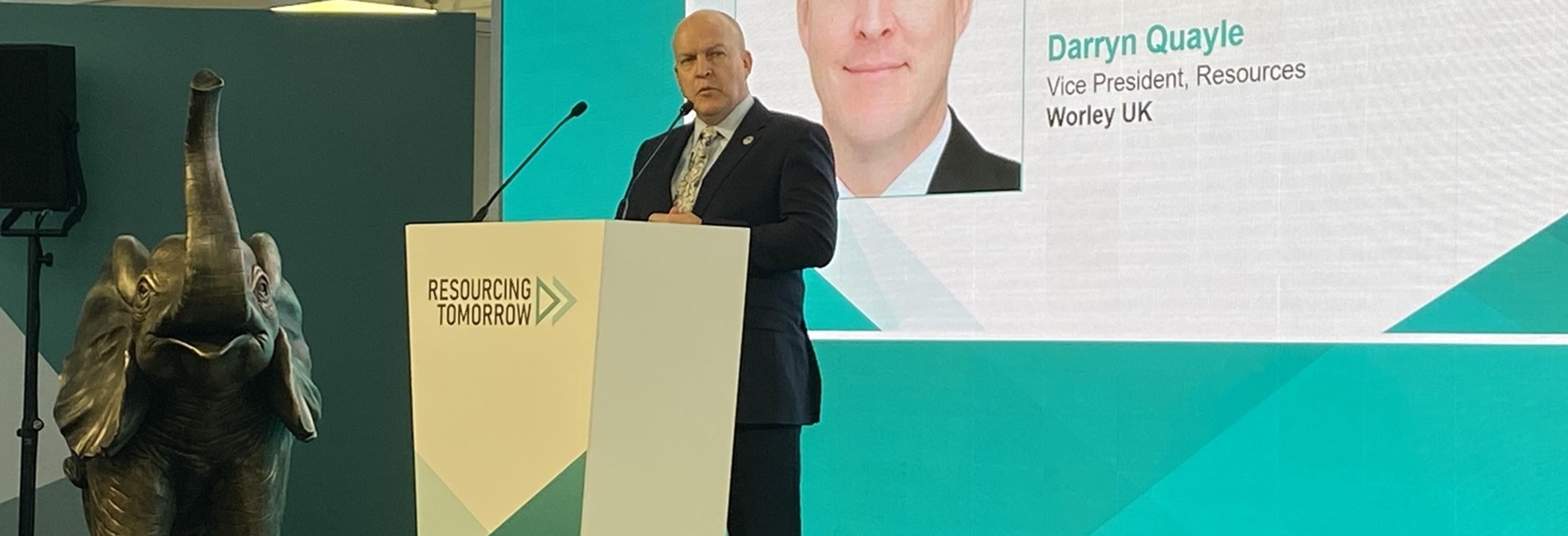
Miners must take the lessons from the past and quickly adopt technologies that can help build a better future to deliver projects in ways that inspire confidence in investors and communities, Worley UK Resources Vice President, Darryn Quayle, said at Resourcing Tomorrow 2025, in London, this week.
“The International Energy Agency projects that by 2030 global demand for key minerals like lithium and cobalt will roughly double and by 2040 it will triple,” Quayle said. “And yet our industry’s current trajectory doesn’t give us the confidence that we’ll meet that same demand, not with business as usual. Unless we dramatically change how we mine and finance we risk falling short.
“That is the elephant in the room and no one’s addressing it.”
Engineering company Worley is working with mining, energy and chemical companies to deliver significant new projects around the world, Richard Roberts, Editorial Director, Beacon Events, writes.
Resourcing Tomorrow heard mining project timelines had generally blown out to untenable levels, with average times depending on commodity, location and regulatory capacity. Quayle said cost blowouts were also common.
“Our industry has a credibility problem in the eyes of investors and lenders,” he said. “Simply put, we haven’t been delivering projects on time and on budget.
“If a lithium discovery in 2025 only starts helping by 2040 that’s a serious timing problem. Entire tech revolutions happen in 15 years. Yet that kind of delay is normal in mining. It wasn’t always this way. A few decades ago many mining projects came in on schedule and under budget. If a company promised a mine by 2025 for $1 billion, investors had reason to believe it. Today that trust has eroded.
“Only about one in six mining projects is completed as planned. The vast majority blow past budgets or deadlines, or both. On average, a project ends up costing around 50% more than initially estimated and starting production years late. Imagine budgeting $4 billion and spending $6 billion or aiming for first output in 2025 but not delivering until 2028.
“That scenario has become all too common.”
Quayle said the industry had to look to the past and the future for answers.
“A good start is to look at how projects were delivered when things went right, and how that differs from today, so we know what to change or restore,” he said. “Decades ago, when mines often met their targets a few principles prevailed. Companies planned realistically from the outset. Once they began building they minimised changes and stuck to the plan. Owners and contractors worked as partners, trusting each other and solving problems together rather than fighting.
“Decisions were made quickly on the ground with minimal bureaucracy. These conditions created efficiency and predictability, which gave investors confidence.
“Today, many of those practices have weakened. Initial plans can be over-optimistic or in flux. Projects are larger and more complex and mid-course design changes are common. Even if sometimes necessary they still cause havoc with schedules and costs.
“The partnership between owners and contractors often frays. Too often they operate in silos, each protecting their own interests. And there’s more red tape: project managers spend as much time on reports and approvals as on problem-solving, which slows everything down.
“Add stricter regulations and higher community expectations on top of that and it’s no surprise our projects struggle.
“It’s telling that industry surveys now rank project execution as one of the top risks in mining – above things like geopolitical instability. If we as an industry can’t predict our own outcomes why should financiers bet on us?
“Our predecessors built mines and infrastructure with far more limited tools than we have now. They didn’t have computers or automation or AI; they had grit, ingenuity and determination. We have all of that and then some. Often what’s holding us back today is … a lack of coordination and an excess of caution. And those are things we can change.
“We must show that we can build mines when and how we say we will. Speeding up doesn’t help if we don’t also become more reliable. Even if permitting could be cut to two years it won’t matter if construction then takes 10 years and double the budget. We have to improve both the pace and the predictability of project delivery.”
Quayle said technology and innovation were keys to building and permitting mines faster, but also to making mines and mine-waste storage less invasive and ultimately more sustainable.
“If we could tell communities and regulators, this project will have minimal surface disturbance, no tailings dam and when we’re done you won’t even know it was here, imagine how much easier approvals would be. That’s the kind of step-change we need in mining’s environmental performance,” he said.
“Caution [toward adopting new approaches] is understandable on an individual project level but collectively it holds us back. We stick with old methods, improving them only incrementally, instead of leapfrogging to new ones that could transform our industry’s footprint and efficiency. The bottom line is we need to get out of our comfort zone and embrace innovation while finding ways to share or mitigate the risks of being early adopters.
“That’s the only way to shrink mining’s environmental footprint and earn the public’s trust on a grand scale.”
The post Worley’s Quayle on addressing the ‘elephant in the room’ appeared first on International Mining.