

Support CleanTechnica’s work through a Substack subscription or on Stripe.
Thanks to Simply Gregster EV for the footage confirming our earlier story.
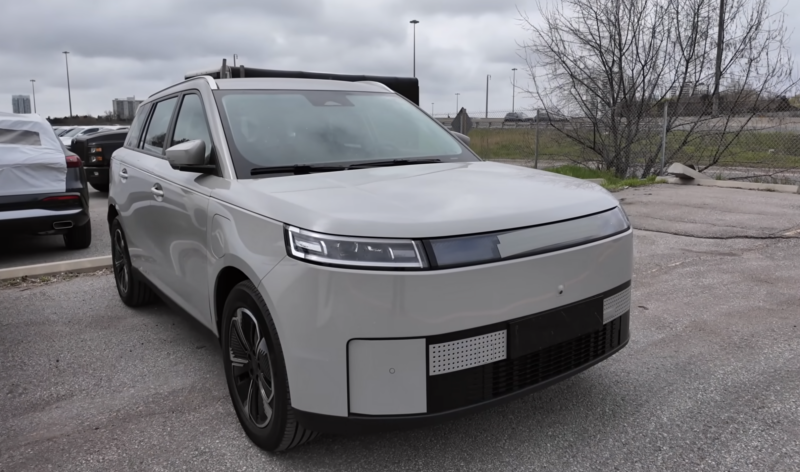
A walkaround video from Simply Gregster EV has provided the clearest on-the-ground evidence yet that Chinese automakers have already begun staging vehicles in Canada ahead of a formal market entry. Filmed in Toronto, the footage captures multiple camouflaged units from Chery and its sub-brands sitting on manufacturer plates in what appears to be an active testing and validation environment, rather than a static display or media preview.
The vehicles shown include the Jaecoo J5 EV, the Omoda 9 plug-in hybrid, and a larger premium SUV from Chery’s Exeed division, all partially taped but easily identifiable. The condition of the vehicles suggests they are undergoing benchmarking and pre-launch preparation, with some units showing markings and minor disassembly consistent with engineering work, while interiors remain covered and inaccessible to the public.
This visual confirmation aligns directly with earlier reporting on CleanTechnica, which correctly identified that Chery would probably lead the first wave of Chinese automakers preparing a return to the Canadian market.
That earlier analysis framed the question of whether Chery could succeed this time around. Simply Gregster EV’s YouTube post shows that Chery is indeed the first in Canada (the video was posted on May 2) and confirms the validity of our source information from Chery International that the company has quickly moved beyond planning and into execution.
According to another source within Chery International’s export division in China, approximately 150 units have already been delivered to Canada as part of the initial deployment phase. These vehicles are not intended for immediate retail sale but are being used to populate showrooms, establish floor stock, and support testing and certifications required by the Canadian government as well as test-drive programs as the brand prepares for a formal launch of the first dealers by the third quarter of 2026 in Toronto, Quebec, and Ontario.
The next phase is already scheduled and notably aggressive, with around 1,000 units slated for delivery within the next three months as supply chains and distribution channels ramp up. This level of early allocation indicates that Chery is not approaching Canada cautiously, but instead preparing for a rapid scale-up once retail operations are fully in place.
That retail infrastructure is also developing in parallel, with the same source confirming that an initial network of 10 dealerships is targeted to be operational before the end of June. The synchronization between vehicle deployment, dealer readiness, and inventory flow suggests a coordinated market entry strategy rather than a gradual or experimental rollout.
The lineup captured in the video reveals how Chery intends to position itself across multiple segments from the outset, rather than relying on a single halo product. The Jaecoo J5 EV appears aimed squarely at the affordable electric crossover category, with a reported 60 kWh battery and an estimated range of around 400 kilometers, which could make it one of the more competitively priced entry EVs in Canada if early pricing assumptions hold.
The Omoda 9, configured as a plug-in hybrid, represents a different strategic layer by targeting consumers who remain hesitant to transition fully to battery-electric vehicles. In a market where charging infrastructure and winter performance still influence buying decisions, this category remains highly relevant and could serve as a bridge product for mainstream adoption.
At the upper end, the Chery Exeed SUV signals Chery’s intent to compete in the premium space, with indications of larger battery options, advanced suspension systems, and a noticeably more upscale design and interior execution. The presence of this model alongside entry-level and mid-tier offerings reflects the same multi-brand, multi-segment strategy that Chery has already deployed successfully in Europe and other international markets.
Equally notable in the video is the presenter’s repeated observation regarding build quality, with tight panel gaps, consistent paint finish, and the use of globally recognized component suppliers such as Michelin and Continental Tires, along with Sony-branded audio systems. Even in a pre-release, transport-worn state, the vehicles appear to meet or exceed baseline expectations for fit and finish, underscoring how far Chinese export models have evolved since Chery’s earlier, unsuccessful attempt to enter North America nearly two decades ago.
What emerges from both the video and the accompanying source information is a clear shift in timeline and intent, with Chinese automakers no longer testing the idea of entering Canada but actively preparing to compete within it. The presence of multiple models, the early arrival of inventory, and the near-term establishment of dealerships all point to a launch window that is rapidly approaching rather than distant or hypothetical.
For a market that has long debated whether Chinese EVs would arrive, the more relevant question now is how quickly they will scale once they do.
Sign up for CleanTechnica’s Weekly Substack for Zach and Scott’s in-depth analyses and high level summaries, sign up for our daily newsletter, and follow us on Google News!
Have a tip for CleanTechnica? Want to advertise? Want to suggest a guest for our CleanTech Talk podcast? Contact us here.
Sign up for our daily newsletter for 15 new cleantech stories a day. Or sign up for our weekly one on top stories of the week if daily is too frequent.
CleanTechnica uses affiliate links. See our policy here.
CleanTechnica’s Comment Policy