

Support CleanTechnica’s work through a Substack subscription or on Stripe.
Before a single offshore wind turbine rises off Philippine waters, something else has to be built first. Not at sea, but on land.
Across San Miguel Bay in Bicol and the Guimaras Strait in Western Visayas, the country’s most advanced offshore wind zones are beginning to reveal a hard truth about the energy transition: the real starting point is not generation, but logistics. And in offshore wind, logistics means ports.
Despite more than 40 gigawatts of awarded Offshore Wind Energy Service Contracts and growing investor interest, the Philippines has yet to move a single project into offshore construction. Turbines have not been installed. Foundations have not been laid. No wind farm has reached full marine execution. What exists instead is a rapidly advancing pre-development pipeline — permitting, site assessments, engineering studies, and early infrastructure planning.
That distinction matters. Because offshore wind does not fail or succeed at the concept stage. It fails or succeeds at the interface between land and sea.
The Global Wind Energy Council’s 2026 study makes this point implicitly but repeatedly. San Miguel Bay and the Guimaras Strait were not chosen only for their wind resource. They were selected because they already have identifiable port pathways. In Camarines Norte, Pambuhan Port is being positioned as a potential offshore wind hub through government-led planning. In the Guimaras corridor, Pulupandan is emerging as a privately driven logistics base supported by nearby industrial centers.
These are not secondary details. They are the foundation of the entire industry.
Offshore wind turbines are among the largest machines ever deployed in the energy sector. A single unit can exceed 15 megawatts, with blades longer than a football field and components that cannot be transported or assembled using conventional port infrastructure. Building offshore wind at scale requires specialized “marshaling ports” capable of handling heavy-lift operations, deepwater berths, vast laydown areas, and continuous assembly workflows.
In effect, the port becomes the factory floor of offshore wind.
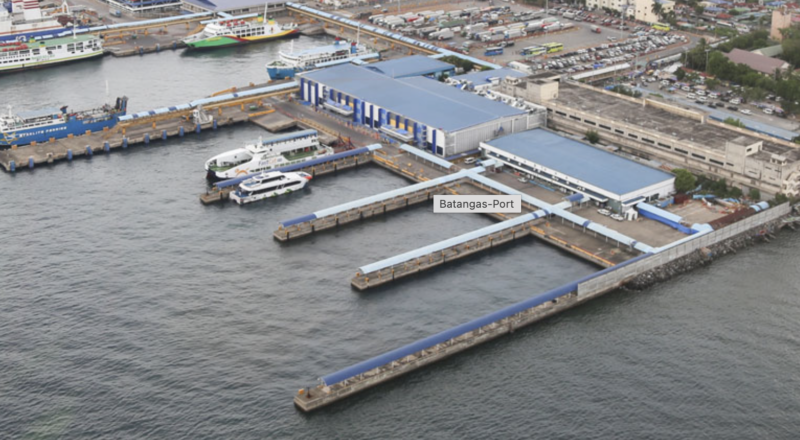
This is where the Philippines faces its first real bottleneck. The country does not yet have a fully developed offshore wind port capable of supporting turbine assembly and large-scale deployment. Existing ports were not designed for this type of industrial activity. Retrofitting them — or building new ones — takes years, significant capital, and coordinated policy support.
Offshore wind is often framed as a clean energy technology. But in reality, it is also a heavy industrial system. And the transition to offshore wind is as much about building new coastal industrial ecosystems as it is about generating zero-carbon electricity.
No port, no wind
Ports sit at the center of that transformation.
The GWEC report highlights how port development triggers a cascade of sustainability-linked effects. Upgraded ports attract shipbuilding and maritime services. They enable local fabrication of components, reducing reliance on long-distance imports and lowering embedded carbon in supply chains. They create hubs for operations and maintenance over decades, anchoring long-term employment in coastal regions.
In other words, ports are not just enabling offshore wind. They are shaping the kind of offshore wind industry the Philippines will have.
This becomes even more critical when viewed against the country’s policy timeline. The Department of Energy’s Green Energy Auction program is targeting offshore wind capacity deployment beginning toward the end of the decade. On paper, the pipeline is moving. But offshore wind timelines are unforgiving. Globally, port readiness often determines which projects actually get built and which remain stalled.
Without ports, turbines do not move. Without staging areas, foundations do not reach the water. Without logistics hubs, installation vessels have nowhere to operate from.
Offshore wind begins onshore
The Philippines is now entering that decisive phase where ambition meets infrastructure reality. The first visible structures of the Philippine offshore wind industry may not be turbines rising above the horizon. They may be reinforced quays, expanded laydown yards, and heavy-lift cranes along the shoreline.
San Miguel Bay and the Guimaras Strait illustrate two different pathways forward. One is state-led, anchored in national planning and early public investment. The other is market-driven, leveraging existing industrial corridors and private-sector initiative. Both approaches recognize the same underlying constraint: offshore wind begins onshore.
There is also a deeper sustainability implication. If the Philippines develops its port infrastructure strategically, it can localize significant portions of the offshore wind supply chain — fabrication, assembly, maintenance — turning what could be an import-dependent industry into a domestically anchored one. That reduces emissions associated with global transport, strengthens energy sovereignty, and embeds long-term economic value in coastal communities.
Sign up for CleanTechnica’s Weekly Substack for Zach and Scott’s in-depth analyses and high level summaries, sign up for our daily newsletter, and follow us on Google News!
Have a tip for CleanTechnica? Want to advertise? Want to suggest a guest for our CleanTech Talk podcast? Contact us here.
Sign up for our daily newsletter for 15 new cleantech stories a day. Or sign up for our weekly one on top stories of the week if daily is too frequent.
CleanTechnica uses affiliate links. See our policy here.
CleanTechnica’s Comment Policy