


Support CleanTechnica’s work through a Substack subscription or on Stripe.
There is a distinct difference between watching an industrial birth from the clean gallery of a press junket and standing on the factory floor while the machinery runs at scale.
Five years ago, I wrote a piece for CleanTechnica outlining six reasons why VinFast could become an electric vehicle superpower. At the time, the proposition seemed ambitious. VinFast was still producing internal combustion engine vehicles, global sales were negligible, and the company had yet to prove it could compete outside Vietnam. What stood out then was not volume or profitability but something less tangible: speed, ambition and a willingness to take risks that most established automakers would never consider.
A return to a comeback
Returning recently to VinFast’s sprawling 335-hectare manufacturing complex on Cat Hai Island in Hai Phong, I found myself revisiting that original thesis. The question is no longer whether VinFast can build electric vehicles. The company has already answered that. The more relevant question today is whether it can sustain the extraordinary pace of growth that has defined its first decade.
I first visited the Hai Phong facility when it was producing gasoline-powered models such as the Lux A2.0 and SA2.0, vehicles built on licensed German platforms. Not long afterward came one of the boldest pivots in modern automotive history. VinFast halted production of internal combustion vehicles entirely and committed itself to an all-electric future.
I was part of the original VinFast Elite Group tour organized for international media as the first VF 8 and VF 9 units were being prepared for shipment to North America. The criticism from many Western publications was relentless. Early vehicles were scrutinized as though they had come from a century-old manufacturer rather than a startup attempting one of the industry’s most aggressive transformations. Reviewers focused heavily on flaws in pre-production and engineering validation units, often overlooking the fact that VinFast was exposing a manufacturing process still undergoing rapid development.
Thus the transition from ICE to pure EV was anything but smooth. In hindsight, some of those criticisms were justified. The vehicles were not perfect. Software needed work. Build quality required refinement. The customer experience was still evolving. Yet many observers missed the larger story unfolding behind the vehicles themselves. VinFast was building not merely a product but an industrial ecosystem, and industrial ecosystems improve through iteration.
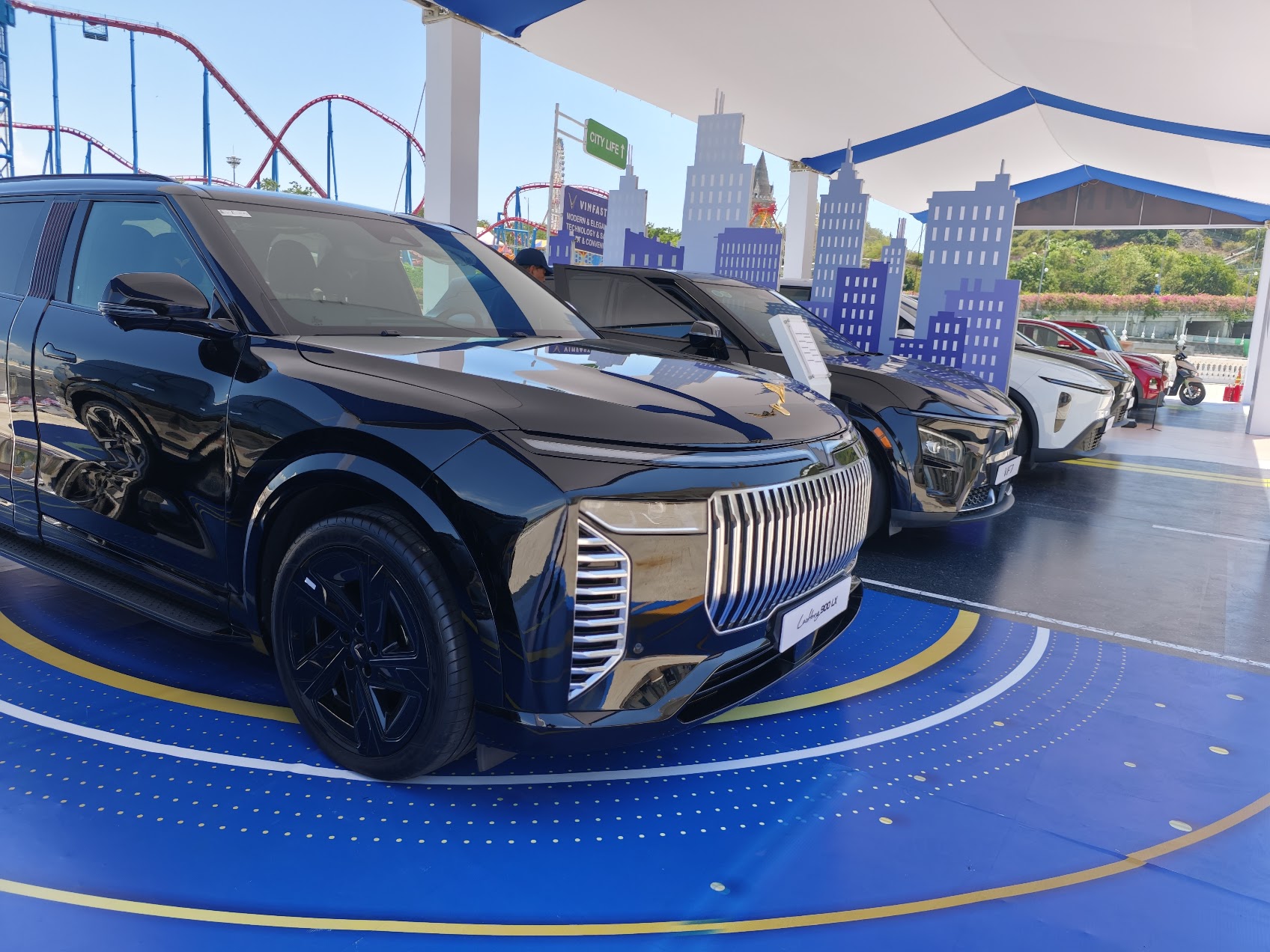
That reality becomes immediately obvious upon returning to Hai Phong in my visit last week. The factory I visited in 2026 bears little resemblance to the one I saw in 2022. The first thing that strikes visitors is the noise. Four years ago, portions of the facility felt almost like a demonstration site operating through a transitional phase. Today, the plant hums continuously. The giant Schuler presses stamp body panels around the clock. More than 1,400 ABB welding robots move in synchronized rhythm. Paint lines and assembly operations run continuously to support three-shift production schedules.
Manufacturing surge
The atmosphere no longer resembles a factory preparing for growth. It feels like a factory already experiencing it and the numbers tell the story more effectively than any guided tour ever could.
VinFast delivered roughly 35,000 electric vehicles globally in 2023. That figure rose to 97,399 units in 2024. By the end of 2025, deliveries had surged to 196,919 vehicles, representing growth of more than 100 percent year on year. Annual revenue doubled to approximately $3.6 billion.
Just as significant, Hai Phong produced more than 200,000 electric vehicles during 2025, operating at roughly two-thirds of its installed capacity of 300,000 vehicles annually. This year, before turning the reins of power to his son, Quan Anh, VinFast CEO Pham Nhat Vuong said the company will achieve the 300,000 units sales this year, maximizing plant capacity and ready for additional growth.
Half a million on two wheels
That number does not include the electric two-wheeler division which easily hit the million mark in sales and catch up with production.
While the production line maintained a steady baseline of roughly 70,000 units in 2024, continuous three-shift factory rotations led to a massive 473 percent year-over-year escalation in manufacturing volume by the end of 2025. The plant recorded 406,453 domestic e-scooter deliveries for that full year, establishing the brand as a dominant volume manufacturer in the region. This manufacturing pace increased further in the first quarter of 2026, delivering 143,136 electric two-wheelers, which included a record-shattering month in March where the plant processed more than 135,000 incoming orders and shipped over 93,000 completed units to distribution networks.

The actual factory occupied a 31,000-square-meter section within the larger Dinh Vu Cat Hai Industrial Park. VinFast’s e-scooter plant avoids the limitations of simple kit-assembly lines by running a fully integrated production loop. Automated tube-bending machinery and robotic welding cells fabricate the structural chassis frames before overhead conveyors transport them to a specialized paint shop utilizing multi-stage electrodeposition coating. Final assembly operations run on synchronized lines where component delivery is managed through automated guided vehicles, while an adjacent high-security facility handles the assembly of proprietary lithium iron phosphate battery modules.
An experiment no more
Five years ago, many viewed VinFast as an ambitious experiment. I questioned its US offensives and asked why not focus on Asia and South East Asia first. I doubted what I believed were vehicles not yet ready for the toughest car market in the world. I couldn’t reconcile in my mind how VinFast executives disregarded brand recognition and not diffusion. Today, it operates one of Southeast Asia’s most significant electric vehicle manufacturing ecosystems, produces nearly 200,000 EVs annually and has steadily extended its footprint outside of their North America dream and into neighbors closer and friendlier.
What I underestimated five years ago was not whether VinFast could build electric vehicles. It was how quickly the company could scale. That growth has been accompanied by a noticeable improvement in product maturity. The software glitches, inconsistent finishing and quality concerns that characterized some of the earliest exports have steadily diminished through successive engineering revisions. Vehicle interiors feel more cohesive. Exterior fit and finish have improved. Chassis tuning demonstrates a stronger understanding of diverse road conditions across global markets.
Global strategies for market specific needs
Perhaps more important than the vehicles themselves is the evolution of VinFast’s market strategy. The company’s early international approach focused heavily on larger and more premium electric SUVs such as the VF 8 and VF 9. Over time, however, VinFast discovered where its greatest strengths lie. Instead of relying solely on flagship products, it expanded into mass-market segments that better reflect consumer demand across Southeast Asia and other emerging markets.
The results have been significant. In Vietnam, VinFast captured roughly 36 percent market share during 2025. Much of that success came not from premium models but from affordable vehicles such as the VF 3 mini-SUV and VF 5 compact crossover, each delivering around 44,000 units during the year.
The company has also broadened its presence in commercial mobility. Vehicles originally developed for Green SM taxi operations have evolved into specialized fleet products, including the Limo Green seven-seat MPV and the Nerio Green commercial vehicle. By late 2025, fleet-focused products accounted for a substantial portion of overall deliveries.
The industrial model refined in Hai Phong is now being replicated abroad. VinFast formally opened its manufacturing facility in Subang, West Java, Indonesia, as part of a multibillion-dollar investment strategy aimed at Southeast Asia. The factory initially focuses on right-hand-drive production of key models including the VF 3, VF 5, VF 6 and VF 7. Meanwhile, the company’s expanding operation in Tamil Nadu, India, has grown beyond vehicle assembly to include broader electric mobility ambitions involving buses and two-wheelers.
Together, these facilities have increased VinFast’s installed plus potential global manufacturing capacity to approximately total 600,000 vehicles annually.
International deliveries represented 18 percent of total volume during the final quarter of 2025, a clear indication that international markets are beginning to respond. In Indonesia, VinFast has emerged among the leading electric vehicle brands. In India, the company gained traction rapidly following its market entry. In the Philippines, data from the Chamber of Automotive Manufacturers of the Philippines Inc. placed VinFast among the country’s leading battery-electric vehicle brands as it prepares a broader rollout of electric motorcycles, scooters and battery-swapping infrastructure.
None of this means VinFast’s journey is complete. Profitability remains a challenge. Building factories simultaneously across multiple countries requires enormous capital. Competition from Chinese manufacturers continues to intensify. Established global automakers are investing heavily in their own electric vehicle programs. The road ahead remains difficult.
The critics who focused solely on the imperfections of the first vehicles were examining a snapshot. What mattered was the trajectory. Looking back at the arguments I made in 2021, the core premise remains intact. VinFast possessed the ingredients necessary to become a serious electric vehicle player: capital, industrial ambition, vertical integration and an unusual willingness to move quickly. Those ingredients have since evolved into factories, supply chains, export markets and hundreds of thousands of vehicles on the road.
I stick to my fearless forecast that VinFast will be a global automotive powerhouse. After walking through Hai Phong again, one conclusion feels increasingly difficult to dispute: this is no longer a startup trying to prove it can build electric vehicles. It is an industrial machine learning how to compete with the world.

Sign up for CleanTechnica’s Weekly Substack for Zach and Scott’s in-depth analyses and high level summaries, sign up for our daily newsletter, and follow us on Google News!
Have a tip for CleanTechnica? Want to advertise? Want to suggest a guest for our CleanTech Talk podcast? Contact us here.
Sign up for our daily newsletter for 15 new cleantech stories a day. Or sign up for our weekly one on top stories of the week if daily is too frequent.
CleanTechnica uses affiliate links. See our policy here.
CleanTechnica’s Comment Policy