
Climate Solutions Need To Pass Three Tests Before They Deserve Policy Or Capital

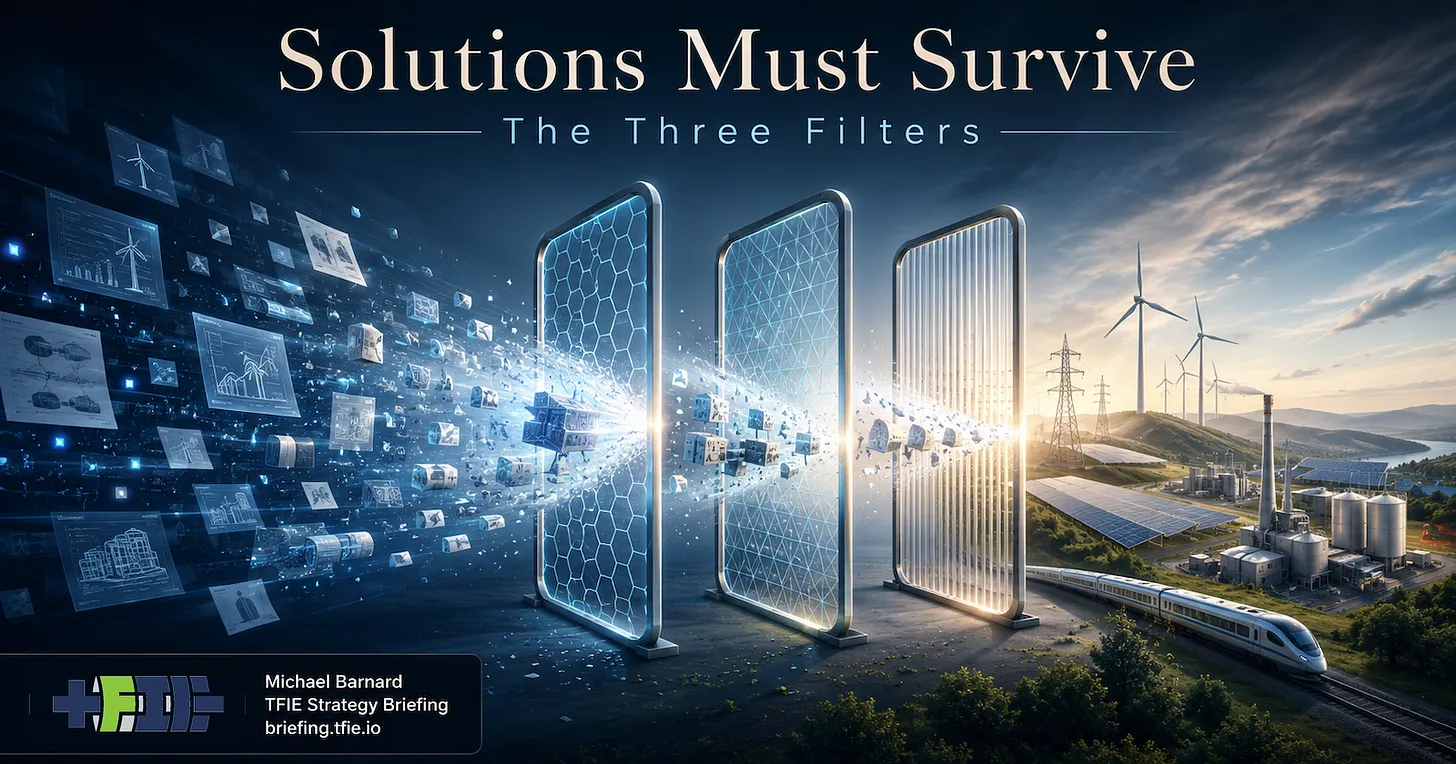
Support CleanTechnica’s work through a Substack subscription or on Stripe.
A lot of transition analysis gives too much credit to technologies that can be made to work and not enough scrutiny to whether they matter. The difference shows up across carbon capture hubs, synthetic fuel claims, small modular reactor schedules, cement decarbonization pathways, aviation fuel projections, ammonia shipping forecasts, grid storage proposals, critical-mineral panic stories, and hydrogen strategies. A process can work in a lab, run in a pilot, attract a grant, or look credible in a diagram and still fail as a useful pathway for climate, capital, or policy.
The first test is technical, but not in the weak sense of asking whether something can be made to happen once. Many things can be made to happen once with enough money, attention, engineering talent, and tolerance for inconvenience. The harder question is whether the proposed solution holds together as science, engineering, operating system, and cost stack at the scale being claimed. Before a pathway competes with alternatives, it has to survive its own arithmetic.
Cement is a useful example because every serious decarbonization pathway carries a different set of constraints. Clinker substitution depends on supplementary cementitious material availability, cement standards, performance, logistics, and construction practice. Electrified heat has to deal with kiln temperature, heat transfer, retrofit complexity, electricity supply, utilization, and capital cost. Carbon capture has to deal with capture energy, kiln integration, compression, transport, storage, monitoring, liability, and cost per durable tonne. Alternative binders have to deal with chemistry, feedstock volume, durability, standards, and contractor acceptance. The fact that cement is hard to decarbonize does not make every cement pathway credible.
Steel has the same issue in another form. A route does not pass the first test because it produces iron once. It has to deal with demand, stock turnover, scrap availability, ore quality, new iron requirements, furnace configuration, electricity supply, reducing-agent supply where needed, capital cost, utilization, and product quality. Scrap-electric arc furnaces, electrochemical ironmaking, direct reduced iron, biomethane, biocarbon, and hydrogen routes all have different constraints. Before they are compared with one another, each one has to make sense on its own terms.
This is where tonnes, joules, kilowatt-hours, temperatures, flow rates, concentrations, pressures, degradation rates, capacity factors, asset lifetimes, balance-of-plant costs, and cost per delivered unit matter. The same discipline applies to ocean carbon capture, gravity storage, subsurface energy storage, direct air capture, shipping fuels, and aviation fuels. The mechanism may be real and the pilot may run. The full system can still be too energy-intensive, too material-intensive, too fragile, too hard to monitor, too slow to scale, or too expensive.
The second test is competition. A pathway that survives its own engineering and cost stack still has to beat the alternatives after the full chain is counted. Carbon dioxide captured at a stack is not carbon dioxide permanently stored. Synthetic fuel at a reactor outlet is not certified fuel delivered to an airport. Ammonia at a production plant is not safe marine fuel available at the right port, on the right route, with trained crew, emergency response, insurance, and regulation. Hydrogen at an electrolyzer is not useful heat in a home, motion at a wheel, firm capacity on a grid, or low-carbon steel in a market.
Full-chain comparison is where many plausible pathways become much smaller. Passenger transport does not need to preserve fuel distribution when battery-electric drivetrains are simpler and more efficient for most use cases. Most building heat does not need a new clean fuel chain when heat pumps deliver much more useful heat from the same electricity. Synthetic liquids can run internal combustion engines, but electric drivetrains remove the need for liquid fuel in most road transport. Hydrogen can store energy, but batteries, pumped hydro, transmission, demand response, and renewable overbuild reduce the size of the storage problem it might address.
The third test is adoption. Even a technically coherent pathway that beats alternatives on paper has to pass through institutions, firms, workers, customers, regulators, voters, insurers, standards bodies, procurement systems, and supply chains. This is not a soft issue. It is where capital cost, downtime, permitting, safety rules, maintenance contracts, training, warranties, insurance, financing, and organizational competence determine whether deployment is likely. A technology that requires many fragmented actors to change equipment, operating practice, contracts, safety procedures, maintenance routines, and financing at the same time is not equivalent to one that saves money and fits into normal replacement cycles.
This matters for public policy because research support and deployment-scale support are different decisions. Research is relatively cheap compared with bad infrastructure. Demonstrations can be useful when they reduce uncertainty. The expensive error is treating immature or weakly competitive pathways as if they already deserve mandates, procurement commitments, regulated cost recovery, or strategic-infrastructure status. A government can support learning without pretending that every first-of-a-kind project is a future pillar of the energy system.
It matters for investors for the same reason. A company can have real chemistry, a real machine, a real pilot, and a real customer conversation while still lacking a serious market. The question is not whether the technology exists. The question is whether it survives the full stack, beats the alternatives, and can be adopted by the people and institutions that would have to live with it. Many climate-tech disappointments are not frauds. They are solutions that passed one test and were marketed as if they had passed all three.
That is the useful discipline. Technologies that pass the science test, beat the alternatives after the full chain is counted, and make it through adoption reality deserve capital, policy attention, and a place in serious projections. Technologies that have not passed those tests may still deserve research, pilots, or niche use. They do not deserve to be treated as central transition pathways merely because they are technically possible.
A longer maintained version of this analysis is available at TFIE Strategy Briefing: Solutions Must Survive The Three Filters, part of Michael Barnard’s broader WorldView work on the assumptions underneath serious 2100 transition scenarios.
Sign up for CleanTechnica’s Weekly Substack for Zach and Scott’s in-depth analyses and high level summaries, sign up for our daily newsletter, and follow us on Google News!
Have a tip for CleanTechnica? Want to advertise? Want to suggest a guest for our CleanTech Talk podcast? Contact us here.
Sign up for our daily newsletter for 15 new cleantech stories a day. Or sign up for our weekly one on top stories of the week if daily is too frequent.

CleanTechnica uses affiliate links. See our policy here.
CleanTechnica’s Comment Policy