

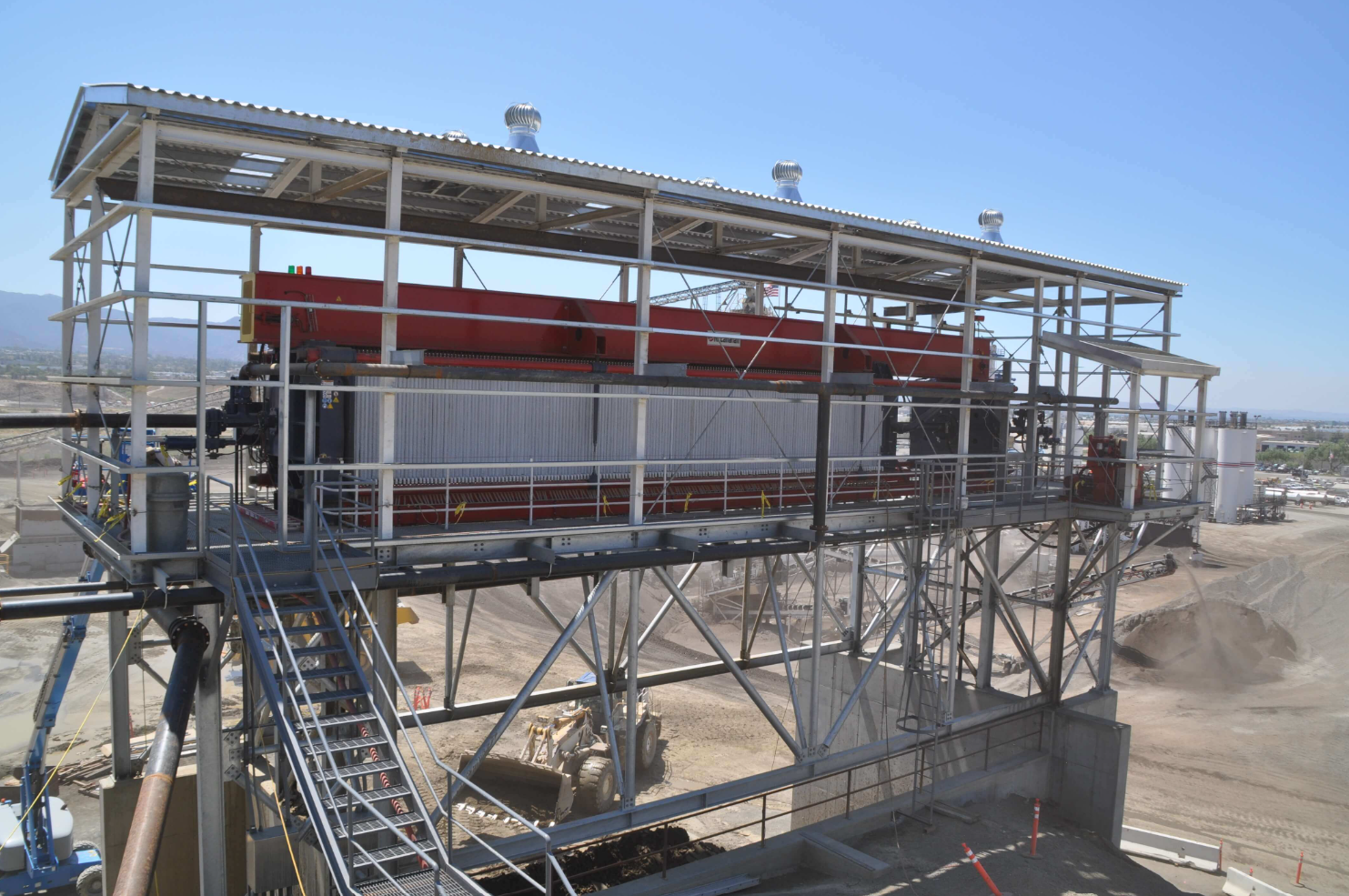
In March 2025, Hollidaysburg, PA-headquartered McLanahan Corporation, in collaboration with its sister company Diefenbach in Medolago, Italy, which it acquired in 2023, introduced the QUICKCHANGE system – a patent-pending innovation that is said was set to transform filter press maintenance.
Engineered for speed, simplicity and safety, this was described as a groundbreaking technology, streamlining filter cloth replacement and filter plate inspection, slashing downtime and boosting operational efficiency.
QUICKCHANGE enables operators to perform maintenance at ground level in minutes – reducing McLanahan stated the industry-standard replacement time of 10-20 minutes per cloth can be cut to just 1-2 minutes. “Traditional systems require replacing filter cloths on both sides of a plate when one fails, but QUICKCHANGE allows operators to replace only the damaged side, cutting material waste and long-term maintenance costs. A specially designed feed shoe protects high-wear areas around the feed hole, extending cloth lifespan and ensuring consistent, high-performance filtration.”
At CONEXPO-CONAGG earlier this year, IM Editorial Director Paul Moore sat down with McLanahan’s Cory Jenson, Executive Vice President of Sales and Business Development, to understand more about why it sees the solution as a gamechanger and what progress had been made to date; plus its general filter press design attributes; and also its strengths in thickener design and supply for mining.
IM Editorial Director Paul Moore and McLanahan’s Cory Jenson, Executive Vice President of Sales and Business Development

On QUICKCHANGE, Jenson stated: “The response has been very good – we have several systems already sold in mining, and we welcome the opportunity to take prospective customers to see the QUICKCHANGE in action. Almost every mining site has a filter press or presses whether its in the tailings circuit or for concentrate. So, most mining maintenance teams are well aware how laborious it is to change a filter cloth – they don’t like having to get inside and on top of the presses plus having to use cranes. Most of the demos we have done either at mining shows or taking people to an existing site have either resulted in advanced discussions or actual purchase commitments from engineering houses or owner operators.”
He added: “For us, the technology is also driving up demand for our own filter presses that are equipped with QUICKCHANGE. The way our filter press is designed means we can fill up almost the entire footprint with plates – only using about two metres for the stroke of the cylinder. With many existing mines wanting to increase capacity – this also means increases are required for tailings and concentrate – our system allows them to achieve significant capacity upside in the footprint of their existing filter press plus we can equip our press with QUICKCHANGE, with cloth changes using the conventional system being the biggest cause of downtime for the machine.”
Jenson said McLanahan is working on a system in South America at a copper concentrate plant that will allow them to have 60% more plates than their current press. A lot of filter presses open with an accordion type movement – so the plates when they are dewatering only take up about half of the footprint; with the other 50% only used when discharging the cakes. “With a McLanahan filter press, with only about two metres of space for a 20 metre long or even larger machine, the capacity is much higher – it depends on the application and how fast the cycles are but it could be as much as 50-70% higher. In many cases this means planned expansions can be accommodated without adding new presses.”
Is QUICKCHANGE only available for McLanahan presses or can it be retrofitted to competitor machines? Jenson: “It depends on the style of the filter press, but if it is an overhead beam design then we can do it; but not with a side beam type of machine. Our machine is popular because there is nothing on the side of the press to get in the way so you have optimal access to be able to pull the cloths out plus when you do that you can inspect the plate right in front of you. With a side beam machine, you are standing on top, and having to inspect the plate through a small opening of 75 mm or so – as the plates are two metres long it is very difficult to see everything. As a result they have to take the plates out with cranes and all the suspended load risks that comes with that.”
McLanahan and Diefenbach filter presses have a similar design – both supply a version of the OH2500 that has 2.5 m by 2.5 m plates with up to 230 plates installed on one machine. Sales are divided on where each company is strongest in terms of traditional markets, plus service and support. In general, in North and South America plus East Asia, McLanahan is the primary filter press range offered; with Diefenbach’s range the main offering in Europe and Africa as well as Central Asia including Kazakhstan. Jenson: “Generally we have looked at where McLanahan already has a large presence and the best support and vice versa. The product ranges are similar and can be used in the same types of mining applications. We had done a lot of tailings presses prior to acquiring Diefenbach, so we did take a lot of the features that our customers had come to expect from a maintenance and serviceability standpoint, and standardised those across both product lines. Plus we have taken on some attributes of the Diefenbach design. So we very much have the best of both worlds.”
From a commercial point of view – McLanahan is still a big company but Jenson said it brings another perspective and another option to the mineral processing market beyond the small number of giant mineral processing equipment groups. Founded in 1835, it is also sixth generation family owned. He says this enables it to offer a unique approach to collaboration with customers. “They can talk to our technical experts directly and quickly to solve any issues or problems. And this does only apply to our equipment – we have had done an upgrade of competitor filter presses that were only six months old but the customer felt they had little to no support from the OEM. We completely redid the automation control systems on their tailings filter presses and then their concentrate filter presses. Most of their downtime was due to poor functionality of their initial automation system which had been outsourced. The customer had been told to call a third party for support which was not available 24/7 and was not a filter press specialist. We were able to not only redo the system but add other maintenance functionality like being able to track which filter cloths had been replaced.”
Thickeners in a system context
IM also discussed McLanahan’s thickener range, which is very widely used in the sand and industrial minerals market but also in mine tailings and concentrate applications with models like the HRT-E-50 High Rate Thickener with a 50 m tank diameter and installed torque of 950 kNm.
McLanahan also offers advanced feedwell options on all of its thickener designs – it says it can help increase underflow densities, reduce chemical and reagent consumption, and dramatically improve overflow clarities – all of which can reduce operating costs and increase the amount of immediately reusable water at site. It adds that the available feedwell design can significantly reduce froth, as well as minimise the loss of valuable concentrates to overflows that typically report to tailings.
McLanahan has developed an adaptive automatic control algorithm designed for dynamic thickening environments

Jenson talked out its ability to look at the system big picture: “We have been doing tailings for a long time – and we know what is important in the thickener design for cost reduction in filtered tailings processing. We take a comprehensive look at what the mine is feeding to the thickener; can any of the water be recovered in less costly ways; how can we optimise the density to achieve the best filtration performance. Our experience allows us to tie everything together – I would argue that some others in the industry are either specialists in filter presses or thickeners but not both – but I think McLanahan has a lot of experience in integrating both in a tailings circuit and identifying ways to make the whole system more efficient.”
He also referred to a recent paper during SME 2026 by Scott O’Brien and Javier Sierra, which outlined how McLanahan is bringing a new real time digitalisation approach to thickening. It has developed an adaptive automatic control algorithm designed for dynamic thickening environments. The algorithm integrates real-time measurements of feed density, rake torque, bed level, and turbidity (overflow), optimising the underflow slurry density while minimising suspended solids in the overflow. The proposed control strategy is modular, simple, scalable, and applicable to both existing and new thickening systems, “offering a robust alternative to manual operation in increasingly demanding metallurgical environments.”
McLanahan’s approach integrates phenomenological sedimentation information into a Model Predictive Control (MPC) formulation. The central contribution is the introduction of live constraints and dynamic model updates based on real-time settling-profile measurements, most notably the settling velocity obtained from GENKO system. This transforms the controller from a static linearised approximation into a structure capable of reshaping its feasible operating region according to the instantaneous behaviour of the feed stream.
McLanahan: “Although validation is not yet presented, the conceptual framework provides a clear roadmap for improving stability, water recovery, and operational predictability in thickening circuits. The proposed methodology advances the state of the art by explicitly embedding feed sedimentation characteristics into the MPC constraint architecture. Traditional thickener controller’s manual, expert-system-based, or fixed-parameter MPC lack the capacity to anticipate changes in hindered settling, bed compaction, or rake torque. By contrast, this framework formalises how settling velocity, solids loading, and sedimentation profiles can be used to adjust flocculant limits, solid concentration at the feed, rake torque envelopes, and allowable turbidity ranges.”
It says this approach aligns with recent mineral process control trend emphasising physics-informed automation and better utilisation of online instrumentation. Looking forward, McLanahan says its adaptive MPC framework offers strong potential for integration with emerging AI-driven optimisation tools and digital-twin environment.
McLanahan sees demand for thickeners around the world, but the largest and most complex projects are found in the mining industry. “In mining, you have a lot of specific gravities of material and mineral types you are dealing with; and different seismic related requirements for different mining regions – so there is a lot more customisation involved than for the aggregate market which is more of a standardised solution. In mining, the feedwell needs to be dimensioned appropriately based on the density that you are feeding into the thickener, plus if you are diluting the feed. Basically, every thickener is made for that particular site.”
Jenson added that downstream you also have to take into consideration that if you are going to be filtering the tailings, a large thickener can allow you to store it longer and send a higher density to the filter press, so you might be able to use a smaller filter press or less of them, therefore reducing OPEX.
The post McLanahan’s growing might in mining appeared first on International Mining.