

Fed Rate Decision & Gold Price: What July 29 Means for Your Portfolio
Gold and silver have spent the past few weeks in a holding pattern, and the next major catalyst now has a firm date on the calendar: July 29, 2026.
That is when the Federal Reserve’s rate-setting committee, the FOMC, wraps its two-day meeting and announces its next decision. For precious metals investors, few macro events are watched as closely as a Fed rate decision because interest rates, inflation expectations, and confidence in the dollar all influence the price of gold and silver.
Here’s what is driving the current market, what could happen on July 29, and why many investors view moments like this not as a threat, but as an opportunity to reassess whether their portfolio has enough balance and protection.
Why the Fed Moves Gold and Silver Prices
Gold and silver do not pay interest or dividends. That single fact is the foundation of their relationship with Fed policy.
When interest rates rise, investors can earn more from interest-bearing assets like Treasury bonds, CDs, or savings accounts. That increases the opportunity cost of holding metals that do not generate yield on their own.
When rates fall, or when rates stay flat while inflation remains elevated, that opportunity cost shrinks. In that environment, gold and silver often become more attractive because investors begin asking a different question:
Am I being paid enough to hold dollars, or do I need protection from the dollar losing purchasing power?
Of course, the relationship is not mechanical. Geopolitical risk, the strength of the U.S. dollar, central bank buying, debt levels, and investor confidence all play a role. But Fed policy remains one of the most closely watched inputs in the precious metals market.
Where Things Stand Heading Into July 29
The setup for this meeting is more uncertain than usual.
At the Fed’s June 16–17 meeting, the committee voted unanimously to hold the federal funds rate at 3.50%–3.75%. But the minutes released July 8 revealed a committee that is far from unified on what comes next.
According to the Fed’s projections, nine of eighteen participants expect at least one rate hike before year-end, eight expect no change, and one projects a cut.
Adding to the uncertainty, new Fed Chair Kevin Warsh chose not to submit his own rate forecast at his first meeting in charge — reportedly the first Fed chair in 14 years to skip that step. That has left markets with less forward guidance than usual about where policy may be headed.
The reaction in metals has been notable:
- Gold traded around $4,075 per ounce in early July, down roughly 27% from its January all-time high near $5,589.
- Silver traded near $58–$60 per ounce in early July, down more than 50% from its January peak near $121.60, though still roughly 60% higher year over year, depending on the quote time and source.
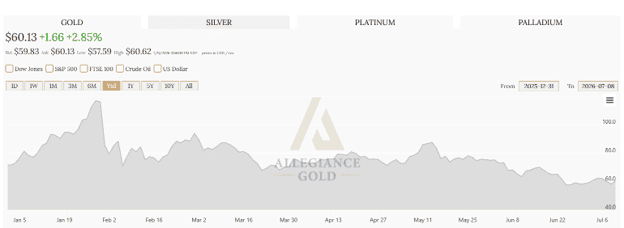
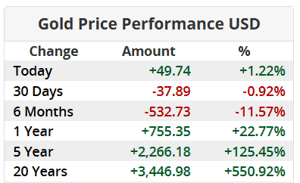
Despite the pullback from January highs, both metals remain meaningfully higher over the last 12 months. Gold is up approximately 22.77%, while silver is up approximately 57.71% over that same period.
That is important. The recent decline feels sharp because investors are comparing prices to the January peak. But when viewed over a full year, the broader trend still shows strong performance from both metals.

Three Scenarios for the July 29 Decision
No one can predict the Fed’s decision with certainty. But investors should understand the three main scenarios and how precious metals may respond.
- If the Fed holds rates steady with a neutral or dovish tone
This would likely give gold and silver more room to stabilize, especially if inflation data shows signs of cooling. A steady-rate decision with softer language could signal that the Fed is closer to the end of its tightening cycle, which may reduce pressure on metals.
- If the Fed signals another hike is coming
Metals could face near-term headwinds. Higher rates tend to strengthen the appeal of interest-bearing assets, at least in the short run. This would echo the pattern seen after the June meeting, when a more hawkish tone weighed on both gold and silver.
- If the Fed signals a rate cut may be coming sooner than expected
This could be very supportive for gold and silver. Lower interest rates reduce the opportunity cost of holding metals and often raise concerns about inflation, debt, and currency debasement.
A key data point to watch before the meeting is the June Consumer Price Index report, scheduled for release on July 14. That inflation report could shape expectations heading into July 29.
The World Gold Council’s mid-year outlook suggests gold is broadly aligned with its macro valuation framework and may trade around $4,100, plus or minus roughly 5%, if current conditions do not materially change. That estimate is based in part on the assumption of one rate hike by October 2026, meaning the July 29 decision — and the inflation data leading into it — could shift expectations in either direction.
The New Wild Card: A Softer Labor Market
The Fed is not only watching inflation. It is also watching employment.
Last week, the U.S. economy added just 57,000 jobs in June, far below the roughly 110,000 economists expected. April and May were also revised lower by a combined 74,000 jobs, suggesting the labor market was weaker than previously reported.
Even more concerning, the labor force participation rate fell, with roughly 720,000 people leaving the labor force.
That matters because a weaker labor market gives the Fed more justification to pause, soften its tone, or even consider cutting rates sooner rather than later.
As of early July, futures markets were pricing roughly a 30% probability of a rate hike at the July 29 meeting based on Fed funds futures and FedWatch-style market pricing. But weaker job numbers, combined with renewed geopolitical tensions, could change the Fed’s calculus quickly.
In other words, the Fed is walking a very narrow bridge.
If it hikes too aggressively, it risks damaging an already softening economy. If it cuts too soon, it risks reigniting inflation and further weakening confidence in the dollar.
That is exactly the kind of uncertainty that keeps long-term investors focused on diversification.
The Bigger Picture: That Does Not Wait on the Fed
It is worth remembering that Fed policy is only one piece of the gold and silver story in 2026.
Structural demand has remained resilient even through periods of rate uncertainty:
- Central banks purchased an estimated 244 tonnes of gold in the first quarter of 2026 alone, exceeding both the prior quarter and their five-year average, according to the World Gold Council.
- Major buyers in recent months have included China, Poland, and several other central banks continuing to diversify reserves away from the U.S. dollar.
- The Silver Institute projects a sixth consecutive annual silver market deficit in 2026, supported by tight supply, resilient investment demand, and continued industrial use across electronics, AI infrastructure, automotive, and solar, even as solar-related silver demand faces thrifting and substitution pressure.
This kind of institutional and structural demand tends to be far less sensitive to any single Fed meeting than short-term trading activity.
That is one reason many long-term holders view rate-driven pullbacks as part of the normal cycle rather than a reason to abandon the broader thesis.
It is also worth noting that the relationship between rates and gold is not always as straightforward as the textbook version suggests. Gold has climbed during past rate-hiking cycles when other forces — geopolitical tension, a weakening dollar, heavy central bank accumulation, or concerns about debt — outweighed the pull of higher yields.
The Fed matters. But it is not the only force shaping the market.
What This Means for You
Whatever the Fed decides on July 29, the underlying question for most investors is not:
“What will gold do this week?”
The better question is:
“Do I have enough protection if the next surprise shows up?”
When the Fed itself is split — with some members discussing hikes while political pressure builds for cuts — that is not a minor disagreement. It is a signal that even the central bank does not have a confident read on the economy.
And uncertainty at that level does not stay contained to Wall Street.
It can show up in your mortgage rate.
Your savings account yield.
Your retirement account volatility.
Your purchasing power.
Your ability to plan with confidence.
For the average family, the lesson is not to guess whether rates go up or down next. The lesson is that you cannot build a retirement plan that only works if the Fed gets everything right.
Gold does not need the Fed to be perfect. Historically, gold has responded to currency debasement, loss of confidence in fiat policy, excessive debt, and financial uncertainty — not just one meeting or one rate decision.
That is why many investors do not own gold because they are trying to predict the Fed. They own it because they are hedging against the possibility that the Fed, Washington, or the broader financial system gets it wrong.
The Three Questions Investors Should Be Asking Now
The better way to look at gold today is not through one Fed meeting. It is through the conditions that supported the move in the first place.
Ask yourself:
- Are central banks still net buyers of gold?
Yes. They have been for more than a decade. That is not retail speculation. That is sovereign-level positioning. - Is the debt and deficit picture improving?
No. The U.S. continues to face a growing debt burden, rising interest costs, and persistent deficit pressure. - Have the issues that caused gold’s run been resolved?
Currency debasement, geopolitical instability, de-dollarization, inflation pressure, and distrust in fiat policy have not disappeared.
So the real question is not whether gold moves higher or lower after one Fed announcement.
The real question is:
Do you own enough protection if the next surprise shows up?
If you are considering how gold or silver may fit into your retirement savings, an Allegiance Gold specialist can walk you through your options, including how a Gold IRA works and what current market conditions may mean for your specific goals.
Get Your Free Gold IRA Rollover Guide
Rolling over a retirement account is not something to figure out as you go. Our free Gold IRA Rollover Guide walks you through every IRS rule referenced in this article in more detail — including a downloadable rollover checklist, a breakdown of IRS-approved metals, and answers to the questions our specialists hear most often from people exploring this decision for the first time.
Request Your Free Gold IRA Guide →
No obligation. No pressure. Just clear information, so you can make the decision that’s right for your retirement.
To Start Your Gold IRA Today:
Download Your Free Gold IRA Guide | Open Your Gold IRA Account | Book Your Consultation
Protect your financial future with Allegiance Gold an Inc 5000 company– Your trusted partner in Gold and Silver IRA investments.
Act now and join the millions who trust gold to secure their wealth.