
ACMobility’s Power-on-Wheels Shows How Southeast Asia May Solve EV Charging Differently


Support CleanTechnica’s work through a Substack subscription or on Stripe.
I first encountered these blue-and-white little vans at the BYD Shark launch more than a year ago. I was inquisitive about what made it tick, because fellow journalists were teasing that there was a diesel-powered generator that ran an inverter to charge a large battery storage system.
Of course, that was simply technical jest. In the overall thinking of overcoming range anxiety, which continues to be one of the psychological barriers to EV adoption, ACMobility, the operator of the BYD brand in the Philippines included the mobile charging station in its portfolio.
Adoption proposition
In the Philippines presently, the problem of the availability of charging stations (not in number but in distance) is particularly acute. Dense urban development, limited private parking, aging electrical systems, and severe traffic congestion complicate the deployment of conventional charging networks.
Rather than waiting for fixed infrastructure to fully mature bringing the charger directly to the vehicle is a temporary Band-Aid, which according to ACMobility sources, is rarely used.
The company’s “Power-on-Wheels” (POW) system, launched in March last year deploys mobile DC fast-charging units across Metro Manila’s major thoroughfares and inside the business districts. The service allows EV owners to request charging through and app called Evro with battery-equipped electric vans dispatched directly to the vehicle.
Singapore inspired
The concept itself is not entirely new. Singapore-based Power-Up Tech, branded as P.UP, had already been operating mobile EV charging services in Singapore before ACMobility adopted the platform. ACMobility itself acknowledged that the Philippine deployment was developed in partnership with the Singapore company, which also operates in Malaysia.
But while Singapore pioneered the operational model earlier through pilot programs and concierge-style services, the Philippine deployment appears to be among the first attempts in ASEAN to scale mobile charging into a broader public-facing urban infrastructure layer. That distinction matters.
Most mobile charging deployments globally remain niche services aimed at emergency roadside assistance, premium vehicle support or temporary infrastructure gaps. ACMobility is positioning Power-on-Wheels differently — as a practical extension of daily EV usability in one of Southeast Asia’s most congested urban regions. Of course it can be an emergency system and can cooperate with the Automobile Association of the Philippines (AAP) which handles the major road assistance services in Luzon.
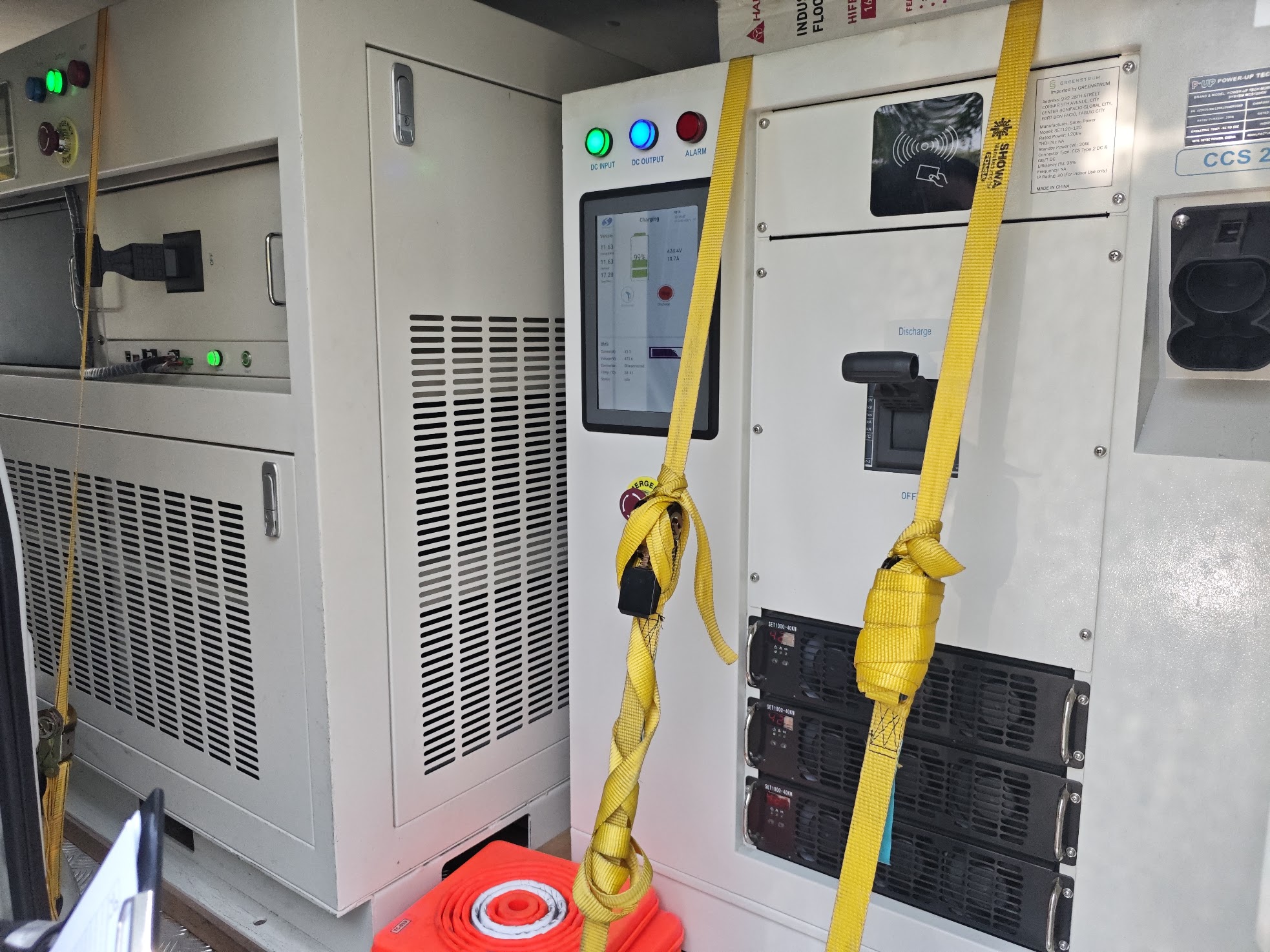
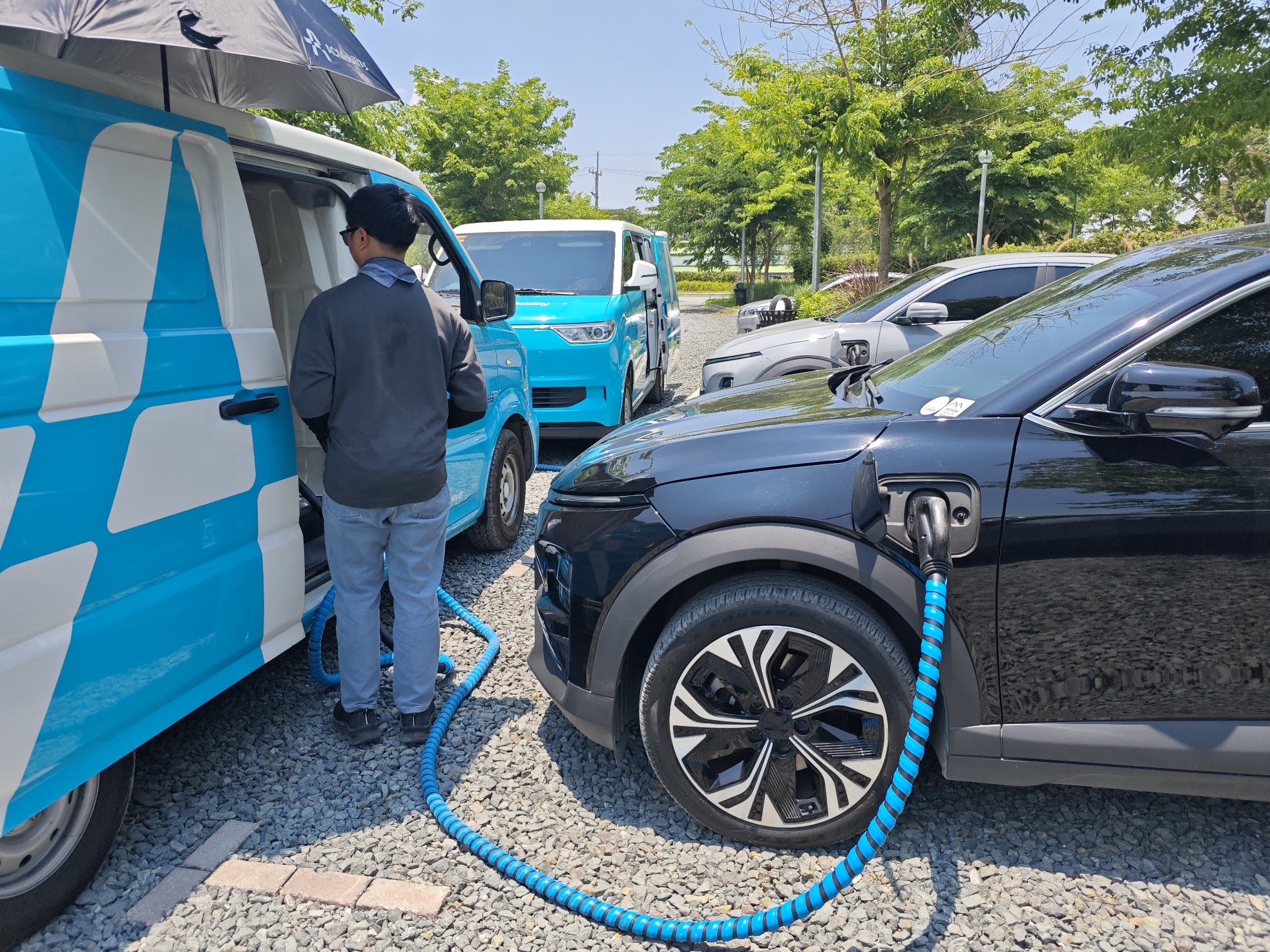
The company currently operates 10 mobile charging units across Makati, Bonifacio Global City and Mandaluyong. Instead of large generator trucks, ACMobility uses compact electric commercial vehicles including the BYD T3, DFSK EC35 and DFSK EC31.
Metro Manila’s narrow streets, basement parking structures and truck restrictions make heavy charging vehicles impractical. Thus the choice of smaller electric platforms is a necessity. The lower-profile BYD T3 vans can access underground parking facilities to augment charging systems and service stranded EVs.
Some DFSK EC31 units are configured with dedicated DC power-delivery systems and onboard conversion hardware. Each mobile unit reportedly carries battery storage capacities of up to 120 kilowatt-hours and supports both CCS2 and GB/T charging standards, making the system compatible with most EVs currently sold in the Philippine market.
All electric
The charging fleet itself is electric. That may sound obvious, but many mobile charging systems elsewhere still rely on diesel-powered generator trucks. ACMobility’s approach preserves the emissions-reduction logic behind EV adoption by ensuring the charging vehicles themselves produce no tailpipe emissions.
The service is fully integrated into ACMobility’s Evro platform, allowing users to locate available charging vehicles, request service, monitor charging sessions and process payments digitally. Operationally, the system focuses on rapid top-ups rather than full charging sessions, typically servicing vehicles from around 20 percent to 80 percent state of charge.
Pricing is reportedly aligned with conventional DC fast-charging rates, averaging roughly ₱35 per kilowatt-hour.
Beyond convenience
Metro Manila presents structural barriers that conventional EV infrastructure alone may not solve quickly. Many condominium residents lack dedicated charging access. Older commercial buildings often require expensive electrical upgrades to support high-capacity chargers. Public charging availability remains uneven, while urban land constraints limit large-scale charging hub development. This is why Power-on-Wheels extends beyond convenience. It makes mobile charging as an infrastructure extension and provides charging flexibility.
Instead of forcing every building to immediately deploy extensive charging hardware, mobile systems can temporarily absorb demand while fixed infrastructure expands. In practical terms, the model functions less like roadside assistance and more like a distributed urban energy service.
The project also aligns with ACMobility’s larger EV strategy. Beyond charging infrastructure, the company serves as the Philippine distributor for brands including BYD and Kia. Building consumer confidence around charging reliability directly supports vehicle adoption.
In the ASEAN perspective
Singapore demonstrated that mobile charging was technically viable. But comparatively the island nation is small and the infrastructure can be tuned to ensure charging infrastructure can be built both green and brownfield. ACMobility is testing whether it can become commercially scalable and operationally integrated into mainstream urban EV ownership.
During an interview in a technology podcast in the Philippines called Tech Sabado, Edmund Araga, president of the Asean Federation of Electric Vehicle Associations (AFEVA) said that “charging solutions aside from solid infrastructure can rapidly improve the transition arc.” He also mentioned that in the region, the primary charging source is still home charging.
Whether mobile charging becomes a permanent component of ASEAN’s EV infrastructure remains uncertain. Fixed charging networks will still dominate long-term electrification strategies.
But in highly dense Asian cities where infrastructure deployment cannot always keep pace with vehicle adoption, mobile charging may become an important transitional layer — particularly in markets where many drivers still view charging access as the single largest obstacle to going electric.
Sign up for CleanTechnica’s Weekly Substack for Zach and Scott’s in-depth analyses and high level summaries, sign up for our daily newsletter, and follow us on Google News!
Have a tip for CleanTechnica? Want to advertise? Want to suggest a guest for our CleanTech Talk podcast? Contact us here.
Sign up for our daily newsletter for 15 new cleantech stories a day. Or sign up for our weekly one on top stories of the week if daily is too frequent.
CleanTechnica uses affiliate links. See our policy here.
CleanTechnica’s Comment Policy