

Support CleanTechnica’s work through a Substack subscription or on Stripe.
Yesterday, Carolyn Fortuna wrote about how to change the narrative about clean energy. “If we want to infuse greater renewable energy understanding in others, we must be self-reflective about the way we talk — from how we frame a thought to how we present arguments. Each of us has space to improve our communicative methods so we can reach audiences more effectively.”
She said, “Evidence-based science experts don’t recognize how much specialized language they incorporate into their conversations.” That reminds me of a story I heard many years ago about two Senators — one Republican and one Democrat — who sat through a lengthy presentation by a noted climate scientist. When it was over, one turned to the other and asked, “Did you understand any of that?” His colleague replied, “Not one word.” When we speak, we need to use language the listener understands, not technical jargon.
Reframing The Debate
Latitude Media reports that since 2024, nine clean energy groups have emerged that spread the word about clean energy in a way that is quite different from traditional trade associations. They focus more on pocketbook issues like affordable utility bills, economic growth, and removing barriers to building energy infrastructure, particularly at the state level, rather than selling any specific technologies. Many are skipping the corporate membership model and relying instead on donations. That allows them to avoid the conflicts that arise between corporate members, which can weaken the influence of traditional trade groups.
In conversations with Catherine Boudreau of Latitude Media, the leaders of these new organizations said that relying on federal action is a fragile strategy when the party controlling Washington changes every four years. Policies established by state and local governments are not as subject to abrupt changes, and local governments have more power over permitting, electricity rates, and grid reliability.
“The way to get legislators and public officials to trust you is by not advocating for any specific technology,” said Arnab Pal, executive director of Deploy Action, a group that launched in 2025 to advocate for clean energy as an affordability solution. “The point isn’t that we need more solar or batteries, but rather to clean the grid and bring costs down in the process,” he said.
Deploy Energy Leads The Way
On its website, Deploy Energy says: “Clean energy dominance is inevitable. We are working to accelerate clean energy at scale. Deploy Action operates at the intersection of finance, development, and clean energy policy advocacy. Clean energy is the biggest economic opportunity of a generation. We’re fast-tracking the infrastructure needed to slash energy bills, fortify our grid, and build an American economy that lasts.”
Deploy Action was founded by Pal and Jigar Shah, two veterans of the Biden administration’s Energy Department, among other things. Despite its Democratic Party roots, the group is trying to bridge political divides by focusing on market reforms and utility accountability that can both reduce costs for ratepayers and expand clean energy.
Pal said he knew there was a need for more policy and advocacy work at the state level from his experience working at DOE’s Loan Program Office, now known as the Office of Energy Dominance Financing, where he helped implement clean energy programs under the Inflation Reduction Act. He spent time with developers, utilities, and elected officials in California, and identified both misconceptions and market barriers to deploying clean energy and bringing rates down.
Once the current administration seized power, it was clear that federal policies to promote clean energy would end, so Shah and Pal turned to the states. “We saw an opportunity to help governors create policies that incentivize utilities to use more of the existing grid, especially on the distribution side, and promote clean energy,” Pal said.
Others Groups Join The Push
Other groups have similarly chosen to focus on state policy. Permit Power seeks to lower utility bills by making it cheaper for homeowners to install rooftop solar and home batteries. That involves streamlining municipalities’ bureaucratic and expensive permitting and interconnection rules. “We do research, education, and advocacy to break down the bureaucratic barriers that get in the way of American families installing rooftop solar, home batteries, and other energy upgrades,” it says on its website.
PowerLines is a consumer advocacy group that regularly publishes reports on why energy bills are rising, and targets the state public utility commissions that decide what utilities can charge customers. Utilize Coalition advocates for policies that make more efficient use of the grid, which operates at half its capacity most of the year. The group supports battery storage, demand response programs, virtual power plants, and other technologies. Unlike the other new energy groups, Utilize Coalition has a corporate membership model including Google, Renew Home, Sparkfund, SPAN, Verrus, and Tesla.
All four of these groups call themselves nonpartisan. Their approach skirts the cultural and partisan baggage that comes with specific technologies like wind and solar. Several founders made the same point — the clean energy industry has matured from its roots in the environmental movement to a market force that competes with fossil fuels, and therefore is in need of more sophisticated advocacy.
That means creating an ecosystem that expands beyond national trade groups like the American Clean Power Association or Solar Energy Industries Association, which are beholden to the business interests of the corporate members. For example, both count renewable energy developers and utilities as members, which makes it challenging to form consensus on issues like federal permitting reform — especially for large-scale transmission lines.
Economics Matter
Businesses are thinking about how they can make the most money selling their products or services, Nick Josefowitz, founder of Permit Power, said. His group has a “fundamentally different lens,” because it is funded by donations, which he says allows it to advocate for affordable energy for American households.
The launch of the conservative American Energy Leadership Institute last year is yet another sign of how energy politics is evolving. The group is explicitly right-wing and aligned with President Donald Trump’s “energy dominance” agenda, but doesn’t pick a favorite resource, especially because the grid needs all the capacity it can get now that load growth is booming from data centers and reshoring manufacturing.
“We’re in a very different moment now, where there’s increasing electricity demand and all kinds of new technologies that are more market-efficient than 10 years ago,” Chris Johnson, co-founder and president of AELI, said. “Traditionally Republicans have leaned on fossil fuels and their approach was to defend it against competitors. Now we don’t have to do that. We don’t have to choose. We also don’t have the privilege to choose which electrons are best. We just need more.”
A Generational Divide
Johnson, a regular on Fox News and former campaign manager for the Ohio Republican Party, said there’s a generational divide in the GOP. A lot of younger members are excited about nuclear and geothermal energy, as well as solar and battery storage technologies that are made in the US and not imported from China. But lawmakers are wary of working with clean energy groups, in part because it puts them at risk of getting targeted in primary elections. Johnson wants AELI, which he said is funded by conservative philanthropic foundations and wealthy private donors, to be a credible voice in support of all forms of energy.
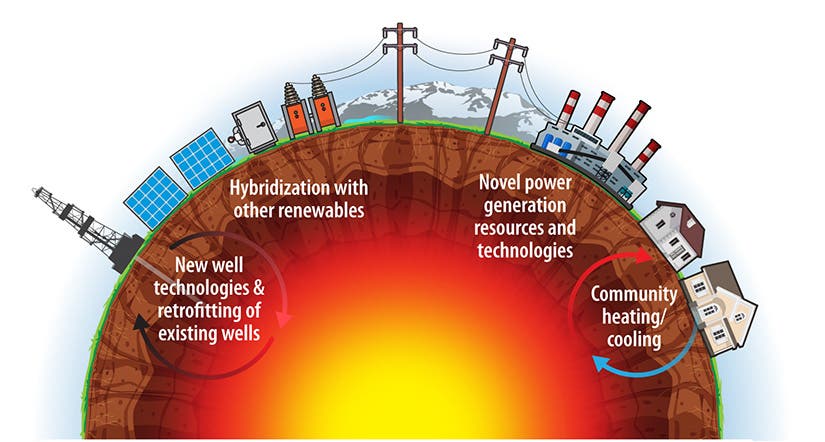
A recent win for both AELI and clean energy groups came when the House unanimously passed a package of bills aimed at speeding up the federal permitting process for geothermal energy. It helped that geothermal isn’t coded red or blue, perhaps because it produces constant baseload power and also doesn’t produce emissions that are unhealthy for people and the climate. But in four western states — Arizona, Colorado, New Mexico, and Utah — local initiatives are promoting geothermal energy despite what Congress may or may not do, which is pretty much the point these new advocacy groups are making.
So far, those geothermal bills are the only boost to clean energy in this Republican-controlled Congress, and they still need approval in the Senate. And it remains to be seen whether the emerging messaging on cost savings, grid reliability, and economic growth is a winning strategy.
Clean Energy Moves Forward
Permit Power this year has had success in five states, all of which are led by Democrats. New laws in Connecticut and Virginia require the creation of an automated permitting platform for home solar and batteries that local governments also must adopt or match. The goal is to eliminate slow, paper-based processes that can add thousands of dollars to installing projects. Colorado legalized solar systems that are small enough to fit on balconies and can plug into a standard outlet. It also became the first state to allow certain rooftop solar systems to interconnect without a utility agreement.
“We’ve found that both Republicans and Democrats want to make it easier for families to save money on their utility bills, even if they might want to go about it in different ways,” Josefowitz said, noting that the Texas state legislature is discussing how distributed energy resources like battery storage can lower residential energy costs and reduce congestion on the grid.
Deploy Action worked with Virginia Governor Abigail Spanberger on a grid utilization law this year. While Democrats hold the majority in the state legislature, the law also won support from lawmakers on both sides of the aisle. It directs utilities to study whether there are cheaper ways to boost grid capacity than building new poles and wires, such as distributed energy resources and other grid enhancing technologies.
The good news here is that we no longer need trot out scientists to tell us why solar or wind or battery storage is more efficient or more environmentally sustainable. America is more committed to free market capitalism than any nation in history. So these groups are using the language of capitalism to craft a message that every American, regardless of political orientation, will immediately understand — cheaperer is betterer.
Sign up for CleanTechnica’s Weekly Substack for Zach and Scott’s in-depth analyses and high level summaries, sign up for our daily newsletter, and follow us on Google News!
Have a tip for CleanTechnica? Want to advertise? Want to suggest a guest for our CleanTech Talk podcast? Contact us here.
Sign up for our daily newsletter for 15 new cleantech stories a day. Or sign up for our weekly one on top stories of the week if daily is too frequent.

CleanTechnica uses affiliate links. See our policy here.
CleanTechnica’s Comment Policy