


Support CleanTechnica’s work through a Substack subscription, on Patreon, or on Stripe. Help us produce all of the high-quality, original content we publish week after week despite the challenges of content-scraping AI, antisocial media, inflation, and other hurdles.
Three months ago, in our previous quarterly report, I wrote the following:
If costumer interest remains and high oil prices start to hit the region, there’s a very real chance we will surpass 10% at some point this year.
By this, I meant I was hopeful that, if the stars were to align, we would see something like 10.2% EV market share through Latin America by the fourth quarter (given that it’s normally the one with the highest sales and market share).
Normally it’s not fun to be wrong, but today I’m very happy, for what we got instead was an uptick in growth in Q2 that raised EV sales 137% above the levels from a year ago and brought market share all the way up to 10.7%!
Another piece of good news is that BEVs are growing faster than PHEVs (+162% vs. +109%), meaning that despite a few markets remaining stubbornly focused on plug-in hybrids, the region is pivoting towards a more BEV-centric market distribution, with 58% of regional sales being purely electric cars and 42% being either plug-in hybrids or extended-range electric cars.
The factors promoting EV adoption through Latin America — namely, more affordable options and higher fuel prices — are likely to remain in the third quarter, so it’s possible we’ll see similar growth in the near future. For now, however, let us celebrate the milestone of 10% EV market share in the region!
Market overview
EV sales reached a new all-time high in Q2, getting very close to 190,000 units. The previous record, in Q1, saw the total at just under 120,000 units, meaning the growth from that already impressive quarter was substantial. For the first time, we also saw BEV sales surpass 100,000 quarterly units.
EV market share jumped substantially to 10.7% (6.2% BEV), significantly above last year’s (4.6%) and last quarter’s (7.7%). This means that we’re now very likely to see a yearly market share near or perhaps above 10%, something unthinkable just a few months ago!
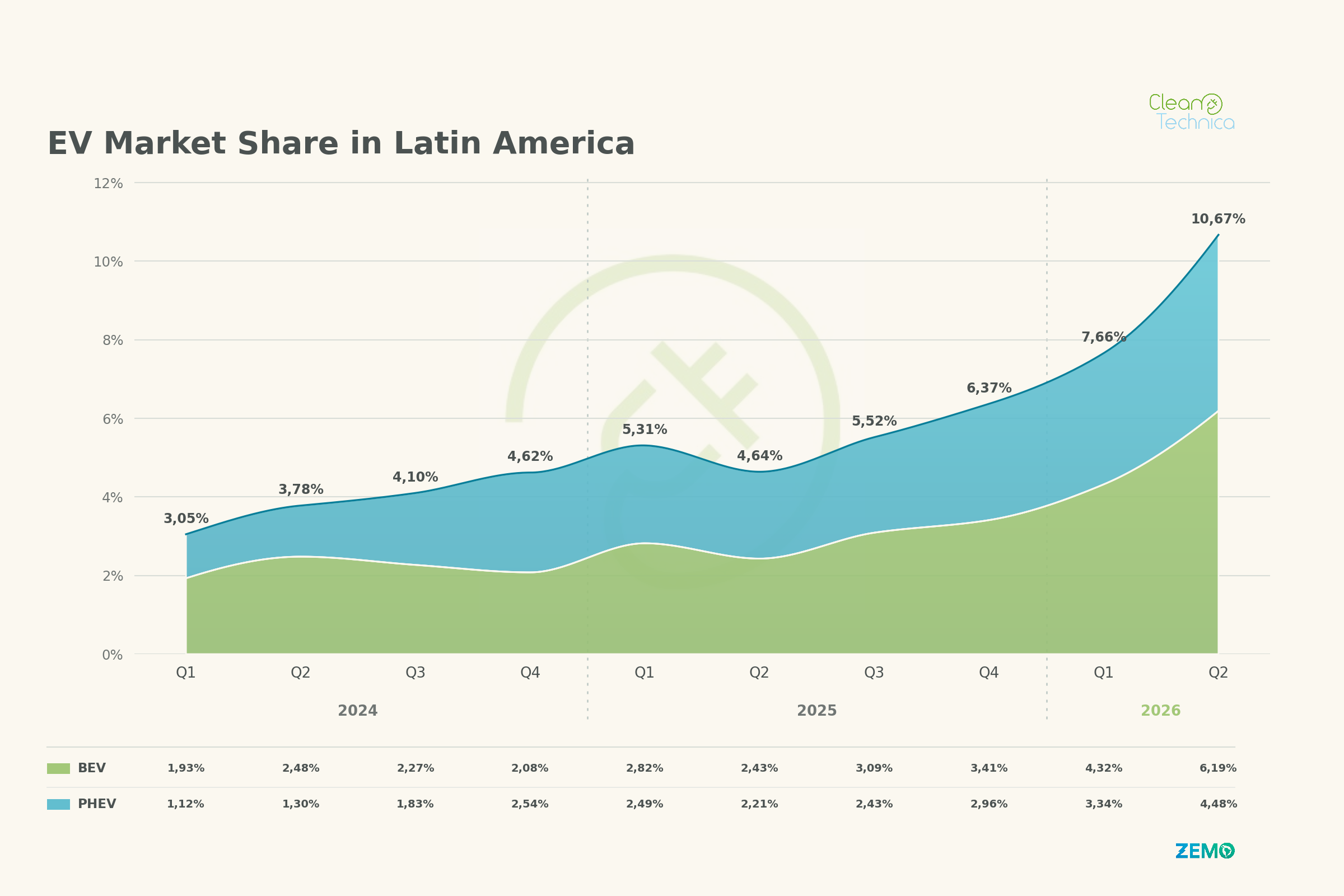
The good news doesn’t stop here. For the first time, we’re seeing combustion powertrains (ICEV+MHEV+HEV) fall YoY despite the overall market presenting slight growth. In Q2, total vehicle sales grew by nearly 50,000 units, yet because EVs grew by 110,000, ICEVs and hybrids fell by over 60,000 units! It’s a small start, but it points to a trend we’re already seeing in many markets around the world.

Country overview
Unlike in Q1, we’re seeing quite a few changes this time around in our regional ranking. As usual, we will rank based on BEV sales, regarding PHEV sales as important but secondary.

Looking at overall sales, Brazil remains the undisputed leader due to its gargantuan market and its fast pace of electrification, which stands above the regional average. However, Colombia’s significant growth in BEV sales means the country won silver, with a significant advantage over Mexico, which got bronze (and which, to be fair, has far higher PHEV sales).
Further down, we again find Uruguay and Costa Rica, followed by Chile, Ecuador, and Argentina. Below, all with under a thousand quarterly BEV sales, we have Paraguay, Peru, Guatemala, Panama, and El Salvador.
It’s interesting to note that there are currently 4 countries where PHEV sales are higher than BEV sales: Mexico, Argentina, Paraguay, and Peru. Of these, only Paraguay is a notable EV seller (with EV market share reaching 15% for the quarter, 10% of this being PHEVs), whereas Mexico and Argentina remain below 8% market share and Peru remains below 2%. This points to a trend where PHEV-heavy markets tend to be laggards, and it remains to be seen if they will pivot towards BEVs as they develop.
Speaking of market share, we’re also seeing multiple records in here: Uruguay is now over 40% (37% BEV), Costa Rica is again growing and has reached 22%, and Colombia is now over 20% (18% BEV). Below, we find Ecuador now over 11% (8% BEV, and, yes, thanks to ZEMO, we now have data on Ecuador’s PHEV sales). But the most important player is Brazil: South American’s giant is now at 13.5% EV market share, of which 7.5% are BEVs only. And, spoiler alert: it seems the country was at or very close to 10% BEV market share in July, meaning this rapid growth phase is not over.
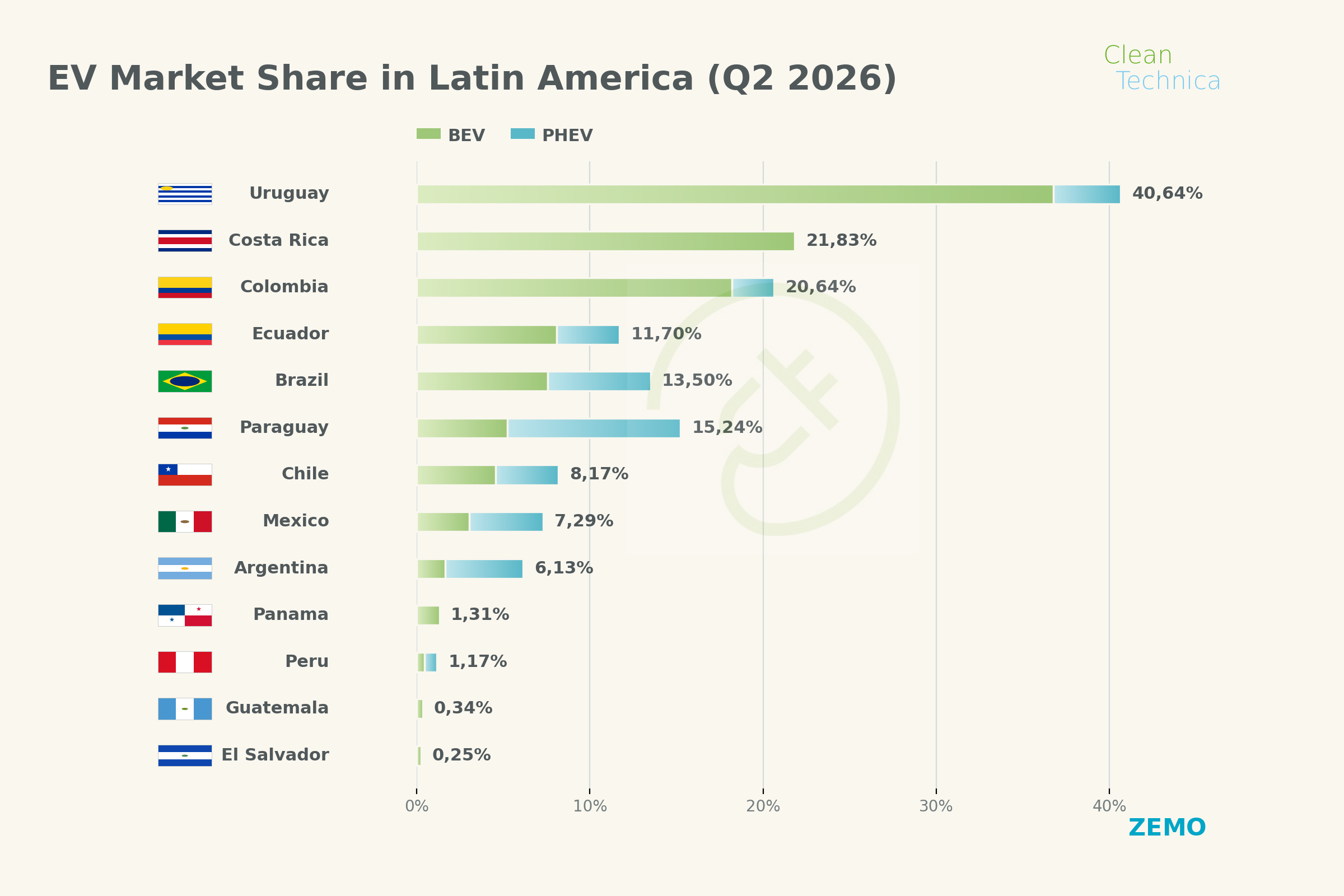
Below, we find explosive growth coming from Paraguay, with sales in May alone already surpassing the total from 2025. Chile, in 7th position, also saw rising sales, nearly doubling market share and overall numbers from Q1. Argentina, a former laggard, is meanwhile presenting impressive growth, nearly tripling market share from Q1 to Q2 and getting pretty close to Chile in overall market share. However this is mainly due to PHEVs, which account for 73% of all EV sales in Argentina, higher than in any other country.
At last, we have five countries — Mexico, Peru, Panama, Guatemala, and El Salvador — which are lagging behind either because growth rates are subpar despite decent(ish) EV adoption or because growth rates, though impressive in isolation, depart from such a low base that the final result is not impressive at all. In the former group we have Mexico, at a reasonable 7.3% EV market share (3% BEV) but with a mere 24% growth YoY; in the latter, we find El Salvador and Peru, growing at rates of 117% and 175%, respectively, but with overall market share at 0.25% and 1.2%, respectively. Guatemala and Panama, meanwhile, have the worst of both worlds: very low market share and sluggish growth.
Final thoughts
When Mr. Trump started his war in Iran, many of us predicted that the mother of all oil crises was coming. We were wrong, as is evident, but since the war is still ongoing and the Strait is still closed, the worse part of the crisis may just be delayed.
(On another note, I’ve been trying to make sense of the oil market, because nothing seems to make sense, and I think an update is due on that matter … perhaps for later this month.)
Regardless, my point here is that gasoline prices went up by a mere 15% — on average — in the region, whereas diesel prices did so by an equally unimpressive 20%. This, though relevant, is not enough to explain the massive growth in Q2, and since there has not been any meaningful push from public policy to promote EVs this year, we can conclude that the market has been growing for more organic reasons: mainly, the fact that EVs are cheaper than ever, that the charging network has been improving in most countries (with Chile and Brazil having a very robust one by now), and that new arrivals cater to more specific tastes, providing ample choice for anyone who wants to switch to an electric car.
However, to understand what’s happening, we need to look beyond the regional numbers and focus on one specific country: Brazil. EV sales in Latin America grew by 108,000 year on year, of which — get this — 66,666 were in Brazil. This means that close to two-thirds of all growth came from this one country, and in this case, it’s entirely due to Brazil’s push for local EV production, which has ramped up significantly and now even supplies some neighboring countries.
The EV push — in Brazil and in Latin America as a whole — is just starting, and developments in the second quarter of this year make me hopeful that we will see faster adoption than I once believed. Stay tuned for future updates, and leave us your insights down in the comments!
And remember, you can see all this data and more down at the Zero-Emissions Observatory for Latin America.
Sign up for CleanTechnica’s Weekly Substack for Zach and Scott’s in-depth analyses and high level summaries, sign up for our daily newsletter, and follow us on Google News!
Have a tip for CleanTechnica? Want to advertise? Want to suggest a guest for our CleanTech Talk podcast? Contact us here.
Sign up for our daily newsletter for 15 new cleantech stories a day. Or sign up for our weekly one on top stories of the week if daily is too frequent.


CleanTechnica uses affiliate links. See our policy here.
CleanTechnica’s Comment Policy